The golden scissors caught the morning light just as my husband finished his speech.
“This woman,” he said, hand resting on the small of Vanessa’s back, “is the one who will carry this ferry terminal—and this entire business—into the future.”
Three hundred guests applauded. Cameras flashed.
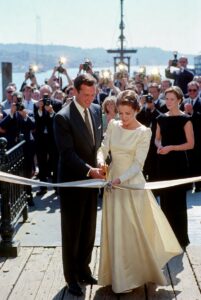
Vanessa stepped forward in cream silk, smiling the practiced smile of someone who had already begun rewriting the guest list of my life. The wide ceremonial ribbon stretched across the newly rebuilt dock, the family name still faintly visible beneath the fresh coat of paint my grandmother had insisted on preserving.
They expected me to cry. Or to make a scene. Or to slip away like a woman who had finally understood she had lost.
I stood at the back of the crowd in a simple black dress, my grandmother’s diamond earrings cold against my skin, and watched.
Because deep in a fireproof box in the county archive lay a single page neither of them had ever bothered to read.
By the time Vanessa lifted the golden scissors, they were already celebrating on land that did not belong to them in the way they believed.
The ferry terminal had been my family’s for four generations. My great-grandfather built the first wooden dock. My grandmother rebuilt it in concrete and steel after the storm of ’87. When the structure began to fail again five years ago, I was the one who secured the historic-preservation grant, the one who sat through eighteen months of coastal-commission hearings, the one who signed the restoration contracts in my own name. Julian had smiled and called it “our project” while he was busy moving money into accounts I was not meant to see.
The mistress was new. The public claim on my family’s work was not.
I discovered the document on a rainy Tuesday three months before the opening. I had gone to the archive looking for the original 1924 survey maps. Instead I found a folded instrument dated 1952, signed by my great-grandfather and recorded in the county ledger: a reversionary clause. The land beneath the terminal, and all improvements upon it, would remain in the bloodline of the original grantor. Any attempt to transfer operational control, naming rights, or beneficial interest outside that bloodline without the written consent of the senior living heir would trigger automatic reversion of the entire property to the family trust.
I was the senior living heir.
Julian had never read past the first page of the title report. Vanessa had never asked to see one.
They planned the ribbon-cutting as a coronation. I planned nothing at all. I simply waited.
When the scissors closed and the ribbon fell, the applause was loud enough to cover the sound of my phone vibrating once in my pocket. The message was from the trust’s attorney, who had been standing quietly near the caterers the entire time.
Filed. Timestamp matches the cut. Reversion is active.
I did not smile. I only watched Julian lift Vanessa’s hand as if they had just claimed a kingdom.
That afternoon the first formal notice was hand-delivered to the temporary site office Julian had set up in the old ticket booth. By evening the county recorder’s office had updated the chain of title. By the following morning every vendor contract, every docking agreement, and every insurance policy tied to the terminal received a quiet amendment: operational authority now rested solely with the Voss Family Trust. Julian’s name was removed from the signature block. Vanessa’s was never added.
He called me at 7:12 a.m., voice stripped of the polished confidence he had worn on the dock.
“What did you do?”
“I enforced a document that has been a matter of public record for seventy-four years,” I said. “You should have read it before you handed another woman the scissors.”
“This is still my company—”
“The boats are yours. The schedules are yours. The land and the terminal are not. You may continue to operate the ferries under a temporary license the trust is willing to extend for ninety days while you find a new dock. After that, the slip fees will be recalculated at market rate. For non-family operators the rate is considerable.”
Silence stretched across the line. Somewhere behind him I heard Vanessa’s voice, sharp with panic.
“You stood there,” he said finally. “You stood there in those earrings and let us cut the ribbon.”
“Yes.”
“Why?”
“Because some victories are quieter when the other side is allowed to finish the performance first.”
I ended the call.
In the weeks that followed, the story moved through the coastal towns the way salt moves through wood. People who had clapped for Vanessa now spoke in lower voices about the clause no one had checked. Julian tried to challenge the reversion in court. The judge needed less than forty minutes to uphold a document that had been properly recorded before either of them was born. The temporary operating license expired on a gray Thursday. On Friday the terminal opened under new management—mine.

I kept the original name. I kept the old ticket booth. I kept the small brass plaque my grandmother had installed the year I was born. On clear mornings the first ferry still leaves at six, cutting a clean white line across the water while the light rises over land that has never belonged to anyone who refused to read the fine print.
Sometimes I walk the length of the dock after the last boat has gone. The diamonds my grandmother left me catch whatever light is left in the sky. I do not wear them for show. I wear them because she once told me that the only thing more dangerous than a man who underestimates a woman is a man who underestimates the paper she keeps.
Julian and Vanessa learned that lesson in front of three hundred people and a pair of golden scissors.
I simply made sure the lesson was permanent.