Under the leaden sky of the Ardennes in the winter of 1944, snow fell without pause, as if trying to bury the entire war beneath the frozen earth. The dense forests, once silent, had become a maze of smoke, fire, and distant explosions echoing through the trees. When news of the sudden German offensive in the Battle of the Bulge reached headquarters, it did not arrive as mere shock—it came as a warning that every prior calculation could collapse in a single night.
Inside a temporary command room set up in a war-worn French town, senior officers gathered around a table. A map lay spread before them, marked with red arrows pushing deep into Allied lines, forming a dangerous “bulge.” The air was heavy—not from a lack of ideas, but from the sheer number of things that could go wrong at once.
At one corner of the table stood George S. Patton, silent, both hands braced against the edge, his eyes fixed on the map. He was not a man known for silence, but when he was quiet, it meant his mind was moving faster than any armored column he had ever commanded. While others were still trying to grasp what had happened, Patton had already moved on to the more important question: how to respond.

“I can pivot my army in 48 hours,” he said, his voice firm, cutting through the tension.
The room fell silent for a moment—an unusually long moment. Some officers stared at him as if he had just spoken the impossible. To turn an entire army—tens of thousands of men, tanks, artillery—in that time, in the middle of a brutal winter, across frozen roads… it was not just difficult. It bordered on absurd.
“You’re serious?” one general asked.
Patton didn’t shrug or smile. “I’ve already prepared for it,” he replied. “You just didn’t know.”
And it was true. Not because he had predicted the German attack exactly, but because he understood something simple: war is always unpredictable, and victory belongs to those who prepare for what they cannot be certain will happen. In the weeks before, while many believed the front had stabilized, Patton had quietly instructed his staff to draft contingency plans—rapid pivot scenarios for unexpected breakthroughs.
Now, those plans were no longer theory.
They were the only chance.
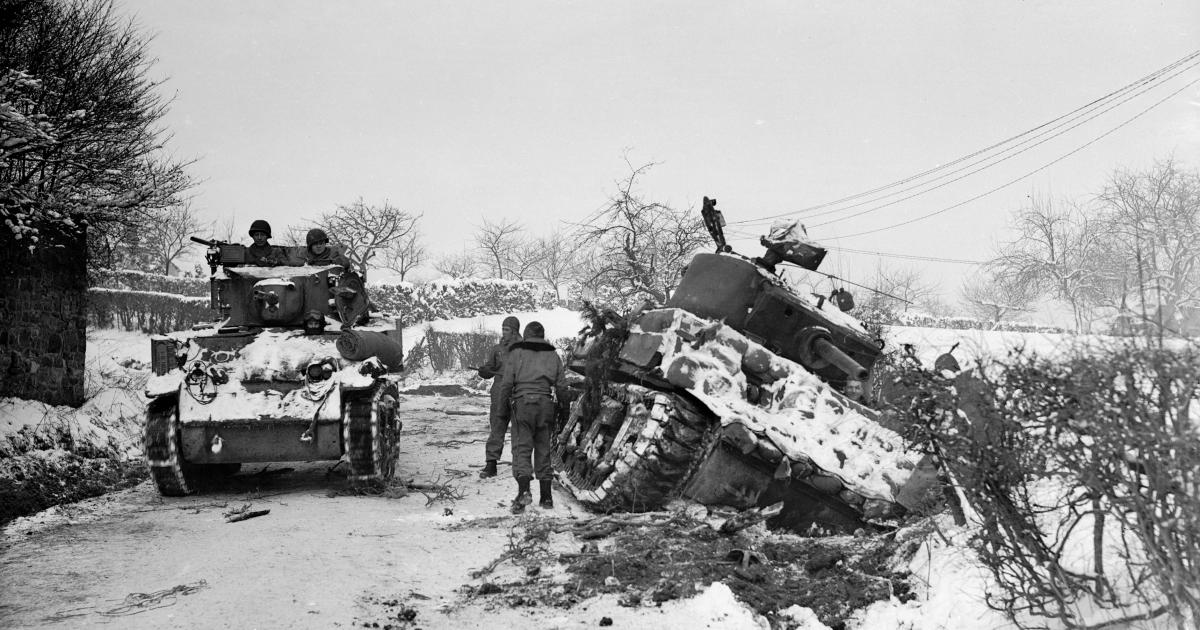
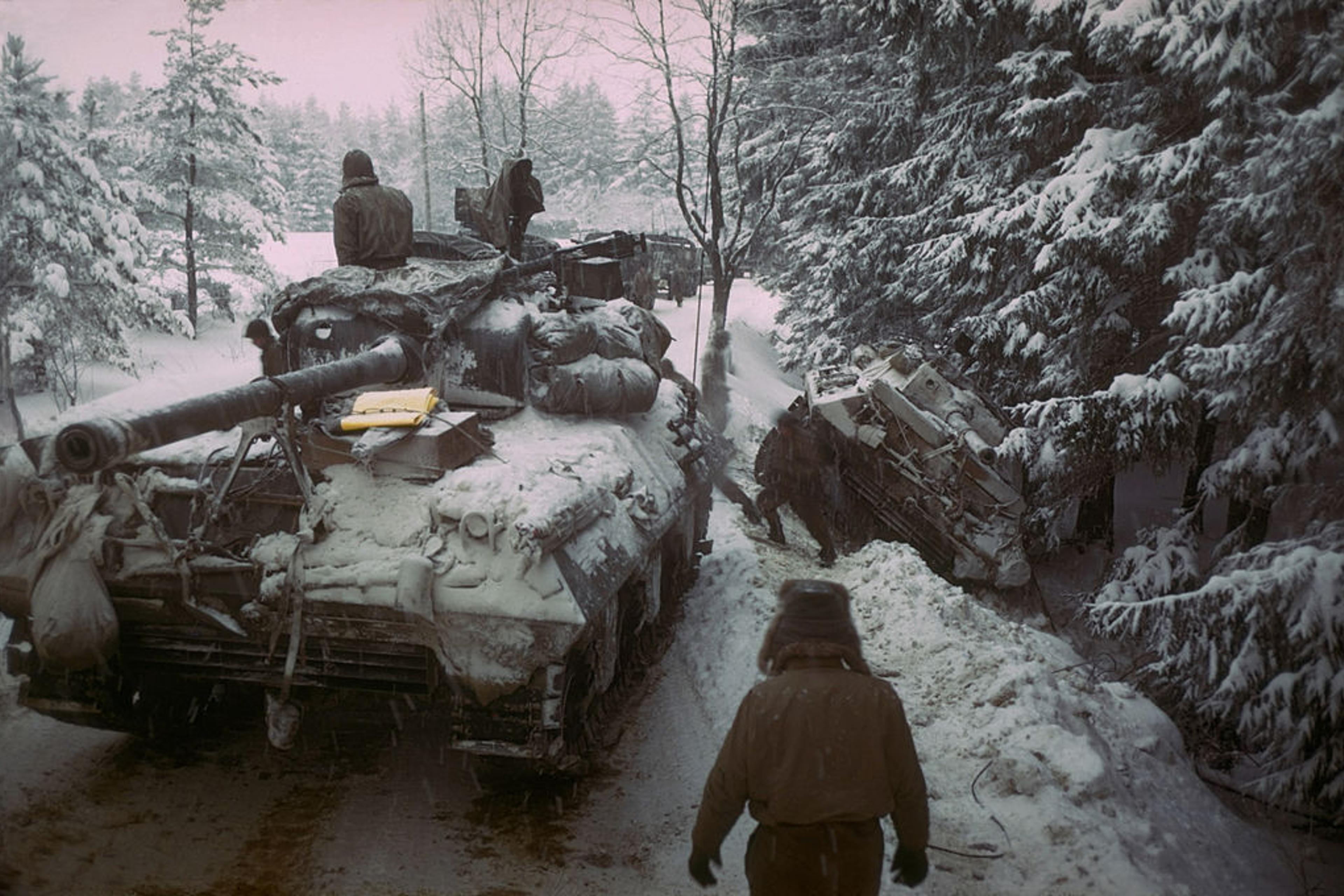
In the days that followed, the Third Army began to move. This was not a normal march—it was a race against time and weather. Snow covered the roads, turning them into slick ribbons of ice. Trucks stalled, tanks slid, and every kilometer gained came at double the effort. But Patton’s orders were clear: do not stop.
On a narrow road cutting through the forest, Sergeant James Walker sat in the back of a truck, gripping his rifle, staring ahead at a convoy stretching beyond sight. He didn’t know exactly where they were going—only that they were moving fast, faster than anything he had seen in a war that had seemed to slow down.
“What the hell are we doing?” he asked.
“Patton,” the driver replied simply.
And in a way, that was enough.
Ahead lay Bastogne, surrounded. American troops—men of the 101st Airborne Division—were cut off, low on ammunition, low on food, and under attack from all sides. They had received a German demand to surrender, and their now-famous reply—“Nuts!”—had already begun to circulate. But defiance alone could not hold a line forever.
Patton knew that.
Inside his mobile command post, he tracked every report, every update. The map was no longer static—it shifted by the hour. He did not merely issue orders; he drove them forward. Every unit, every subordinate commander felt the pressure—not fear, but a relentless certainty that what they were doing was possible.
One evening, as the weather worsened, an officer reported that a tank unit had been delayed by impassable roads. “We need more time,” he said.
Patton looked at him, his gaze sharp. “Time is what Bastogne doesn’t have,” he replied. “If the tanks can’t move, drag them. If you can’t drag them, find another route. But don’t stand still.”
It wasn’t cruelty. It was his understanding of war: movement meant survival; stillness meant death.
Meanwhile, at Bastogne, Walker and his unit finally neared the front. The sound of artillery was no longer distant—it filled the air. He saw paratroopers—dirty, exhausted, but still standing. When the first elements of the Third Army arrived, there was no dramatic cheering. Just nods. Eye contact. Recognition.
They had been waiting.
And Patton had arrived.
Breaking the siege was no easy victory. German forces did not withdraw immediately. They fought hard, using every advantage. But Patton’s arrival shifted the balance. It brought not just numbers and firepower, but something less tangible—momentum.
In a rare quiet moment, Walker sat beside a paratrooper. “We didn’t think you’d make it,” the man said.
Walker gave a faint smile, lips cracked from the cold. “Neither did we,” he replied. “But Patton did.”
That was the difference.
Days later, the siege of Bastogne was fully broken. Roads reopened. Supply lines flowed again. The bulge in the Allied front began to shrink. What had started as a bold German offensive was losing its force.
Back at headquarters, Patton did not celebrate loudly. He looked at the map, saw the red lines pulling back, and gave a small nod. To him, this was no miracle. It was the result of preparation, decisiveness, and the refusal to stand still.
But for the soldiers, it was something else.
It was a march through ice and exhaustion, where every step could have been the last. It was sleepless nights, frozen roads, and moments when they believed they would never arrive in time. And somehow—they had.
Years later, stories about Patton would be told in many ways. Some called him a genius. Others called him reckless. But for those who had been at Bastogne, he was the man who refused to slow down.
And in war, sometimes speed is not just an advantage.
It is the line between life and death.