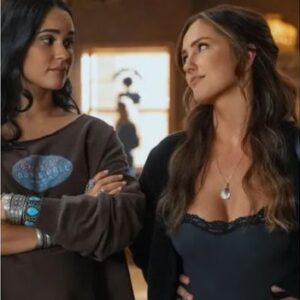
One of the biggest reasons Margo’s Got Money Troubles has sparked so much discussion online is because viewers — especially actual content creators — say the series feels surprisingly authentic in the way it portrays life on OnlyFans.
Now, the creative team behind the show is revealing just how far they went to achieve that realism.
According to author Rufi Thorpe, who wrote the original 2024 novel that inspired the Apple TV adaptation, the project began with a very specific idea: she wanted to tell a story about a mother who works in sex work while exploring the intense stigma surrounding both motherhood and online adult content creation.

That emotional conflict eventually became the foundation of Margo’s character throughout the series, particularly as her private identity becomes publicly exposed and judged by friends, family and strangers online.
But there was one major problem early in the writing process.
Thorpe realized she did not actually understand how OnlyFans truly worked.
Rather than relying on assumptions or internet stereotypes, she decided to research the platform directly — by creating her own customer account and quietly studying real creators.
That decision would later be repeated by executive producer Eva Anderson and the show’s writing team while adapting the story for television.
According to Anderson, the writers initially felt awkward about discussing or sharing creator content internally because they worried about crossing ethical boundaries while researching.

Eventually, however, the entire writers’ room accepted that they needed to openly examine references if they truly wanted the show to feel believable.
Thorpe reportedly followed a wide variety of creators during development, ranging from comedic personalities to pregnant creators and models whose content felt less polished and more personal than traditional adult entertainment.
That authenticity became extremely important to the show’s tone.
One of the most interesting revelations from the interview is that the team intentionally avoided portraying OnlyFans as purely hyper-sexualized content. Instead, they became fascinated by creators who built audiences through humor, weird gimmicks and personality-driven content.
Thorpe specifically cited creators like TooTurntTony, BigHonkinCaboose and HarperTheFox as inspirations because they demonstrated how comedy, absurdity and authenticity could become part of online sex appeal.

That influence clearly shaped Margo’s unusual content style in the show, which includes bizarre alien cosplay, neon paint videos and intentionally funny sexual humor rather than stereotypical glamour content.
“Part of what makes OnlyFans sexy is when it feels authentic and real,” Thorpe explained.
That approach unexpectedly became one of the reasons the series connected so strongly with viewers online. Many fans and creators praised the show for portraying online content creation as an actual form of labor and performance rather than reducing it to simplistic shock value.
The production reportedly became so detail-oriented that the team even recreated the full OnlyFans interface graphically for scenes inside the show, including realistic messaging systems, earnings screens and creator dashboards.

To make things even more accurate, the series hired a real OnlyFans creator known as HankSirStinki as a consultant.
The consultant reportedly corrected dialogue, advised the writers on realistic follower growth and even warned them about phrases Margo would not realistically be allowed to use on Instagram promotions.
One of the most talked-about details from the interview involves how Thorpe contacted creators for interviews while researching the novel.
After initially being ignored through normal social media messages, she discovered that creators were far more likely to respond through OnlyFans itself.
Her solution became surprisingly direct.
Thorpe would send creators a $50 tip alongside a message explaining that she was a novelist researching a character starting an OnlyFans account. She emphasized that she wanted to portray sex work honestly rather than morally judging it.
That exact method was later written directly into the series itself, with Margo also tipping creators while asking questions.
Ironically, Thorpe admitted many responses were initially automated flirt messages rather than real conversations.
“I would have to say, ‘No, earnestly, I wish to converse with you,’” she recalled humorously.
The show’s realism has become especially important because Margo’s Got Money Troubles is not simply trying to glamorize online sex work. Episode 6, in particular, becomes significantly darker after Margo is doxxed online and faces threats to her child custody situation.
Still, both Thorpe and Anderson stressed that they never wanted the story to become “misery porn.”
Instead, they wanted Margo to feel human.
“We didn’t want to judge Margo,” Anderson explained. “That’s for the assholes in the book and the show to do.”
Ironically, that refusal to treat Margo as either a victim or a scandal may be exactly why so many viewers — including real creators — feel unusually seen by the series.