It was my mother’s.
“Daniel… don’t let her know I spoke to you.”
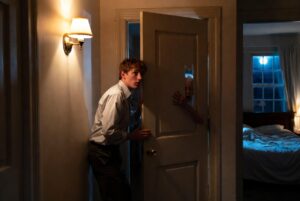
Her whisper drifted through the narrow crack beneath the locked bedroom door.
Weak.
Careful.
Terrified.
I froze in the hallway.
Three months.
Three months overseas with my engineering unit, and this was how I came home.
My wife, Emily, had greeted me at the front door with tears, hugs, and stories about how difficult everything had become.
“Your mom’s dementia got so much worse,” she’d whispered. “She doesn’t know what’s real anymore. She keeps hurting herself. Sometimes she gets violent.”
I wanted to believe her.
Until I saw the lock.
There had never been a lock on my mother’s bedroom.
Then I noticed the blackout curtains.
Then the smell.
No fresh air.
No television.
No phone.
No lamp.
Nothing.
Emily caught me staring.
“The doctor said reducing stimulation helps.”
I nodded.
Of course I nodded.
Because years in the military had taught me one lesson above all else:
When something doesn’t make sense…
Don’t argue.
Observe.
That evening, Emily chatted cheerfully with our next-door neighbor over the backyard fence.
I stayed inside where she couldn’t see me.
“…it’s heartbreaking,” Emily sighed dramatically.
“She doesn’t even recognize people anymore.”
“Oh dear,” the neighbor replied.
“And she keeps throwing herself into furniture. Those bruises are awful.”
Emily lowered her voice.
“I’m honestly afraid she’ll accuse someone of hurting her.”
Perfect.
The story was already prepared.
The witnesses had already been planted.
Interesting.
After Emily went to bed, I unlocked my mother’s door.
She wasn’t sleeping.
She was sitting upright on the mattress.
Waiting.
Moonlight slipped through the edge of the curtains, illuminating her face.
Bruises.
Yellow.
Purple.
One fresh cut near her wrist.
She smiled when she saw me.
“My boy.”
I hugged her harder than I had hugged anyone in years.
She held me for a long moment before whispering,
“You can’t let her know.”
“I won’t.”
“She listens.”
“To what?”
“Everything.”
I quietly searched the room.
No phone.
No charger.
No books.
Even the family photographs had disappeared.
“What happened?”
My mother’s eyes filled with tears.
“She says I forget things.”
“Do you?”
She looked directly into my eyes.
“What day did your father propose to me?”
Without hesitation—
“October twelfth. At Miller’s Lake.”
“What tie did you wear at your high school graduation?”
“The ugly green striped one Grandma bought.”
“What was the first thing you broke in this house?”
“The kitchen window.”
She smiled.
“You were eight.”
Not one hesitation.
Not one confused moment.
This wasn’t dementia.
This was imprisonment.
I didn’t ask about the bruises.
People who are frightened often tell the truth only after they know they’re safe.
Instead I asked,
“Are you eating enough?”
She looked toward the hallway before answering.
“When she’s in a good mood.”
My stomach tightened.
The next afternoon I pretended everything was normal.
Emily smiled constantly.
Cooked my favorite dinner.
Kissed me every chance she got.
She was performing.
Not for me.
For whoever might be watching.
So I performed too.
“I don’t know how you’ve managed all this alone,” I said.
Her shoulders relaxed immediately.
“I’ve tried so hard.”
“I believe you.”
She squeezed my hand.
“I knew you would.”
Exactly what I wanted.
That night, before joining her upstairs, I left my phone recording beneath the living room cabinet.
Just in case.
Years in uniform had taught me something else.
People confess when they believe they’ve already won.
At 1:17 a.m., footsteps.
Then Emily’s voice.
Soft.
Laughing.
She wasn’t alone.
Someone was on speakerphone.
“I told you he’d believe me.”
A man’s voice chuckled.
“I said he would.”
“He’s predictable.”
Then came the sentence that made my blood run cold.
“No one believes an old woman with ‘dementia.'”
More laughter.
“If she keeps refusing to sign, I’ll have to make her look even crazier.”

The man asked,
“What about Daniel?”
Emily answered without hesitation.
“Once guardianship is approved, he’ll never question the paperwork.”
Silence.
Then—
“The house will finally be ours.”
I listened to the recording six times before sunrise.
Each time it became worse.
This wasn’t caregiver exhaustion.
This wasn’t frustration.
This was planning.
At breakfast Emily smiled brightly.
“Don’t forget.”
“I won’t.”
“Her psychiatric evaluation is at ten.”
“I remember.”
She looked relieved.
“So maybe today they’ll finally recommend full-time placement.”
I smiled back.
“I certainly hope today brings some answers.”
It would.
Just not the ones she expected.
Before leaving, I quietly slipped into my mother’s room.
“I’m taking you somewhere.”
She looked frightened.
“The psychiatrist?”
“Yes.”
Her face fell.
“She’ll convince them.”
“No.”
I squeezed her hand.
“She convinced the wrong person.”
The clinic was modern.
Bright walls.
Soft music.
Emily chatted confidently with the receptionist.
“I’ve documented months of memory decline.”
She handed over a thick folder.
Color-coded.
Organized.
Prepared.
Impressive.
Very impressive.
The psychiatrist invited us inside.
Emily immediately began speaking.
“She wanders.”
“She hallucinates.”
“She forgets names.”
“She injures herself.”
The doctor nodded while making notes.
Then he turned toward me.
“Mr. Carter?”
Emily smiled confidently.
She expected agreement.
Instead…
I placed another folder onto his desk.
“This is the file I’d like you to review first.”
Emily frowned.
“What file?”
The doctor opened it.
Photographs.
Time-stamped images of bruises over several weeks.
Medical articles explaining how bruising patterns differ between accidental falls and repeated grabbing.
Copies of bank statements.
Property documents.
Security camera stills from our front porch showing grocery deliveries that never reached my mother’s room.
And finally…
A USB drive.
The doctor looked confused.
“What’s on this?”
I answered quietly.
“My wife’s own voice.”
Emily’s smile vanished.
The recording filled the office.
Every word.
Every laugh.
Every sentence.
“No one believes an old woman with dementia.”
“If she keeps refusing to sign…”
“The house will finally be ours.”
Nobody spoke after it ended.
The psychiatrist slowly removed his glasses.
He looked at Emily.
Then at my mother.
Then back at Emily.
“Mrs. Carter…”
Emily tried laughing.
“This is out of context.”
The doctor didn’t respond.
Instead he asked my mother a series of cognitive questions.
The date.
The president.
Current events.
Simple arithmetic.
Family history.
She answered every one calmly.
Perfectly.
Then he gave Emily a look I’d never forget.
“Your mother-in-law does not appear to suffer from dementia.”
Emily’s breathing changed.
“I think she’s masking.”
The psychiatrist shook his head.
“I think someone else has been creating symptoms.”
Within twenty minutes, Adult Protective Services arrived.
Then police officers.
Emily kept insisting everyone was misunderstanding.
She cried.
She begged.
She even reached for my hand.
I stepped back.
For the first time since we’d met.
Months later, investigators uncovered everything.
Forged medical notes.
Edited journal entries.
Attempts to transfer property ownership.
Deleted phone records.
She had isolated my mother slowly.
Methodically.
So no one would notice.
The bruises?
Most had come from being forcefully restrained whenever she refused to sign legal documents.
People often ask what made me suspicious so quickly.
It wasn’t the locked door.
It wasn’t even the bruises.
It was something much smaller.
When I arrived home, Emily had said,
“Your mother forgot who you were.”

But when I unlocked that dark room…
The first words my mother whispered weren’t confused.
They weren’t frightened.
They were:
“Daniel… don’t let her know I spoke to you.”
A woman losing her memory might forget a name.
She wouldn’t forget who she needed protection from.
That single sentence saved her life.
And every time I visit her now, we sit together on the front porch she nearly lost.
She laughs more than she did before.
She gardens again.
She tells the same family stories she’s told for years.
Only now, when she reaches the part where heroes are supposed to appear, she smiles at me and says,
“You know, Danny…”
“Sometimes the person who saves you doesn’t come charging through the front door.”
“Sometimes…”
“They come home quietly.”
“And pretend to believe every lie.”