One of the most discussed behind-the-scenes details from Margo’s Got Money Troubles recently involves how Nick Offerman prepared for Jinx’s addiction storyline. After several emotionally intense episodes focused on Jinx’s relapse and self-destructive behavior, fans began praising the performance for feeling unusually human and painfully believable instead of turning the character into a stereotypical villain.

Part of that realism, according to Offerman, came from the research he did before filming.
In interviews, Offerman explained that he spoke with real-life friends who were recovering from addiction because he wanted to better understand the psychology behind relapse. Rather than approaching addiction as something purely destructive or immoral, he tried to understand why people repeatedly return to forms of escapism even when they know the consequences could destroy their lives.
According to Offerman, the conversations helped him realize addiction is not only chemical, but emotional too.
He described it as the “euphoria of escaping reality,” explaining that many people struggling with addiction are not simply chasing substances themselves — they are chasing temporary relief from fear, shame, anxiety, grief, or emotional exhaustion. That perspective heavily influenced the way he portrayed Jinx throughout the season.
Fans online quickly connected that explanation to several of Jinx’s most difficult scenes.
Instead of performing the character as openly monstrous or intentionally cruel, Offerman often plays Jinx like someone trapped inside cycles he partially understands but cannot fully escape. Viewers noticed that even during moments where Jinx hurts the people around him, the performance still carries exhaustion, denial, desperation, and emotional collapse underneath the surface.
That complexity is exactly why the fandom response has been so strong.
A huge number of viewers have praised the show for portraying addiction in a more compassionate and psychologically layered way than many television dramas usually attempt. Rather than reducing Jinx into a simple “bad person,” the series presents him as someone whose addiction damages both himself and everyone around him simultaneously.

And fans think Offerman’s research is a major reason why those scenes feel authentic.
Social media discussions especially focused on how carefully he talks about addiction in interviews. Many viewers appreciated that he avoids sensationalizing relapse or framing addiction as moral failure alone. Instead, he consistently describes it as deeply tied to emotional pain and avoidance.
That nuance has resonated strongly with audiences who have personal experiences with addiction, recovery, or family members struggling with similar issues.
Some fans even said the performance becomes harder to watch precisely because it feels so empathetic. Jinx can be frustrating, destructive, manipulative, and heartbreaking all at once, which mirrors the emotional contradictions many people experience in real-life relationships affected by addiction.
And interestingly, this approach may also explain why fandom debates around Jinx have become so divided.
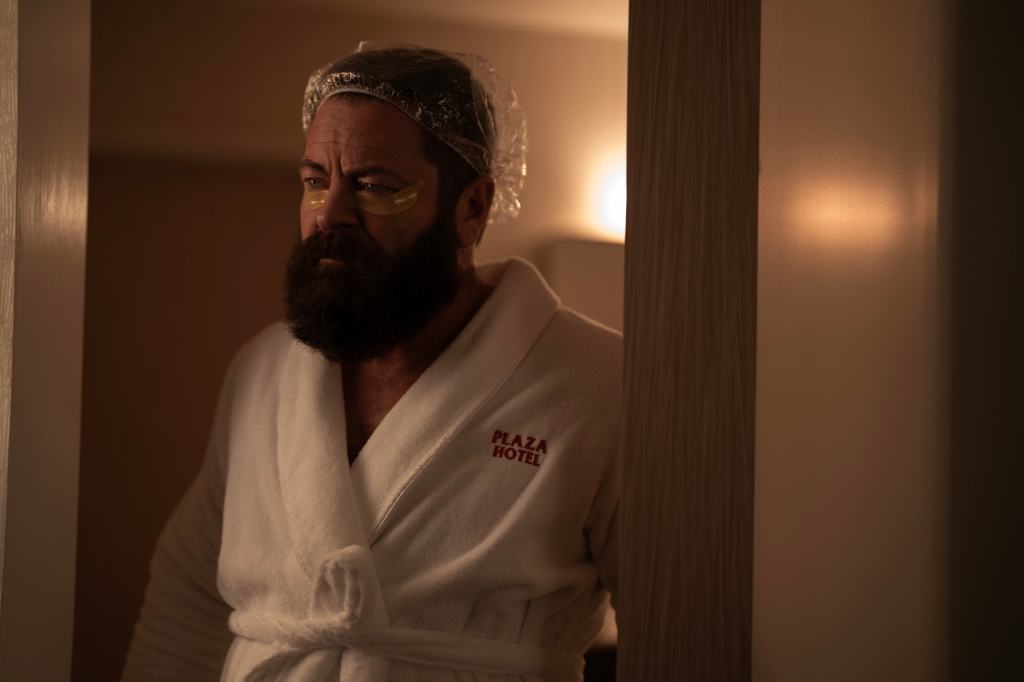
Some viewers still see him as toxic and irredeemable. Others increasingly interpret him as a tragic figure spiraling under emotional dependency and self-hatred. But regardless of where audiences stand morally, many agree the show avoids flattening him into a one-dimensional antagonist.
That balance is what people keep praising online.
Instead of asking audiences to simply hate Jinx, Margo’s Got Money Troubles forces viewers to sit with something much more uncomfortable: understanding how human vulnerability, escapism, shame, and addiction can coexist inside the same person.
And according to fans, Offerman’s preparation is a huge part of why the performance lands with so much emotional weight.