HYBE’s rookie boy group CORTIS has found itself at the center of another online controversy after a statement from the group’s Chinese fan community reignited debate over fan-driven chart manipulation in South Korea.

The discussion emerged shortly after reports that two Chinese fans had been arrested for allegedly trespassing into the group’s residence. In response, members of CORTIS’ Chinese fan community released a statement distancing themselves from the individuals involved while defending the wider fanbase.
In the statement, fans emphasized that the actions of two people should not represent an entire community. However, one section of the message quickly became the focus of public attention. The fanbase stated that they had spent millions of dollars purchasing albums, stayed up all night streaming the group’s music, and invested their own money to help CORTIS achieve greater success.
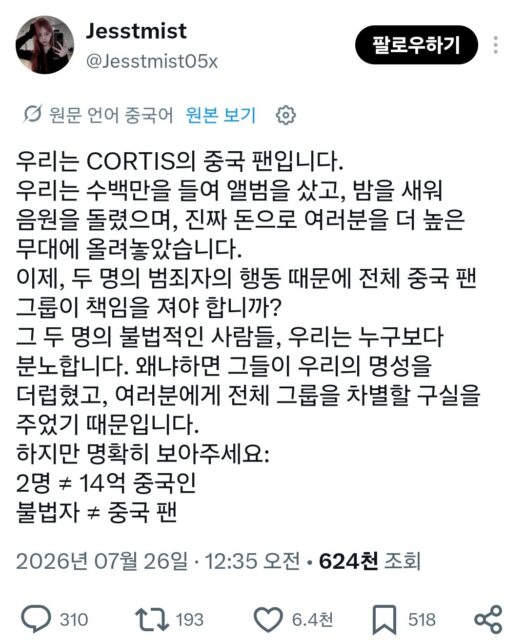
Although the statement was intended to highlight the dedication of the fandom, many Korean internet users interpreted it as an admission that large-scale buying and streaming campaigns had been used to boost the group’s performance on domestic music charts, including Melon.
Screenshots of the statement rapidly spread across Korean online communities, where users questioned how much influence coordinated overseas fan activities have on South Korea’s digital music rankings. Critics argued that organized mass purchasing and streaming campaigns can distort charts that are often viewed as indicators of the Korean general public’s listening habits.

At the same time, others argued that the issue extends far beyond CORTIS or a single fandom. Some commenters claimed that overseas fanbases from China, Japan, Southeast Asia, and other regions have been participating in large-scale streaming and album-buying campaigns for years, making the controversy part of a broader industry-wide discussion rather than an isolated incident.
Several online comments reflected that frustration, with some users claiming Korean music charts have become increasingly influenced by organized fandom activity instead of casual listeners. Others argued that multiple entertainment companies and fan communities have employed similar promotional strategies over the years, making it unfair to single out one rookie group.

It is important to note, however, that the fan statement does not by itself prove any illegal chart manipulation or wrongdoing by CORTIS or HYBE. Purchasing albums and repeatedly streaming songs are common fan promotion practices in K-pop, even though critics continue to debate whether coordinated campaigns should carry as much weight on music charts. As of now, there has been no official finding that CORTIS or its agency illegally manipulated chart rankings.
The controversy nevertheless highlights the growing debate surrounding K-pop’s chart culture, where passionate global fandoms possess enormous purchasing power and can significantly influence commercial performance. As discussions continue online, many fans and industry observers are once again calling for greater transparency in how digital music charts measure popularity while balancing dedicated fan support with broader public listening trends.