Taylor Sheridan’s rise is easy to describe as a Hollywood success story. He went from struggling actor to the creator of Yellowstone, built a major television career, and eventually became the owner of multiple Texas ranches, including the legendary 6666 Ranch.
But that version misses perhaps the most revealing part of the story.
Long before Sheridan could contemplate a ranch purchase worth hundreds of millions of dollars, he was sleeping in his car. And the decisions he made after finally earning money suggest that those months of instability never completely left him.
According to an Entertainment Weekly article about Sheridan’s interview with Town & Country, the writer and producer said he was “homeless twice” during his early acting career.
:max_bytes(150000):strip_icc():format(webp)/Taylor-Sheridan-070126-ed457e50379f4effa11c6d37a6fc7405.jpg)
“I lived in my car,” Sheridan recalled. Sometimes he would drive to Ojai simply to find somewhere he could sleep safely. He said that period lasted six months.
What makes the admission particularly revealing is that Sheridan does not portray himself as someone who had absolutely no alternative. He knew he could abandon acting, find full-time employment and create a more conventional form of stability.
“I could have decided at any point, ‘I’m going to go get a full-time job and I’m going to give up this dream,’” he explained.
Instead, he made an extraordinary calculation:
“And I chose to sleep in my car over that.”
That choice says something important about the stubbornness behind Sheridan’s later career. He was willing to accept immediate insecurity rather than surrender the future he wanted.
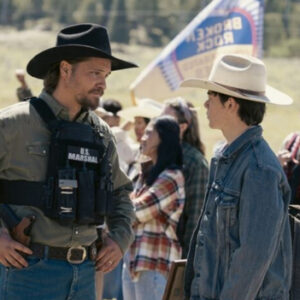
Eventually, acting did provide some stability. Sheridan became a recurring character on Sons of Anarchy, remaining with the series for three seasons before leaving in 2010. But substantial acting opportunities did not immediately follow.
His real turning point came somewhere else: writing.
Sheridan eventually sold the spec script for Hell or High Water. What he did with that first meaningful success may be as revealing as the success itself.
“When I sold that first screenplay, I bought a little house on an acre on a river in Wyoming,” Sheridan said.
:max_bytes(150000):strip_icc():format(webp)/Taylor-Sheridan-Sons-of-Anarchy-063026-2-ea63fd8a75b04cbea280640f8ba1bc29.jpg)
He paid for it outright. Then, as his career improved, he gradually purchased neighboring land and added a few horses.
That progression — car, small house, land, horses, eventually enormous ranches — looks particularly significant when considered alongside another admission.
“I’m still so averse to having to ever owe anybody anything.”
That may be the connecting thread through Sheridan’s story.
Success did not simply give him money. It gave him the ability to construct the security he once lacked.
His unhappy years in Los Angeles also appear to have survived in his writing. Sheridan has compared his experience there to the emotional foundation of Mayor of Kingstown: a man remains trapped in a place he hates while trying to hold it together rather than simply escaping.
“That, to me, was pretty autobiographical,” Sheridan said, explaining, “there I was stuck in L.A.”
:max_bytes(150000):strip_icc():format(webp)/Taylor-Sheridan-062926-c59d6a67b11c4f1696dedb69916f4e77.jpg)
Eventually, Sheridan’s relationship with land became far larger than the modest Wyoming property he bought after selling his first screenplay.
While scouting locations for Yellowstone, he befriended the former owner of the 6666 Ranch. Following her death, the trustees approached Sheridan about taking over the property.
The financial gulf was enormous.
“They said, ‘Do you want to pony up about 350 million bucks and take this place over?’” Sheridan recalled.
His response captured the absurd scale of the opportunity: “Well, I’m $330 million short.”
Sheridan ultimately made an overall deal with Paramount, brought investors aboard and purchased the ranch.
There is a remarkable reversal hidden inside that transaction. The man who once chose sleeping in a car rather than abandoning entertainment eventually used his entertainment career to help acquire one of the very things that had come to matter enormously to him: real land.
And Yellowstone itself played another role in that transformation.
Sheridan recalled seeing CNN describe Yellowstone’s headquarters as “the most famous ranch in America.” Rather than taking the description as a compliment, he was troubled.
“My heart sank, because it’s not a real ranch, right?”
Sheridan believed he had created a “fad,” and fads inevitably disappear.
“But ranching is a real thing.”
That realization helped draw him into real-life cattle ranching. It also reveals an interesting tension at the center of Sheridan’s career. Fiction gave him success, but success appears to have pushed him toward something tangible.
That makes his journey more complicated than a standard rags-to-riches narrative.
The striking contrast is not simply that Sheridan went from homelessness to wealth. It is what he repeatedly chose once wealth arrived: first a small home, then land, then horses, then ranches.
Perhaps the clearest clue to that progression is still his own statement about debt. The man who once slept in his car appears deeply concerned with never again being dependent on circumstances he cannot control.
Hollywood ultimately gave Sheridan enormous power.
But much of what he did with that power seems to have been about building something Hollywood could never provide on its own: a place that was actually his.