Winter, 1987.
The snow-covered mountains along the border had become a graveyard of silence.
Inside a dim military intelligence bunker, Sergeant Daniel Mercer sat alone beneath a flickering desk lamp.
Stacks of captured documents surrounded him.
Maps.
Orders.
Intercepted letters.
Photographs.
And journals.
Hundreds of journals.
Daniel’s job was simple.
Translate everything.
Every scrap of paper recovered from enemy positions.
Every notebook found on dead soldiers.
Every diary left behind during retreats.
Most of the material was useless.
Names.
Weather reports.
Food shortages.
Complaints.
But sometimes intelligence officers discovered something valuable.
And one afternoon, they handed Daniel a weathered black notebook.
“Captured from an enemy officer,” his commander said.
“See if there’s anything useful.”
Daniel opened the cover.
No name.
No rank.
Only a symbol drawn in black ink.
The first page immediately caught his attention.
October 3
Today we completed another sweep through the valley.
Resistance was stronger than expected.
We burned three abandoned farmhouses suspected of hiding enemy scouts.
The villagers watched.
Some cried.
I told myself it was necessary.
War leaves little room for hesitation.
Daniel’s jaw tightened.
He turned the page.
October 8
The operation succeeded.
Enemy casualties were significant.
Several young soldiers attempted to escape through the river crossing.
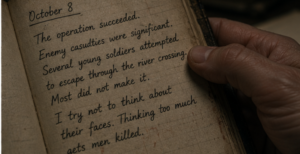
Most did not make it.
I try not to think about their faces.
Thinking too much gets men killed.
Daniel felt anger rising.
He knew that operation.
His unit had been there.
Three of his closest friends had died near that river.
He continued reading.
Page after page.
Month after month.
The mysterious officer described battles Daniel remembered vividly.
Ambushes.
Bombardments.
Night attacks.
Entire villages caught between opposing forces.
Every event appeared through enemy eyes.
And every entry made Daniel hate the writer more.
The officer sounded intelligent.
Disciplined.
Cold.
Far too cold.
Whenever civilians died, the man acknowledged it briefly before moving on.
Whenever enemy soldiers fell, he treated it as military necessity.
Never personal.
Never emotional.
Daniel began imagining the author’s face.
A sharp jaw.
Hard eyes.
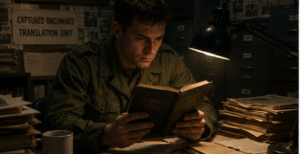
A man who slept peacefully while others suffered.
A man who viewed war as mathematics.
Nothing more.
Nothing less.
Over the following weeks, the diary consumed him.
He stopped reading other documents first.
Every morning he returned to the notebook.
Every night he carried thoughts of its author back to his barracks.
Eventually he gave the man a nickname.
The Butcher.
Because that was what he believed the officer truly was.
One evening another translator noticed his obsession.
“You hate this guy.”
Daniel looked up.
“Hate?”
The other soldier laughed.
“You talk about him more than your own family.”
Daniel stared at the diary.
“Some men deserve hatred.”
The translator shrugged.
“Maybe.”
But Daniel already knew.
If fate ever placed him face-to-face with the officer who wrote those pages…
he would kill him.
Not as a soldier.
As a man.
Weeks passed.
The diary grew stranger.
The entries became more personal.
Less tactical.
More reflective.
The officer wrote about exhaustion.
About nightmares.
About letters from home.
About missing his daughter.
Daniel disliked that.
It complicated things.
Monsters were easier to hate.
Fathers were not.
Yet he forced himself to continue.
Then one night he reached the final section.
The handwriting looked different.
At first he assumed fatigue caused the change.
But the difference became impossible to ignore.
The letters leaned another direction.
The spacing changed.
Even the pressure of the pen looked different.
Daniel frowned.
Something felt wrong.
He turned another page.
And stopped.
The entry began:
March 12
Today we recovered this journal from the body of an enemy soldier.
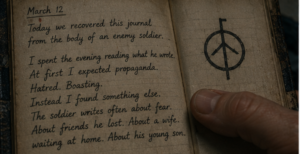
Daniel blinked.
Then read it again.
Slowly.
Today we recovered this journal from the body of an enemy soldier.
His heartbeat accelerated.
What?
He turned the page.
The new writer continued.
I spent the evening reading what he wrote.
At first I expected propaganda.
Hatred.
Boasting.
Instead I found something else.
The soldier writes often about fear.
About friends he lost.
About a wife waiting at home.
About his young son.
Strange.
We have been taught these men are monsters.
Yet his words sound no different from ours.
Daniel sat frozen.
The bunker suddenly felt colder.
His eyes raced down the page.
Yesterday I read an entry where he described one of our attacks.
He called us butchers.
Murderers.
Savages.
I became angry.
Then I realized something uncomfortable.
In my own journal, I describe his side exactly the same way.
Perhaps war requires this.
Perhaps men cannot kill one another unless they first stop seeing each other as human.
Daniel’s breathing became shallow.
The words felt wrong.
Too familiar.
Far too familiar.
He turned another page.
His handwriting is neat.
His observations are thoughtful.
I wonder who he was before the war.
A teacher?
A mechanic?
A father?
Tomorrow we bury him.
I do not know his name.
But I know this:
His family will miss him exactly as mine would miss me.
Daniel’s hands began shaking.
He knew these thoughts.
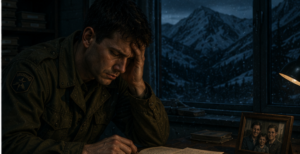
He knew this style.
This rhythm.
This voice.
No.
Impossible.
Then he reached the final page.
The very last entry.
Before returning this notebook to intelligence officers, I wish to write one final note.
To the unknown soldier:
I hope your family learns that you were brave.
I hope this war ends before more men like us die.
And if fate is kind, perhaps one day someone on both sides will understand that we were never enemies by choice.
We were simply men born beneath different flags.
Signed beneath the entry was a date.
Then another sentence.
One that made Daniel’s blood run cold.
The notebook belongs to Sergeant Daniel Mercer.
His name was written inside the back cover.
For several seconds he couldn’t breathe.
His hands trembled violently.
He flipped the notebook over.
Heart pounding.
Then opened the back cover.
Something he had never checked.
Something no one had checked.
There.
Faded almost beyond visibility.
Written in his own handwriting.
Daniel Mercer.
His name.
His service number.
His unit designation.
The room spun.
“No…”
The whisper escaped his lips.
His mind raced backward.
Months earlier.
A failed reconnaissance mission.
An ambush.
Chaos.
Running through artillery fire.
A backpack abandoned during retreat.
A notebook lost somewhere in the mountains.
His notebook.
His diary.
This diary.
The first pages.
The pages he had spent weeks translating.
The pages he hated.
The pages he called evil.
The pages he called monstrous.
They were his own words.
Daniel stared at the entries again.
Suddenly everything looked different.
The burned farmhouses.
The river crossing.
The operations.
He had written those passages.
From his side.
From his perspective.
Describing actions his own unit considered necessary.
Defensive.
Justified.
The enemy translator had merely read them through different eyes.
The same way Daniel had read the enemy officer’s response.
Neither man had lied.
Neither man had invented atrocities.
They had simply viewed the same war from opposite trenches.
And transformed each other into monsters.
Because monsters are easier to fight than people.
The realization shattered something inside him.
For weeks he had imagined murdering the diary’s author.
Had dreamed about it.
Obsessed over it.
Hated him.
Only to discover he had been hunting his own reflection.
The enemy officer had done exactly what Daniel was doing now.
Reading words.
Making assumptions.
Building a villain.
Then slowly realizing there was a human being behind the ink.
A man with fears.
With family.
With regrets.
A man disturbingly similar to himself.
Long after midnight, Daniel remained alone in the bunker.
The lamp above him buzzed softly.
Snow drifted outside.
And the diary lay open before him.
Two handwritings.
Two soldiers.
Two enemies.
Sharing the same notebook.
Sharing the same fears.
Sharing the same war.
For the first time since joining the military, Daniel understood something that frightened him more than any battlefield.
The enemy was not some inhuman creature waiting beyond the horizon.
The enemy laughed.
Worried.
Loved.
Dreamed.
And wrote in a journal exactly as he did.
He closed the notebook slowly.
Then stared at his reflection in the dark window.
The face looking back seemed unfamiliar.
Because the monster he had spent months searching for…
had never existed.
There had only been two tired soldiers trying to survive the same nightmare.
And somewhere beyond the mountains, another man had reached the exact same conclusion while reading the diary of someone he was supposed to hate.