The Bleeding Fortress
The year was 1943. December had draped Northern Europe in a suffocating shroud of grey mist and biting frost. High above the fractured landscape of Nazi Germany, the sky was no longer a realm of birds, but a theater of industrial slaughter.
Second Lieutenant Charlie Brown, a 21-year-old farm boy from West Virginia, felt the vibration of death through the steering yoke of his B-17 Flying Fortress, nicknamed “Ye Olde Pub.” It was their first mission, a baptism by fire that had quickly turned into a funeral pyre. Their target—a munitions factory in Bremen—had been obliterated, but the cost was catastrophic.
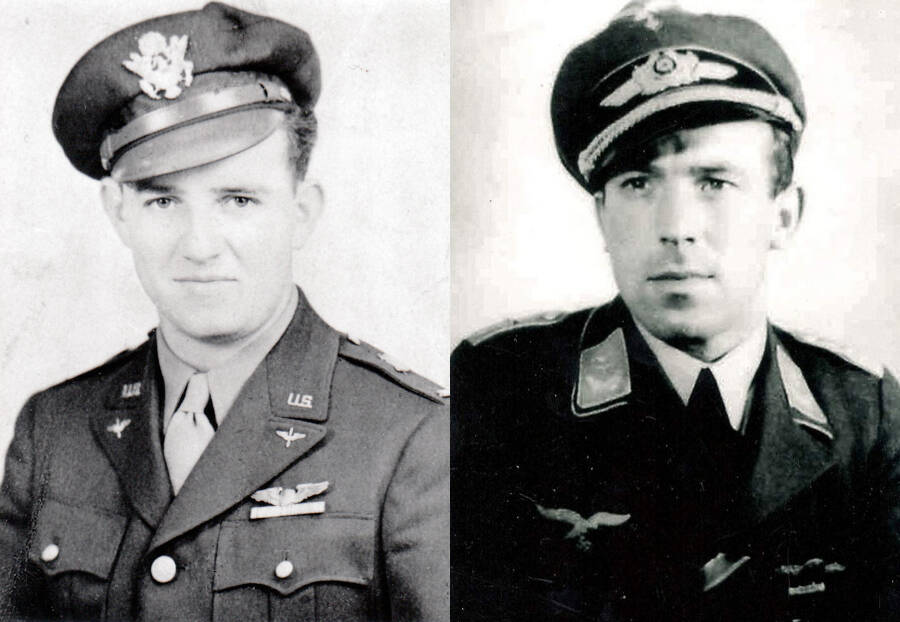
The “Pub” was no longer a plane; it was a screaming skeleton of shredded aluminum. The nose was smashed, the oxygen system had evaporated into the thin air, and three of the four engines were either dead or coughing out their last rhythmic gasps. Inside the fuselage, the scene was a nightmare painted in crimson. The tail gunner was dead, his blood frozen into dark crystals on the shattered glass. The other crew members lay in the waist of the plane, their moans silenced by the roar of the wind whipping through gaping holes in the hull. Charlie himself was dazed, a piece of flak having embedded itself in his shoulder, his blood staining his flight suit a dull, heavy brown.
As they limped toward the English Channel, the altitude dropped. They were a “lame duck,” a wounded beast trailing smoke like a funeral black veil across the German sky.
The Hunter’s Choice
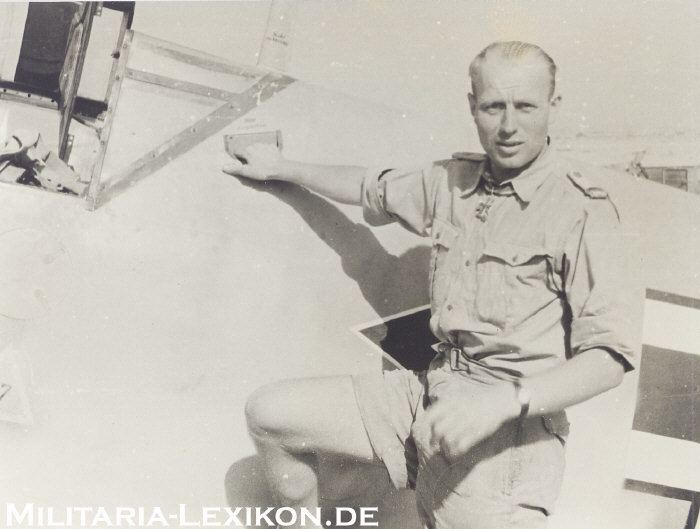
On the ground at a secret Luftwaffe airfield, Oberleutnant Franz Stigler was refueling his Messerschmitt Bf-109. Stigler was a man of iron and experience, a veteran of the desert sands of Libya and the freezing steppes of Russia. He had 22 confirmed kills. One more, and he would be awarded the Knight’s Cross—the pinnacle of German military honor.
![Ace Profile] Oberleutnant Ludwig Franz Stigler - News - War Thunder](https://warthunder.com/upload/image/!%202015%20NEWS/January/Stigler/Stigler5.jpg)
When the roar of a low-flying, struggling American bomber echoed across the field, Stigler didn’t hesitate. He scrambled into his cockpit, the Daimler-Benz engine screaming to life. To him, this wasn’t murder; it was the arithmetic of war. He rose like a hawk, closing the distance within minutes.
He moved into the classic “dead six” position, his thumb hovering over the cannon trigger. He prepared to rake the B-17 from tail to nose, watching it explode in a final, merciful fireball. But as he closed to within twenty feet, his finger froze.
Stigler leaned forward, squinting through his cockpit glass. He saw the B-17’s tail gunner slumped over his twin .50-calibers, which remained ominously silent. He saw the gaping holes in the fuselage, so large he could see the terrified, wounded men inside trying to bandage each other. He saw the pilot—a boy who looked no older than a schoolmate—struggling with all his might just to keep the nose of the plane level.
For the first time in the war, the “enemy” disappeared. In its place, Stigler saw a mirror.
The Ghost of Gustav Rödel
In the deafening silence of his own mind, Stigler heard the voice of his former commander, Gustav Rödel, echoing from the North African campaign:
“If I ever see or hear of you shooting at a man in a parachute, I will shoot you down myself. You fly by rules to keep your humanity. You don’t shoot at a helpless enemy.”
To Franz, this B-17 was no longer a weapon of war. It was a giant, silver parachute. To pull the trigger would be to execute a man in cold blood, a sin that no medal could ever wash away.
In a move that defied every order of the High Command, Stigler did not fire. He flew alongside the bomber, pulling his Messerschmitt so close that Charlie Brown could see the individual rivets on the German fighter.
Inside the B-17, Charlie looked to his left and gasped. A German pilot was staring at him, just feet away. Charlie closed his eyes, waiting for the flash of fire that would end his world. But it never came. He opened his eyes to see the German pilot gesturing wildly. Stigler was pointing toward the ground, then toward the East—urging them to land in neutral Sweden or surrender. He knew the plane would never survive the crossing of the North Sea.
But Charlie, stubborn and driven by a primal need to go home, shook his head. He kept the plane pointed toward England.
The Unlikely Escort
Realizing the Americans would not turn, Stigler made a decision of ultimate treason. Instead of peeling away, he tucked his wingtip just behind the B-17.
As they approached the Atlantic Wall—the heavily fortified German coastline—the anti-aircraft gunners looked up. They saw the battered B-17, but they also saw a Luftwaffe Ace flying close formation with it. The gunners hesitated. Was it a captured prize? Was it a secret German weapon? Because Stigler stayed by their side, the German “flak” batteries remained silent. He was acting as a human shield for his enemy.
They reached the open water of the North Sea. The danger of German territory was behind them. Stigler looked across the void between the two cockpits. He locked eyes with Charlie Brown—two men from different worlds, caught in a tragedy they didn’t start, but choosing a peace they both desired.
Stigler raised his hand and offered a crisp, formal military salute. It was a gesture of respect, a recognition of a fellow warrior’s struggle. Then, with a sharp bank of his wings, he dived back toward the continent, disappearing into the clouds.
The Long Road to Brotherhood
Charlie Brown managed to land Ye Olde Pub on a frantic runway in England. When he told his story to the intelligence officers, they were stunned. However, the military brass classified the incident as “Top Secret.” They didn’t want the Allied pilots feeling sympathy for the “Huns.”
For forty-six years, the story lived only in the memories of the two men. Stigler never told a soul, for the penalty for his mercy was death by firing squad.
In the 1980s, Charlie Brown began a search. He placed an ad in a combat pilot newsletter, looking for “the one who saved my life.” In 1990, a letter arrived from Canada. It was from Franz Stigler.
When they finally met in a hotel lobby, there were no cameras, no medals, and no politics. There were only two old men who collapsed into each other’s arms, weeping.
“I love you, Franz,” Charlie whispered.
Franz Stigler, the man who had traded a Knight’s Cross for a clear conscience, replied, “I couldn’t have lived with myself if I had pulled that trigger.”
The story of the B-17 and the Bf-109 remains a testament to the fact that even in the belly of the beast, humanity can survive. It proves that the greatest act of courage is not the ability to kill, but the strength to refrain. In a sky filled with fire and hate, two enemies found a way to be brothers, proving that mercy is a light that no war can truly extinguish.