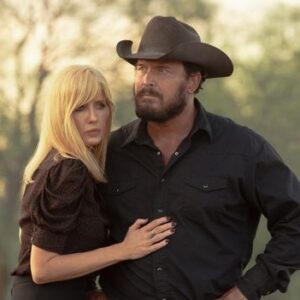
Over a year and a half has passed since the conclusion of the hit television series “Yellowstone,” which wrapped up after five seasons, yet the show’s legacy continues to resonate strongly through its expanding universe. Fans of the Dutton family story still reflect on the dramatic events that brought the flagship series to an end, even as two spin-offs—one focusing on Kayce Dutton, played by Luke Grimes, in Yellowstone: Marshals, and another centering on Beth and Rip, portrayed by Kelly Reilly and Cole Hauser, in Dutton Ranch—carry the narrative forward. Despite this continuation, many viewers remain deeply invested in understanding why the original series ended when it did, and for a long time, creator Taylor Sheridan maintained a guarded stance on the matter.
Recently, however, Sheridan addressed the topic in detail during an episode of The Bill Simmons Podcast, shedding light on the circumstances behind the show’s conclusion. One major factor, as speculated by fans and media alike, was Kevin Costner’s involvement in the series, though the reasons differ from widespread assumptions. Sheridan explained that, according to Costner’s original contract, he was only expected to participate in the first three seasons of “Yellowstone.” The initial plan had been to pass the leadership of the Dutton ranch to Kayce following the events of the third season, which ended on a tense cliffhanger involving several Dutton family members, including Costner’s patriarchal character, John Dutton.
In Sheridan’s vision, the story would then follow Kayce as the head of the ranch, observing his successes and challenges in maintaining the family legacy. This plan reflected a natural progression in the storyline and had been discussed and agreed upon with Costner from the beginning. However, Sheridan revealed that network executives at Paramount played a significant role in altering these plans. Fearing the absence of Kevin Costner, the network pressed for him to remain on the series beyond the originally intended three seasons. Although Costner had expressed his readiness to move on and pursue other projects, he agreed to stay for two additional seasons due to the show’s enormous popularity and commercial success. Sheridan described the network’s decision-making as focused on maximizing the show’s value as a hit property, rather than prioritizing the original narrative structure.
Eventually, Costner reached a point where he insisted on departing from the series to pursue his own creative projects, marking a definitive turning point for “Yellowstone.” His character, John Dutton, was ultimately written off the show and killed offscreen between the first and second halves of the fifth season. Costner redirected his attention to his ambitious four-part film series Horizon: An American Saga, for which he served as writer, director, star, and financier. The first installment premiered in the summer of 2024 but did not perform as expected at the box office. The release schedule for the subsequent parts remains uncertain, as the second installment was removed from theatrical calendars, and no official updates have been provided regarding the remaining films.
Sheridan’s comments made it clear that his frustrations were directed less at Costner and more at the network executives who influenced the show’s trajectory. He characterized them as “marketing executives” rather than storytellers, emphasizing that he refused to take calls from the studio’s development department during the series’ run. His focus remained squarely on crafting the story he envisioned, rather than negotiating or compromising with individuals who did not share the same creative priorities. This distinction underscored Sheridan’s commitment to storytelling above corporate considerations and his insistence on maintaining creative autonomy.
Regarding critical reception, Sheridan admitted that he paid little attention to critics, openly acknowledging that he often acted in ways that might provoke them. He expressed a candid disregard for critical opinions, stating that he did not care what they thought and that this attitude annoyed some critics. His approach reflected a clear preference for creating content according to his own vision and values, rather than conforming to external expectations or conventional industry pressures. Sheridan’s remarks convey a strong sense of independence and artistic integrity, highlighting the tension between the demands of major networks and the intentions of the show’s creators.

Ultimately, the end of “Yellowstone” was the result of a combination of factors, including Kevin Costner’s contractual terms, his eventual desire to pursue other projects, and the network’s emphasis on maintaining the show’s commercial momentum. While fans were left grappling with the dramatic conclusion of the Dutton family saga, the continuation of the universe through spin-offs ensures that the story remains alive and evolving. Sheridan’s reflections offer an insider’s perspective on the complex interplay between creative vision, actor commitments, and network decision-making, illustrating the challenges faced by showrunners in balancing artistic ambition with the realities of television production and audience expectations.
The legacy of “Yellowstone” remains significant, both in terms of its cultural impact and its expansion into new narratives through the spin-offs. Sheridan’s candid insights into the series’ conclusion provide clarity on the decisions that shaped its ending, demonstrating that the choices behind the scenes often involve a mix of creative intent and logistical necessity. For fans, understanding these factors adds depth to the experience of the show and sheds light on the intricate dynamics that influence the life cycle of a major television series.