Recent discussions surrounding the coffee franchise Compose Coffee have drawn significant public attention after reports emerged regarding its plan to renew its endorsement contract with V (BTS). The situation has escalated into tension between the franchisor and its franchise owners, with disagreements over marketing costs and claims that a potential legal dispute may arise.

According to internal proposals, Compose Coffee has been preparing to extend its partnership with the global idol, whose involvement has been credited with significantly raising the brand’s visibility. However, because Compose Coffee operates under a franchise model, the financial burden of high-profile marketing campaigns is not borne solely by the headquarters. Instead, costs are partially distributed among individual franchise owners, which has become the central point of contention.
The proposed renewal contract for V is reportedly valued at approximately 7.35 billion Korean won. Under the suggested arrangement, this cost would be divided between the corporate headquarters and franchisees at a ratio of 6:4. This means that a substantial portion of the expense would still be passed on to individual store operators. On a per-store basis, each franchise would be expected to contribute around 80,000 won per month to cover the endorsement and related promotional activities.
To put this figure into perspective, franchise owners have highlighted that 80,000 won corresponds to the revenue generated from roughly 54 cups of coffee priced at 1,500 won each. For small business owners operating on tight margins, this recurring expense has become a source of frustration, especially given the belief among some operators that the direct financial return from the celebrity endorsement is not clearly measurable in day-to-day sales performance.
As dissatisfaction has grown, a portion of franchise owners has expressed strong opposition to the renewal plan. Some argue that they are already under pressure from multiple marketing-related fees amounting to tens of billions of won in total across the system, yet they do not feel that these investments translate into proportional increases in customer traffic or revenue. In particular, several franchisees have stated that they do not experience a noticeable “BTS effect” in their individual store performance despite the global popularity of V (BTS) and the broader influence of BTS.

Some franchise operators have gone further, reportedly considering legal action if the cost-sharing agreement is enforced without broader consensus. Their argument centers on the belief that marketing decisions made at the corporate level should not automatically translate into mandatory financial obligations for independent store owners, particularly when the return on investment is seen as uncertain. They emphasize that they operate businesses built on narrow profit margins, where even relatively small monthly costs can significantly affect overall profitability.
One franchise owner was quoted expressing frustration, stating that they earn their income “one cheap cup of coffee at a time,” and that being required to contribute monthly fees for a celebrity advertising campaign they did not individually request feels financially burdensome. According to this perspective, the issue is not necessarily opposition to celebrity marketing itself, but rather the perceived lack of consultation and the compulsory nature of the cost distribution.
On the other hand, Compose Coffee has defended its position by stating that the decision to maintain or renew a celebrity endorsement is partly driven by feedback from within the franchise network itself. The company claims that many franchisees have previously requested stronger marketing strategies involving well-known public figures in order to better compete in a crowded and highly competitive coffee market. From this viewpoint, celebrity endorsements are seen as a necessary investment to maintain brand visibility and attract new customer segments, including younger consumers and international visitors.
The company also argues that its collaboration with V (BTS) has already produced positive effects in terms of brand awareness. According to their assessment, overall recognition and public interest in Compose Coffee have increased since the partnership began. They maintain that such improvements in brand perception ultimately benefit all franchise owners, even if the impact is not always directly reflected in short-term sales figures at individual locations.
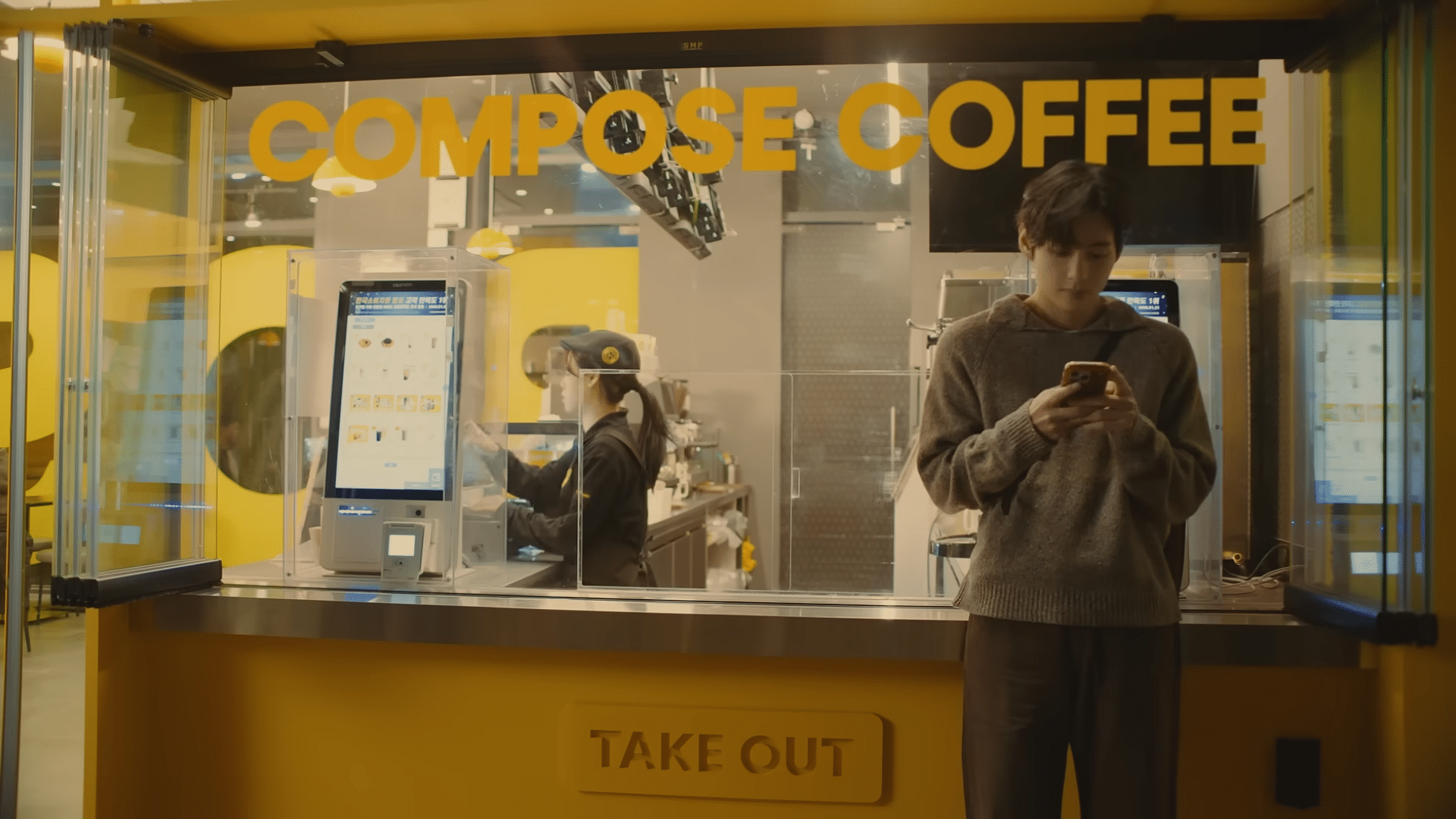
Compose Coffee has further stated that it intends to continue discussions with franchise operators in order to find a more balanced approach to future marketing expenditures. The company has suggested that it may explore strategies to reduce the financial burden on store owners while still maintaining competitive advertising campaigns. This indicates that while the renewal plan has caused friction, negotiations remain ongoing and no final, irreversible decision has been made.
Meanwhile, public opinion on the matter appears divided. Some commentators argue that using a globally recognized figure such as V from BTS elevates the brand’s image, making it more attractive not only to domestic consumers but also to international tourists and fans of K-culture. From this perspective, the marketing investment is viewed as a long-term branding strategy rather than a short-term sales driver.
Others, however, sympathize with the franchise owners, noting that many similar businesses face pressure when large-scale corporate marketing costs are distributed across independent operators. Critics in this camp question whether all franchisees should be required to participate financially in high-cost endorsement deals, especially when the benefits may vary significantly depending on location, customer demographics, and store performance.
In addition, comparisons have been made with other coffee chains that reportedly allocate substantial budgets to advertising without necessarily using global celebrity endorsements. This has further fueled debate about whether the scale of Compose Coffee’s investment is justified or excessive in relation to its operational structure.

As the discussion continues, the situation remains unresolved. What began as a routine contract renewal has evolved into a broader dispute over franchise governance, cost allocation, and the effectiveness of celebrity-driven marketing strategies in highly competitive retail environments. The outcome of this dispute may not only influence Compose Coffee’s future branding decisions but could also set a precedent for how franchise-based businesses manage large-scale promotional agreements involving international celebrities.