The treatment of aespa’s Karina at the 2026 Met Gala has sparked widespread outrage online, with many people expressing anger and frustration at the way the photographers treated her during the prestigious event. The backlash intensified after a video from the gala started circulating, which appeared to show Karina being largely ignored by the photographers as she made her grand entrance on the red carpet.

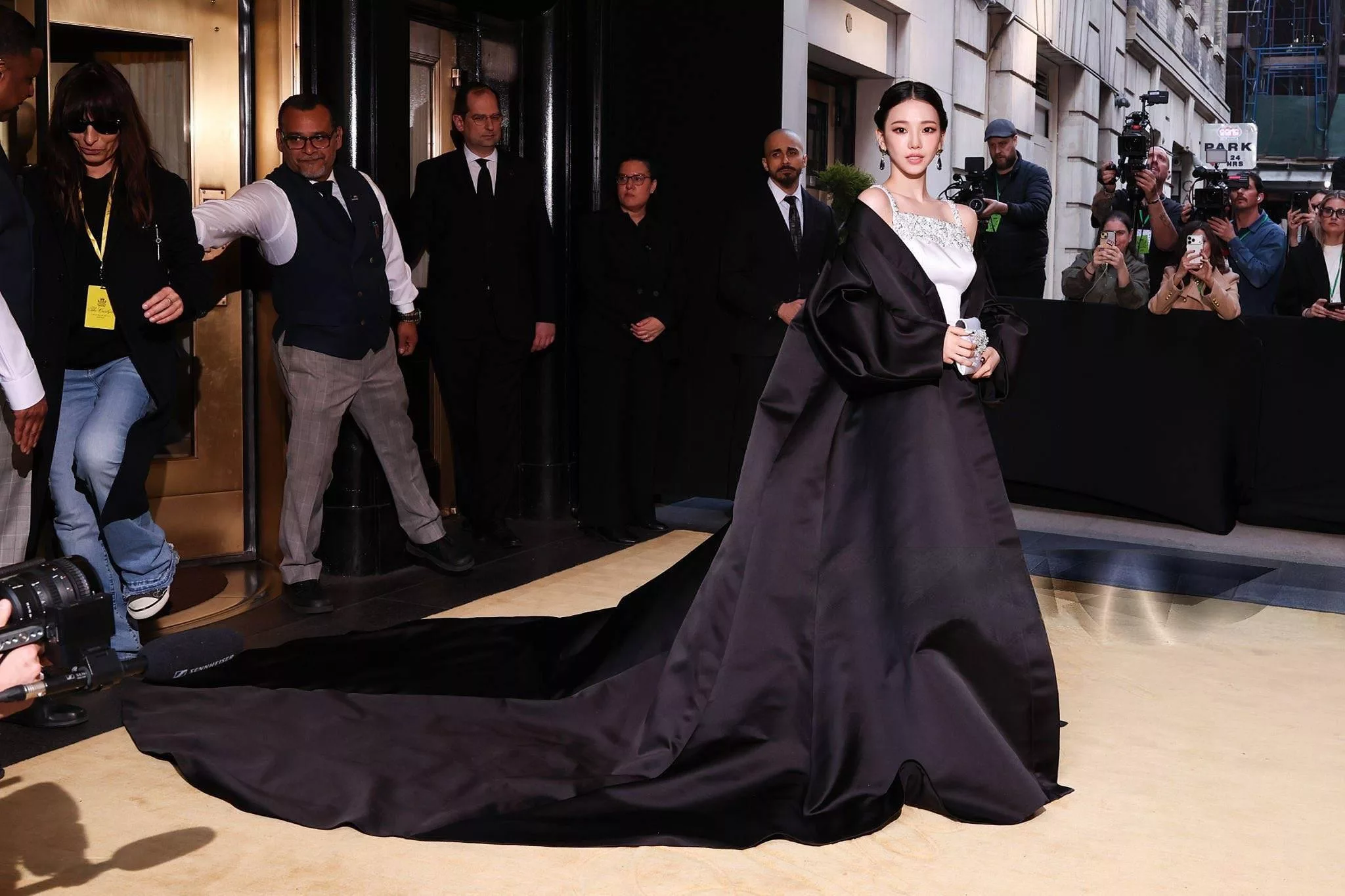
Karina, who has steadily risen to prominence as a member of the K-pop group aespa, attended the 2026 Met Gala in a stunning white satin dress by Prada. The gown featured an intricate tablier neckline, embroidered with jet beads and silver crystals. To complete the look, she wore a black satin evening cape and silver leather sandals. Her ensemble was accessorized with stunning pieces of jewelry from Prada’s Fine Jewelry Couleur Vivante collection, including earrings crafted in white gold and adorned with peridots and amethysts.
As part of Prada’s ambassadorial lineup, Karina’s presence at the Met Gala was undoubtedly significant. Yet, despite her star-studded outfit and impressive credentials, the video that surfaced seemed to show that the photographers were not giving her the attention that one would expect for such a high-profile figure. Some fans, particularly those who follow the K-pop industry closely, were quick to point out that the lack of focus on Karina was not due to her appearance or her style, but rather her status in the global entertainment scene.
The video, which was widely shared across social media platforms, sparked a wave of discussion. While some users cruelly mocked Karina, claiming that she wasn’t famous enough for the photographers to take an interest in her, many others took a different stance. They argued that the real issue lay deeper within the industry, with many pointing to the recurring pattern of racism and mistreatment that K-pop stars, especially Asian artists, often face when attending major international events like the Met Gala.

Some commentators took to social media to highlight the fact that such behavior from photographers has become a common occurrence. These individuals expressed anger at how K-pop stars, including Karina, are frequently subject to disregard and even humiliation. This treatment was not only seen as a result of their fame but also tied to their ethnicity. The idea that Asian acts like Karina are often overlooked by international photographers led many to accuse these photographers of perpetuating racist stereotypes, further cementing the idea that many still fail to recognize or respect Asian celebrities in the global spotlight.
Adding fuel to the fire, another incident from the event caused further controversy. In a moment that many found highly disrespectful, one photographer mistakenly referred to Karina as Jisoo, the member of BLACKPINK, another globally recognized K-pop act. The blunder, where the photographer called her name instead of Karina’s, sparked outrage among fans, who saw it as a sign of the careless and dismissive attitude photographers often adopt toward K-pop stars. It was perceived by many as yet another example of how Asian artists are often lumped together or mistaken for each other, reinforcing harmful stereotypes that contribute to their marginalization.
The outrage wasn’t just confined to Karina’s fans. People across the globe, especially those involved in K-pop fandoms, were quick to express their frustration at the way the photographers behaved at the gala. This wasn’t the first time that such incidents had occurred at high-profile events, and many pointed out that the issue has been a long-standing problem. In 2024, during the Met Gala, photographers were reported to have yelled “arigato” at Stray Kids, another K-pop group, and made insensitive jokes related to COVID-19, further highlighting the uncomfortable and disrespectful atmosphere that many K-pop idols face at international events.
Social media users were vocal in their criticism of these actions, arguing that such behavior was not only unprofessional but also deeply problematic. Many felt that the photographers’ failure to distinguish between different K-pop idols was a clear sign of ignorance and disrespect. The fact that Karina was mistaken for Jisoo was a particularly sore point for fans, who pointed out that it was not only disrespectful to Karina but also perpetuated the stereotype that all Korean celebrities look alike.
This incident also sparked a wider conversation about the treatment of K-pop idols and other Asian celebrities at major global events. Many people expressed frustration at how Asian stars are often treated as if they are interchangeable, with little regard for their individual identities or achievements. The Met Gala, an event that prides itself on showcasing diversity and inclusion, seemed to fall short when it came to recognizing and respecting the individuality of K-pop stars.
In response to the controversy, several fans and supporters of Karina rallied behind her, condemning the photographers’ behavior and calling for greater awareness and respect for Asian artists in the global entertainment industry. They demanded that K-pop idols be treated with the same level of respect and professionalism as their Western counterparts, especially at events like the Met Gala, where celebrities are meant to be celebrated and honored for their contributions to fashion, culture, and the arts.

The incident also highlighted the broader issue of racism in the entertainment industry, particularly in the context of K-pop. Despite the genre’s global popularity and its significant influence on music and fashion, many K-pop idols still face discrimination and marginalization when they step onto the international stage. This reality is not only frustrating for the artists themselves but also for their fans, who feel that their idols are not being given the recognition and respect they deserve.
As the debate rages on, it remains clear that the treatment of Karina at the 2026 Met Gala is part of a larger conversation about racism, discrimination, and the unequal treatment of Asian artists in the global entertainment industry. For many, this incident serves as a reminder that while K-pop continues to break barriers and achieve international success, much work remains to be done in terms of ensuring that Asian artists are treated with the same respect and dignity as their Western peers.