KATSEYE’s Lara recently sparked a major backlash after comments she made in an interview went viral on social media. The controversy erupted when a clip from her appearance on Close Friends Only, an interview series hosted by Larray, was shared online. In the clip, Lara expressed her deep love for R&B music, and her comments about the genre quickly became the subject of intense criticism.
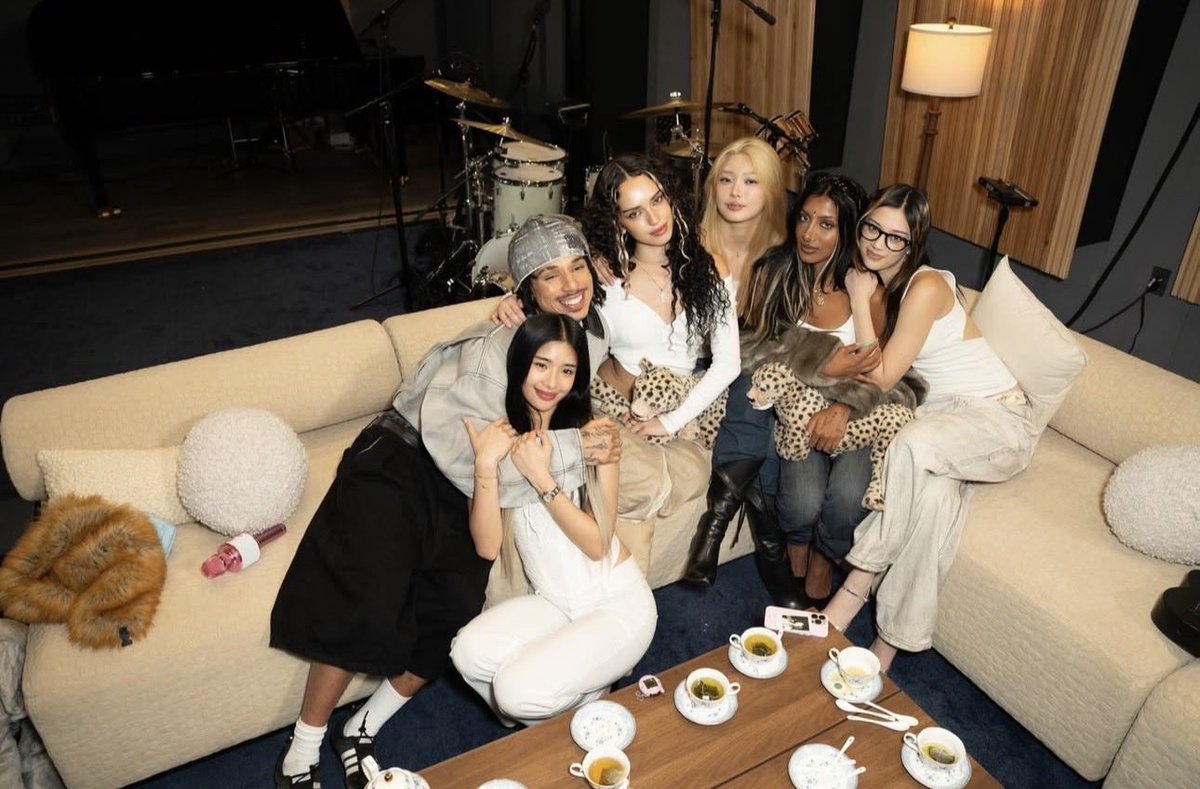
Lara began by discussing her passion for music production and songwriting. “When I am in a studio and have access to music, like I love producing and writing so much, it’s my true true passion, I think. When I produce and when I write, it’s the most free, nobody can tell me what to be when I do that, and that’s why I love it so much,” she said. Her words, which were intended to emphasize her creative freedom, included a statement about R&B that caught the attention of viewers: “I love R&B so much, and like the lack of structure, I think in R&B is much what I love the most.”
This particular comment, describing R&B music as having a “lack of structure,” immediately led to backlash. Many netizens took issue with her description of the genre, especially considering that Lara is of Indian descent. Her comment was perceived as ignorant by some, especially in a context where music is often shaped by cultural and historical roots. Critics pointed out that her description of R&B was oversimplified and lacking understanding of the intricacies of the genre.
One Twitter user reacted by saying, “This girl just said R&B lacks structure and I’m supposed to believe she’s so musically inclined as y’all try to tell me. Just because she can do some clean runs.” The criticism continued with other users pointing out that Lara’s previous work and her use of African American Vernacular English (AAVE) had already been contentious issues. “Lara wants to sound like a real artist so bad. Saying R&B lacks structure is just proof she’s anything but that,” one user added, clearly upset by her statement.

As the comments continued to pour in, some fans of Lara tried to defend her. They argued that the backlash was a result of people misinterpreting her words or taking them out of context. Fans pointed out that Lara had not intended to insult the genre, but instead, she was discussing her appreciation for the creative freedom that R&B provides. One fan wrote, “I understood what she meant immediately. Why do y’all always have to twist anything they say?” Others elaborated further, explaining that Lara’s comment was more about the structure of R&B being less rigid than other genres.
“’R&B lacks structure,’ then she proceeded to say why she liked it because she has full creative control over how the song can be structured. Y’all, please, not today,” one defender wrote. Another fan added, “Omfg when she said lacks structure, she meant it has room for creative freedom… Y’all have to use context, omfg.” These supporters emphasized that Lara was appreciating R&B for its flexibility, which allows artists to express themselves without being confined to conventional verse-chorus formulas. Instead of a rigid structure, R&B allows for vocal runs, tempo changes, improvisation, and emotional pacing, all of which give artists the creative freedom to experiment and explore.
One fan wrote, “She was clearly talking about how R&B tends to be less confined to rigid verse-chorus formulas, more room for vocal runs, tempo switches, improvisation, & emotional pacing. Somehow y’all twisted that into disrespect because outrage is more fun than basic comprehension.” This comment highlighted the underlying issue—many people were quick to misinterpret Lara’s words and jump to conclusions without considering the full context of her statement.

Despite the heated debate on social media, it became clear that the viral clip had stirred up a larger conversation about how artists, particularly those from outside the Black community, engage with and speak about genres like R&B, which have deep cultural and historical ties to African American communities. Lara’s comment, while intended to express her personal connection to the music, struck a nerve with many who felt that her perspective was overly simplistic and dismissed the genre’s rich history and structure.
The incident ultimately highlighted the fine line artists must walk when discussing genres that are tied to specific cultural and racial communities. While some defended Lara by offering more context for her remarks, others were quick to criticize her for not fully understanding the weight of her words. The controversy surrounding Lara’s comments is a reminder of the complexities that come with being an artist in today’s cultural landscape, where every word is scrutinized, and fans and critics alike are quick to form opinions.
Whether Lara intended to disrespect R&B or not, her comments have certainly sparked an ongoing discussion about cultural sensitivity, creative freedom, and the ways in which music is understood and appreciated across different communities.