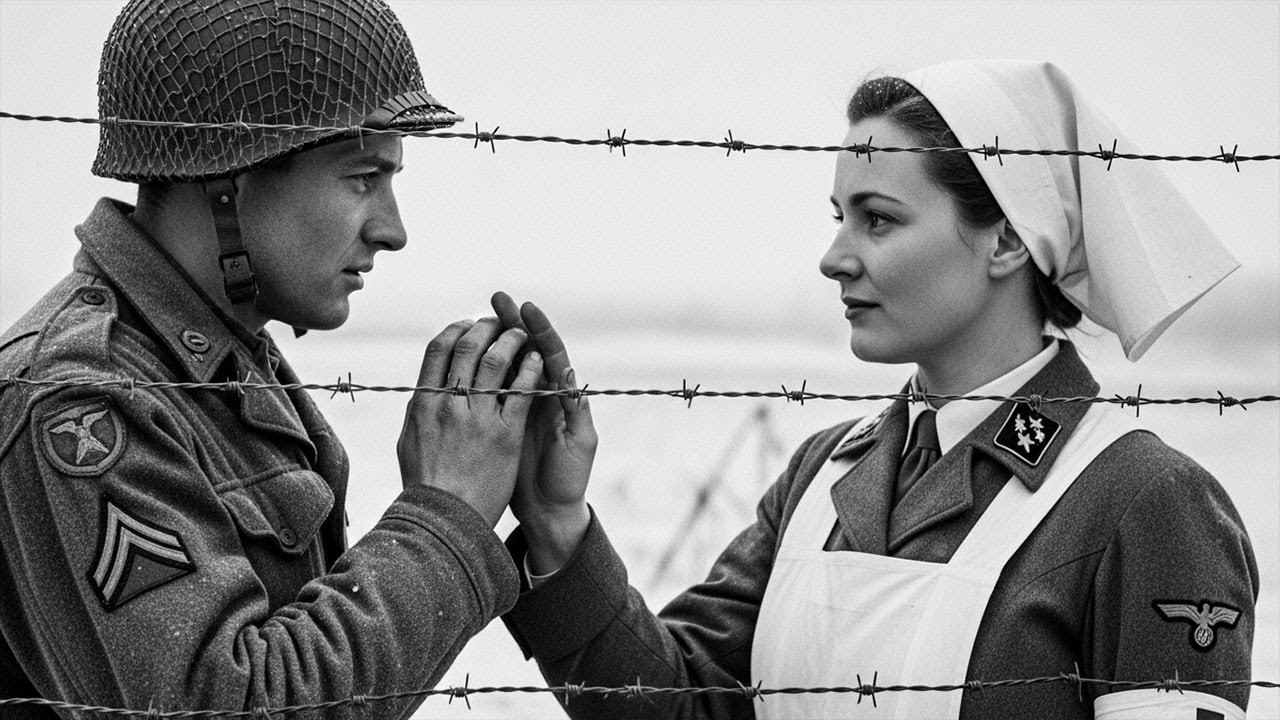
Because “tomorrow” meant choice.
It meant risk.
It meant that in a world ruled by wire and orders, someone had decided—quietly—to be human.
The next morning came gray and brittle. Snow crusted the yard, crunching under boots as guards changed shifts. James forced himself through roll call, heart thudding harder than it ever had under fire. He kept his eyes forward, his face empty. Prisoners learned quickly that hope was the easiest thing to confiscate.
The infirmary bell rang midmorning.
James felt it before he saw her. Marlene entered with a crate of supplies balanced against her hip, her posture calm, her expression unreadable. She did not look at him. Not yet. She moved between cots with practiced care, checking temperatures, tightening bandages, murmuring reassurances in a voice trained to soothe without promising.
When she reached James, she paused. Long enough to be noticed—too long.
A guard cleared his throat from the doorway.
“Quickly,” he snapped.
Marlene nodded, professional again. “Lift your arm,” she said, her English precise.
James did. Her fingers brushed his skin, light as falling snow. As she wrapped the gauze, her thumb pressed once—deliberate—into his palm. He felt the shape before he saw it: another scrap of paper, smaller this time.
She stepped away without a glance.
The paper waited until he could be alone. In the latrine, where the cold bit hardest and the guards least wanted to linger, he unfolded it.
Tonight. After second watch. North fence. Bring nothing.
James stared at the words until they blurred.
The sensible part of him—trained, scarred, surviving—listed the dangers. The fences were electrified in places. Searchlights swept on a schedule that changed without warning. Informers existed. And Marlene—Marlene could be bait, could be coerced, could be watched.
But he remembered her hesitation. The way she’d said I’m sorry. He remembered the tired kindness in her eyes, the courage it took to write a single word.
He folded the paper into nothing and let it dissolve in the latrine sink.
That night, he went.
The north fence was quieter, older. Repairs lagged there. Snow muffled sound, and the wind carried voices away toward the trees. James waited in shadow, breath slow, counting the seconds between the sweep of light.
She came as a darker shape against the snow, moving with certainty that startled him. She wore a heavy coat and carried a lantern—but the flame was shuttered, barely a whisper of light.
“You came,” she said.
He nodded. “I had to.”
For a moment they stood there, two enemies on opposite sides of a war that had already broken them both.
“I shouldn’t do this,” Marlene whispered. “They will kill me if they find out.”
“Then we stop,” James said immediately. “Now.”
She shook her head. “No. Not like that.”
She took a breath, then another. “They are moving the sick tomorrow. East. There is no medicine. Many will not survive.”
James’s jaw tightened. He had heard the rumors. “What can I do?”
“Nothing,” she said. Then, after a beat, “Everything.”
She explained quickly—maps in her head, schedules memorized while pretending not to listen. A supply shed near the river. A sympathetic farmer. A doctor who owed her father a debt from before the war turned everyone into enemies.
“I need you to walk,” she said. “With them. Make them think it’s routine. If they see a uniform they trust, they won’t question.”
James almost laughed. “They don’t trust us.”
“They trust habits,” she said. “And they trust cruelty.”
The plan was thin. Dangerous. And the only one they had.
They parted without touching. Without promises. Love, if it was that, did not need proof yet. Only action.
The transfer began at dawn.
Guards shouted. Prisoners stumbled. Trucks idled, coughing smoke into the cold. Marlene moved with the medics, eyes down, hands steady. James walked with the sick, supporting a man whose fever had stolen his name.
The shed by the river stood as she said it would.
The guard in charge—a man with a scar across his cheek and a habit of kicking—grew impatient. “Hurry,” he barked.
James met his gaze, steady and empty. He had learned the look. The look that said I am already broken; move on.
The guard waved them through.
Inside, chaos became choreography. Crates slid. Doors closed. The truck pulled away empty.
Searchlights swept the riverbank.
And then the farmer’s horn sounded—once. Twice.
They ran.
The camp erupted before nightfall.
Search parties fanned out. Dogs barked. The scarred guard screamed at anyone within reach. Marlene was taken, hands bound, eyes bright with fear she did not allow to show.
In the interrogation room, they demanded names. Routes. Motives.
She said nothing.
They threatened her family. She closed her eyes.
They struck her. She stood again.
The scarred guard raised his hand for another blow—
—and the door opened.
An officer entered, older, colder. He listened to the report in silence, then dismissed the guard with a flick of his fingers.
“You,” he said to Marlene. “Sit.”
She did.
“Do you know what happened to the sick?” he asked.
“Yes,” she said quietly.
“Where?”
“Somewhere safe.”
He studied her. Then sighed. “The war is ending. Do you think this will matter?”
She met his eyes. “It matters to them.”
He stared at her for a long moment. Then, unexpectedly, he nodded.
The scarred guard was reassigned that night—to a unit that never returned. No one asked questions.
Marlene was released back to the infirmary. Watched. But alive.

James crossed the river at dawn.
They hid in barns, moved at night, shared bread and silence. When American lines finally appeared, it was like stepping through a door neither of them had believed existed.
James turned back once. The trees hid Germany behind a curtain of frost.
He did not see Marlene.
Months passed. The war ended. Paperwork replaced gunfire. James healed, body and not quite the rest. He wrote letters he never sent. He built a life that felt unfinished.
Then, one afternoon, a nurse approached him at a clinic in Frankfurt.
She wore civilian clothes now. Her hair was loose. Her eyes were the same.
“You’re late,” she said, smiling through tears.
He laughed—really laughed—for the first time in years.
They married quietly.
The world had enough noise.
Marlene became a nurse again, this time without fear. James worked to rebuild roads that led somewhere instead of nowhere. They told their children that love did not erase borders—it crossed them, carefully, when courage was patient and cruelty was refused.
And when asked how it began, Marlene would say only this:
“It started with a word.”
James would nod.
“Tomorrow,” he’d add.
Because sometimes, beyond the barbed wire, tomorrow is the bravest thing you can choose.