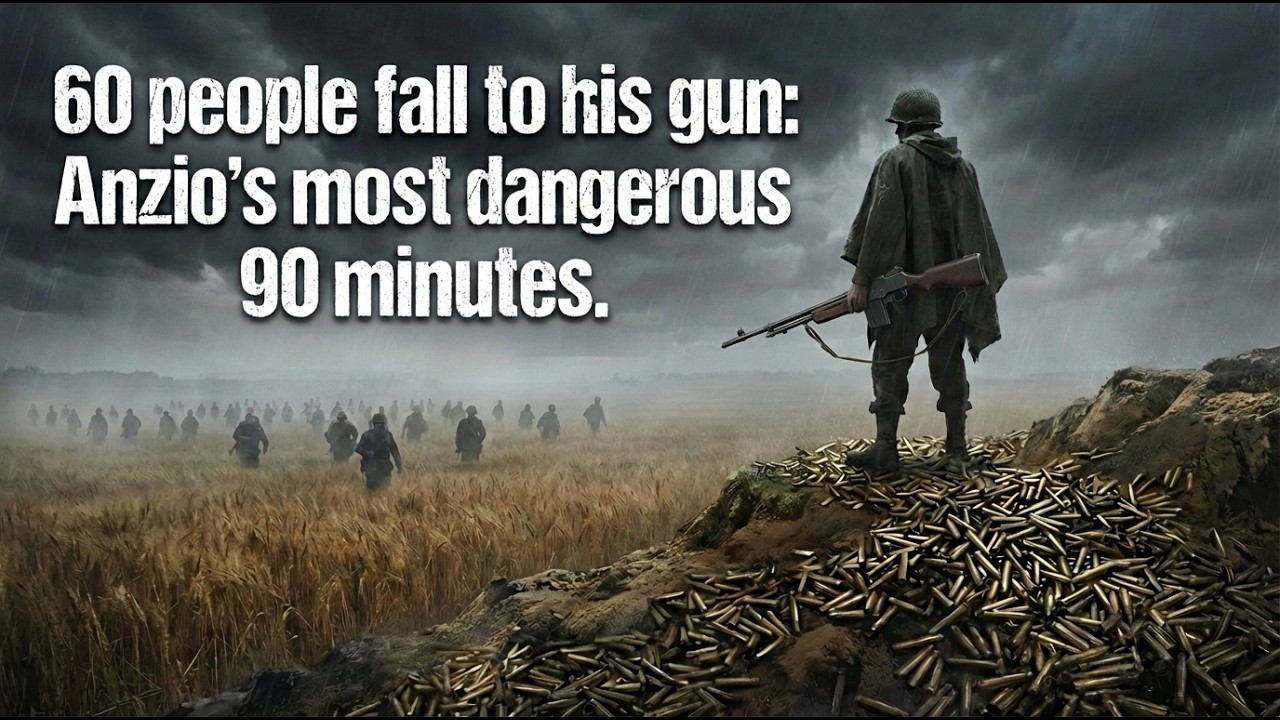
February 1, 1944 — Near Latina, Italy
The land was flat, exposed, and unforgiving.
Winter rain had turned the farmland south of Rome into a skin of mud stretched thin over death. There were no forests to hide in, no ruined cities to disappear into—only low hedgerows, shallow ditches, and a gray sky that pressed down on the men of the 30th Infantry Regiment like a lid.
They had been stuck there for days.
Pinned.
Every attempt to move forward ended the same way—metal tearing the air apart, dirt exploding, men diving for cover that barely existed. The sound never stopped. A mechanical, snarling roar that soldiers learned to recognize instantly.
MG42s.
“Hitler’s Buzzsaws.”
Fast. Relentless. Merciless.
Somewhere across the open ground, three German machine-gun positions controlled everything. Eighty yards. One hundred. One hundred and twenty. Perfectly placed to overlap their fire, turning the field into a killing zone no one could cross without being cut down.
Men whispered estimates under their breath.
Ten minutes. Maybe less.
That’s how long they thought anyone would last out there.
Private First Class Alton Warren Knappenberger lay in the mud with his cheek pressed against cold earth, listening to the guns chew the air above his helmet. He was twenty-three. A farm boy from rural Pennsylvania. Quiet. Unassuming. The kind of soldier officers rarely noticed unless paperwork was missing.
His hands were wrapped around an M1918A2 Browning Automatic Rifle—eleven kilograms of steel and wood that dug into his shoulder even before the fight began. The BAR was powerful, yes—but against an MG42, it was outmatched in every technical way. Slower rate of fire. Smaller magazine. Less suppression.
Everyone knew that.
Knappenberger knew it too.
What he knew—what no one else did—had nothing to do with manuals or doctrine.
It came from deer stands.
From cold mornings spent waiting, motionless, elevated just enough to see what others couldn’t. From learning that height, even a few feet, could change everything. From understanding patience, angles, and the moment when you stop reacting… and start choosing.
He lifted his head slightly and looked toward a bare rise in the field—a low, three-meter knoll that offered almost no cover at all.
Almost.
The machine guns raked the ground again, closer this time. Dirt sprayed. Someone screamed. An officer shouted for everyone to stay down.
Knappenberger exhaled.
Then, without waiting for orders, he began to…
…crawl.
Not forward—not yet—but sideways.
He moved inch by inch, keeping his profile low, timing each shift of his body to the staccato rhythm of the MG42s. He learned their pattern quickly. Even the most terrifying machines had habits. Short burst. Pause. Long burst. Pause. Reload. In those pauses—barely seconds long—Knappenberger slid another handspan through the mud.
A lieutenant noticed him moving and hissed, “Get back here!”
Knappenberger didn’t turn his head. If he did, he might stop.
When he reached the base of the knoll, his arms burned and his lungs felt packed with wet cloth. He waited. Listened. The guns were closer now, their sound sharper, angrier. He could hear German voices between bursts—commands, laughter, the confidence of men who believed the field belonged to them.
Knappenberger pushed upward.
The rise was pathetic by battlefield standards—no rocks, no trees, just a slight swell of earth that lifted him maybe three meters above the field. But it was enough. From here, the geometry changed. The hedgerows that concealed the German positions no longer overlapped perfectly. Angles opened. Lines of fire separated.
He planted the BAR’s bipod into the mud, wiped rain from the sights with his sleeve, and waited for the next burst to end.
When it did, he fired.
The BAR bucked hard, heavier than he remembered, its report a deep, authoritative thump that sounded different from the chatter of the MG42s. He aimed not at the gun, but at the silhouette behind it—shoulders, helmet, the shape of a man who had grown careless.
The first German slumped backward.
The response was immediate. The remaining MG42s swung toward the knoll, their fire tearing the ground inches in front of him. Knappenberger flattened himself, mud splashing into his mouth, then rose again as soon as the barrels shifted.
He fired again.
And again.
Not spraying. Choosing.
The second gun went silent for a moment, then erupted wildly, rounds flying high. Knappenberger waited for the telltale pause—the reload—and stood higher than he should have. He fired until the magazine ran dry, swapped it with practiced speed, and fired again.
The gun stopped.
Now all hell broke loose.
Mortar rounds began to fall, walking toward the knoll in heavy, concussive thuds. Shrapnel tore past him, slicing his sleeve, opening a burning line across his forearm. He barely noticed. Time had narrowed to a tunnel: sights, trigger, breath.
The third MG42 was smarter. It stayed low, firing in shorter bursts, trying to bait him. Knappenberger didn’t take it. He shifted position instead, crawling two meters to his left, changing the angle just enough to catch a glimpse of the emplacement’s flank.

A German soldier popped up to throw a grenade.
Knappenberger fired once.
The grenade fell harmlessly into the mud.
Minutes blurred into one another. Ten passed. Then twenty. Somewhere behind him, the regiment realized something was different. The roar that had pinned them for days was no longer continuous. It stuttered. Faltered. Went silent… then returned, weaker.
“Covering fire!” someone shouted.
American rifles began to crackle from the field. Mortars answered. The Germans, suddenly under pressure, tried to reposition—but the field that had been a killing zone now worked against them.
Knappenberger kept firing.
At the forty-minute mark, his shoulder went numb. At an hour, his hands shook from recoil and exhaustion. A round grazed his helmet, spinning him sideways into the mud. He rolled, gasping, then dragged himself back up, teeth clenched so hard his jaw ached.
They thought he’d last ten minutes.
At ninety minutes, the Germans tried a rush—three men sprinting low toward the knoll, desperate to silence the “invisible gun” that had stalled their line. Knappenberger rose to a knee and cut them down in a single, controlled burst.
At two hours, the third MG42 fell silent.
The field went quiet in a way that felt unreal.
Smoke drifted. Rain hissed against hot metal. Knappenberger sat back on his heels, suddenly aware of the pain everywhere at once. His vision tunneled. He tasted blood.
Then he heard boots.
American boots.
Hands grabbed his shoulders, pulled him down, voices overlapping—disbelief, awe, something like joy breaking through exhaustion.
“You crazy son of a—”
“Jesus Christ, you did it.”
“All guns down. All of them.”
Knappenberger tried to speak, to say something modest or deflecting, but his body chose that moment to give up. He collapsed, the BAR sliding from his grip.
When he woke, it was dark.
A field hospital tent glowed with lantern light. His arm was bandaged, his shoulder immobilized. An officer stood at the foot of the cot, helmet under his arm, eyes tired and respectful.
“You saved the regiment,” the officer said simply. “Two hours. That’s how long you held them.”
Knappenberger swallowed. “Someone had to.”
The officer nodded. “They said you wouldn’t last ten minutes.”
Knappenberger closed his eyes, thinking of deer stands, of waiting, of choosing the moment. “They were wrong.”
Weeks later, word spread. The regiment moved forward. The Germans pulled back. The field near Latina became just another muddy stretch of Italy—but the men who crossed it never forgot who made it possible.
Alton Warren Knappenberger would receive the Distinguished Service Cross. He would return home after the war to Pennsylvania, to quiet fields and early mornings. He would never brag. He would never tell the story the way others did.
But the men of the 30th Infantry knew.
When everything said impossible—
when ten minutes felt like a lifetime—
one man chose to stand, to wait, and to fight.
And for two hours, he held back a war.


