Thirty-four days before Elizabeth Holmes was sent to prison, she made a striking decision.
She invited a skeptical film crew into her home and allowed cameras to document her life at a moment when almost every public perception of her had already been shaped by the collapse of Theranos, a criminal fraud conviction and years of intense media coverage.
That choice now forms the center of You Can See Everything, a new documentary from Nathan Fielder and Lance Oppenheim.
According to PEOPLE, footage released in the film’s trailer shows Holmes speaking directly to Fielder at home before she began serving her prison sentence on May 30, 2023.
:max_bytes(150000):strip_icc():focal(749x0:751x2):format(webp)/Elizabeth-Holmes-2026-doc-tout-090726-a1285e7bbfb440938f7c2775728b6669.jpg)
The exchange is immediately uncomfortable because it revolves around the one subject that has followed Holmes for years: deception.
“I’m not that person, I can promise you that,” Holmes tells Fielder. “I don’t have anything to deceive you on, of course I’m not deceiving you.”
She then adds, “I’m engaging with you as a human being. Why would I deceive you? There’s no reason for me to do that.”
Fielder responds by asking whether she is being real in that moment.
Holmes answers:
“I’m always being real.”
The line carries unusual weight because of who is saying it.
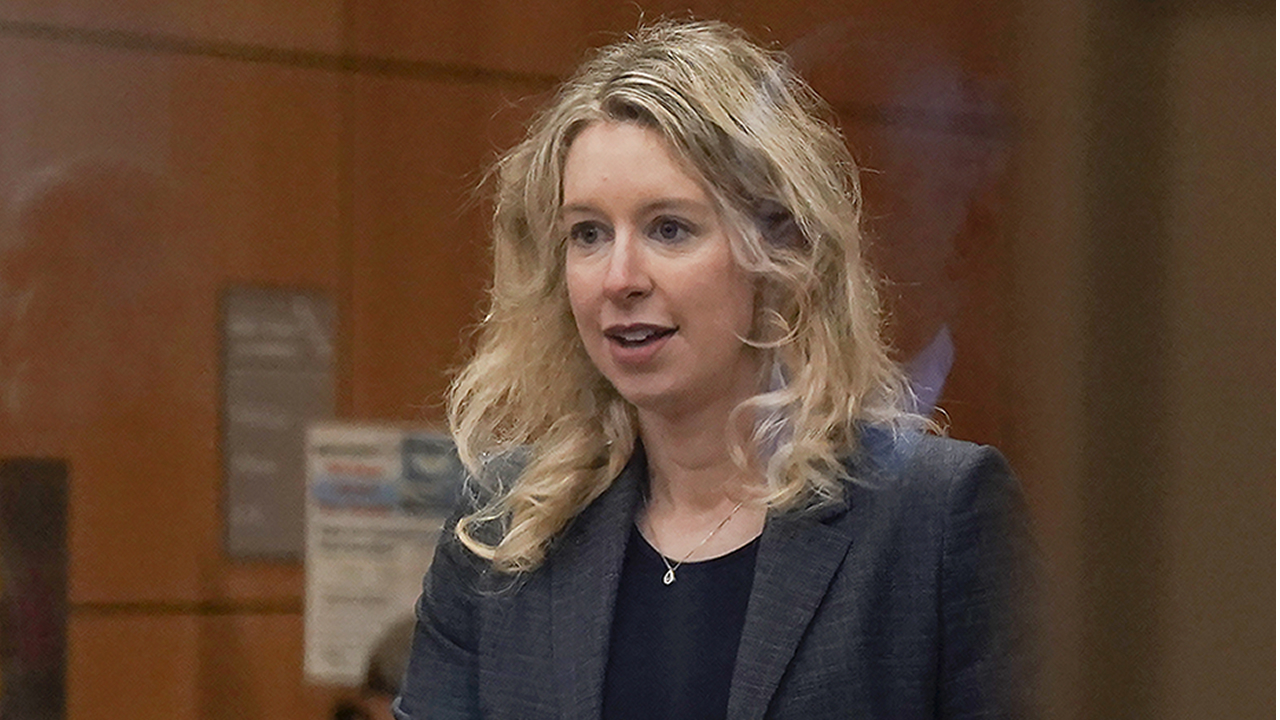
Holmes became famous as the founder of Theranos, the billion-dollar Silicon Valley startup that promised to transform health care with inexpensive diagnostic tests capable of screening patients for hundreds of diseases using only a few drops of blood.
The technology did not work as promised.
The company eventually collapsed, and Holmes was convicted of fraud and conspiracy. She was sentenced to 11.25 years in prison, with her sentence later reduced to about nine years for good behavior.
She is currently incarcerated at Federal Prison Camp Bryan in Texas and is expected to be released on Dec. 30, 2031.
That history makes the documentary’s premise unusually loaded.
Holmes is not simply giving another interview after her conviction. She invited filmmakers into her private life just weeks before losing her freedom.
The official synopsis says the project began when the “notorious Silicon Valley founder” allowed a skeptical film crew to document her every move 34 days before prison.
But what started as an intimate portrait reportedly became a much stranger three-year journey.
The filmmakers describe it as a “mind-bending three-year journey into the abyss.”
Even Fielder appears uncertain about what exactly happened during the process.
During a Q&A after the documentary’s world premiere at the Telluride Film Festival on Sept. 6, he told the audience:
“I don’t know why they wanted me there. Why am I there?”
He also said he was excited for viewers to watch the film and tell him what he had experienced.
That comment may be one of the most revealing clues about the documentary’s approach.
The film does not appear designed simply to argue that Holmes is innocent, guilty, misunderstood or manipulative. Instead, it seems interested in the difficulty of deciding what is authentic when the person at the center of the story knows she is being watched.
The trailer reinforces that tension visually.
After Holmes insists, “I’m always being real,” the camera pulls back and reveals her baby sitting in a bouncer nearby.
At the time, Holmes had recently given birth to her second child with partner Billy Evans.
The couple have two children: son William Holmes Evans, born in July 2021, and daughter Invicta, whose name means “invincible” in Latin.
That domestic image sharply contrasts with the public version of Holmes known through courtrooms, business scandals and the collapse of Theranos.
It also connects with comments Holmes later made about prison.
In a 2025 interview, her first since being found guilty, Holmes continued to maintain her innocence and said being separated from her children “shatters her world.”
She described prison life as surreal and said people who had never met her had formed strong beliefs about who she was.
“It’s surreal,” Holmes said. “People who have never met me believe so strongly about me. They don’t understand who I am.”
She said the experience had forced her to question belief and hope that truth would eventually prevail.
But she also described incarceration in stark terms:
“It’s been hell and torture to be here.”
Those remarks now take on added meaning when placed beside footage filmed shortly before her imprisonment.
The documentary may give viewers access to a version of Holmes that existed in the final weeks before prison: at home, with her child nearby, directly challenging the idea that she is deceiving the person filming her.
But access does not automatically create certainty.
That may be the central problem You Can See Everything is exploring.
Holmes has already been portrayed extensively in popular culture. Hulu’s 2022 miniseries The Dropout, starring Amanda Seyfried, dramatized her rise and fall. Holmes later said she found the series “difficult” to watch.
The new documentary is different because Holmes herself is present.
There is no actor standing between the audience and the subject.
Yet that may not make interpretation any easier.
If anything, the film’s title suggests the opposite.
The audience may be allowed to see almost everything — Holmes at home, Holmes speaking about deception, Holmes with her child, Holmes approaching the date when she will lose her freedom.
But seeing everything does not necessarily mean knowing what is true.
That is why the trailer’s most important moment may not be Holmes declaring, “I’m always being real.”
It may be Fielder’s confusion afterward.
Why was he invited?
Why did Holmes want cameras there?
And what happens when someone who has spent years being publicly defined by fraud is given the opportunity to show the world who she believes she really is?
The documentary’s answer may not be a simple one.
And perhaps that is exactly the point.