Tim Curry spent decades being remembered for characters larger than life, from Dr. Frank-N-Furter in The Rocky Horror Picture Show to unforgettable roles in Clue, Annie, It and Home Alone 2. But in the months before his death at 80, the actor offered something far more personal than another performance: a remarkably calm reflection on mortality.
According to Entertainment Weekly, Curry died on the night of August 25, 2026. His publisher, Jimmy Franco, confirmed the news and described the initial reports as “true and very sad.” The LAPD also confirmed that officers responded to a death investigation involving a man in his 80s at 11:20 p.m. that night, while TMZ reported that no foul play was suspected.
:max_bytes(150000):strip_icc():format(webp)/tim-curry-cbs-1-2e1702afbf5244998d8def677f6158a6.jpg)
What makes Curry’s death especially poignant is that less than a year earlier, he had openly discussed what he believed the end of life might feel like.
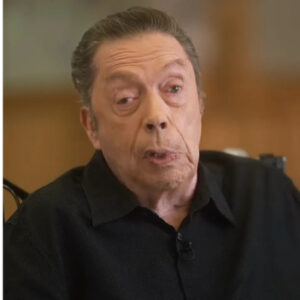
In an October 2025 interview with CBS Sunday Morning, Curry was asked directly about death. His answer was characteristically unsentimental.
“I don’t fear death,” he said. “I try to avoid it, as I think we all do. But, I suspect that in the end, I will welcome it.”
When pressed on what he meant, Curry laughed and explained that dying might actually feel “very comforting.”
“Well, I think it may be very comforting to go bye-bye — and I want to earn it,” he said.
He then added another striking line: “I want to earn the privilege of not being here.”
Curry was careful to make clear that this did not mean he was rushing toward death. He said he was not “galloping towards it.” But when asked whether death might bring a sense of relief, he gave perhaps the most memorable answer of the interview.
“I think I will embrace it.”
:max_bytes(150000):strip_icc():format(webp)/Tim-Curry-during-1994-Cable-Ace-Awards-in-Los-Angeles-082626-0ff62ae032c84bd3a994d1ba27020db4.jpg)
Those words now sound very different after his death, but they were not the product of a sudden preoccupation with mortality. Curry had been thinking and speaking about death for years, particularly after surviving a major stroke in 2012.
That stroke changed the course of his life.
Curry suffered it in July 2012 while receiving a massage. He later recalled that the person giving him the massage became concerned and suggested calling a doctor, even though Curry himself did not feel that anything was seriously wrong.
“It was so strange,” Curry said. “The guy who was giving me a massage said, ‘I’m worried about you. I think we should call a doctor.’ I felt fine. I had no symptoms that I was aware of. I wasn’t in pain.”
The reality was far more serious than he initially realized.
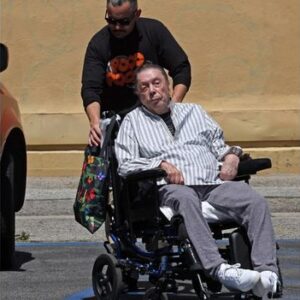
The stroke left Curry partially paralyzed and required brain surgery. Afterward, he had to relearn how to speak. The experience carried an additional emotional weight because Curry’s father had died from a stroke when Curry was only 10 years old.
He admitted that learning what was happening to him was frightening.
Yet one of the clearest themes of Curry’s later life was his refusal to define himself through pity.
“I don’t admire self-pity much,” he said.
:max_bytes(150000):strip_icc():format(webp)/tim-curry-3-082626-7439658efcfc4b13aca04d6105633715.jpg)
He connected that attitude to his mother, recalling a lesson from her that had stayed with him: “Why are you so important that we have to pity you?”
That philosophy seems to have shaped not only the way Curry approached disability and recovery, but also the way he approached death itself.
In his 2025 memoir, Vagabond, Curry wrote that he was not “frightened” of dying. He also said he did not believe that heaven, hell, or anything in between necessarily awaited him, although he joked that he would be curious to visit either.
His description of death was quiet rather than dramatic.
“If death comes for me peacefully and I fade gently from light into dark oblivion, why would I be afraid of it?” he wrote. “Sometimes, I rather think it would be a comfort.”
There is a clear consistency between those words and what Curry later told CBS Sunday Morning. He did not glorify death, nor did he deny the instinct to stay alive. He simply appeared to have reached a point where fear no longer dominated the conversation.
That perspective becomes especially powerful when viewed alongside what he had endured physically.
The 2012 stroke permanently altered his life, but it did not end his career. In later years, Curry shifted more heavily toward voice work. He narrated the 2016 tribute production The Rocky Horror Picture Show: Let’s Do the Time Warp Again, lent his voice to Over the Garden Wall in 2014, and also appeared vocally in the 2024 slasher film Stream.
For an actor so strongly associated with theatricality, Curry’s final public reflections were strikingly simple.
He had survived a medical crisis that forced him to relearn one of the most basic tools of his profession: speech. He had lived for years with the consequences of partial paralysis. He had seen stroke take his father when he was a child, then experienced one himself decades later.
And yet, in his later years, he spoke less about fear than about acceptance.
That may ultimately be one of the most revealing parts of Curry’s legacy.
His career will always be tied to extraordinary characters, cult films and an unmistakable voice. But the final chapter of his public life showed something quieter: a man who had already confronted the possibility of death once, survived it, and eventually decided that when the real ending came, he did not want to meet it with terror.
Months before his death, Curry said he believed he would “embrace it.”
Those words were once simply a reflection on mortality. Now, they read almost like a final statement about how he wanted to face the end.