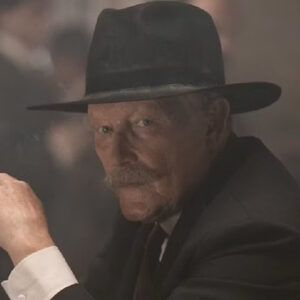
Brandon Sklenar has been unusually open about how playing Spencer Dutton in Taylor Sheridan’s 1923 completely changed the trajectory of his acting career. Before joining the Yellowstone universe, Sklenar had spent roughly a decade grinding through smaller opportunities and trying to establish himself in an industry that rarely hands out easy breaks. Then 1923 arrived, placing him alongside major stars such as Harrison Ford and Helen Mirren while giving him a character with enough emotional depth to finally showcase what he could do. Sklenar has repeatedly described the series as the project that changed his life, and that statement feels bigger than the usual Hollywood gratitude. His comments reveal what happens when an actor finally receives a role that matches years of preparation with the right opportunity at exactly the right moment. In Sklenar’s case, Spencer Dutton was not simply another credit on his résumé but the character that moved him from quietly working actor to recognizable leading man.
One reason Spencer became such an important turning point was the complexity Sheridan built into him. Spencer is introduced as someone physically and psychologically shaped by World War I, carrying trauma while trying to find purpose far away from Montana. Instead of making him a traditional heroic cowboy, Sheridan presents a man who survives through instinct, violence, discipline, and emotional restraint. Sklenar has explained that when he first joined 1923, he did not completely understand who Spencer was, how he should sound, or even what emotional tone the show would ultimately have. That uncertainty is significant because it shows that the character was not something he could simply switch on after reading a few pages. He had to discover Spencer gradually, while the production itself was also defining its identity as a new chapter in the Yellowstone universe. The result was a performance that made Spencer feel less like a polished television protagonist and more like a damaged human being trying to figure out how to keep moving.
The pressure became even more complicated because 1923 placed Sklenar opposite actors with enormous reputations. Harrison Ford and Helen Mirren brought decades of experience and instant recognition, meaning Sklenar had to hold his own inside a cast where almost every scene carried serious dramatic weight. Yet instead of describing that situation as intimidating competition, Sklenar has spoken about it as an opportunity to learn and grow. His gratitude toward Ford is especially revealing because their scenes required Spencer to exist within the Dutton family structure while still maintaining his own emotional identity. Ford’s Jacob Dutton represents authority, experience, and responsibility, whereas Spencer represents a younger generation shaped by a completely different kind of violence. Their relationship works because Sheridan allows the generational contrast to remain visible without turning either character into a simple stereotype. Sklenar therefore had to perform alongside a legend while simultaneously building a character who could eventually stand on his own.
The two-season structure also gave Sklenar something unusual: time to change alongside his character. Nearly two years separated the filming periods, allowing him to work on other projects and experience major personal growth before returning as Spencer. Sklenar acknowledged that being in his early thirties during that gap mattered because those years represented a significant period of development in his own life. He effectively returned to the series as a different person, which meant Spencer could also feel different without becoming inconsistent. That distinction is important because actors sometimes have to preserve a character exactly as audiences remember them, even when years have passed. Sheridan’s story instead gave Sklenar space to bring new maturity, understanding, and emotional experience into Spencer’s second chapter. The time gap became an advantage, turning the actor’s real-life evolution into another layer of the character’s development.
Sklenar has also been remarkably direct about how much he owes 1923 for the opportunities that followed. He has said that he was grinding for twelve or thirteen years before the show finally broke things open for him, which puts his success into perspective. After 1923, he landed major roles in It Ends with Us, Drop, and The Housemaid, while continuing his collaboration with Sheridan on F.A.S.T. The timing felt almost surreal to him, especially after years when progress probably seemed painfully slow. He described the sudden wave of opportunities as a kind of “universal wink,” suggesting that success arrived after an extremely long period of uncertainty. That perspective makes his career story more relatable because the breakthrough was not the result of overnight fame but the payoff after years of rejection, small roles, and persistence.
His relationship with Taylor Sheridan is another major part of the story because Sklenar has never been shy about expressing gratitude toward the creator. He has said that Sheridan’s decision to trust him with Spencer Dutton fundamentally altered his career and that he would remain grateful for the opportunity. For an actor who had spent years trying to prove himself, being handed a major character by a creator with an expanding television empire was a huge vote of confidence. Sheridan apparently knew what he wanted from Spencer, including the character’s full emotional trajectory, even before Sklenar had fully stepped into the role. Sklenar has recalled that Sheridan essentially told him how Spencer’s story would unfold from the beginning. Knowing the destination gave Sklenar an unusual advantage because he could make choices with the character’s entire journey in mind rather than reacting only to individual episodes.
That long-term knowledge became particularly important when Sklenar talked about the second season and its ending. He described the finale as one of the best things he had ever read, which is an extraordinary compliment considering his years working across film and television. He also revealed that the second season became much larger than originally planned, expanding from an initial eight episodes to fifteen. That change helps explain why he was eager for production to finally finish, especially after spending so much time inside the world of 1923. At the same time, the expansion apparently gave Sheridan more room to develop Spencer’s story and push the characters into darker territory. Sklenar teased that the tone shifted significantly, becoming darker while remaining visually beautiful. His enthusiasm suggested that the additional episodes were not simply filler but an opportunity to deepen the emotional consequences of everything established earlier.
Interestingly, Sklenar has also admitted that he wants to move beyond acting eventually and potentially direct. He has talked about using the next few years to learn from the directors and actors around him before taking that step. That ambition fits his broader approach to his career because he seems less interested in simply collecting famous roles than in understanding how productions actually work. He has also expressed a long-standing desire to make a proper western, which feels almost inevitable after his experience with Sheridan and the Yellowstone universe. Yet his definition of that dream is important because 1923 is not exactly a traditional western; it blends historical drama, family tragedy, romance, survival, and violence. A straight western would allow Sklenar to explore the genre more directly while using everything he learned from playing Spencer. In that sense, 1923 may have given him not only fame but also a clearer idea of what kind of storyteller he wants to become.
There is another layer to Sklenar’s story because his rise after 1923 coincided with intense public attention surrounding It Ends with Us. His texts with Blake Lively became part of the legal dispute involving Justin Baldoni, putting Sklenar under a microscope outside the normal promotion cycle for an actor. The situation demonstrated how quickly an actor’s professional success can become tangled with controversies surrounding a completely different project. Yet his comments about wanting to promote It Ends with Us while still filming 1923 also reveal how complicated his schedule had become. He recognized that the film could create major momentum for his career and wanted the opportunity to capitalize on it. At the same time, the demanding production schedule of 1923 limited how much freedom he had to pursue that momentum. His frustration therefore reflects a very real problem in Hollywood: breakthrough opportunities can arrive simultaneously, but an actor cannot physically be everywhere at once.
Ultimately, Brandon Sklenar’s reflections on Spencer Dutton are really about what happens when persistence finally meets opportunity. He spent years working toward a breakthrough, then 1923 gave him a character powerful enough to change how the industry viewed him. Taylor Sheridan trusted him, Harrison Ford and Helen Mirren gave him elite acting partners, and the long production gap allowed him to grow into Spencer rather than simply repeat himself. The role subsequently opened doors to projects such as It Ends with Us, Drop, The Housemaid, and F.A.S.T., transforming what once looked like a slow career into a rapid rise. Yet Sklenar’s comments remain surprisingly grounded because he still talks about learning, directing, making a western, and improving rather than acting as though he has already reached the finish line. His journey suggests that Spencer Dutton was not the destination but the launchpad, giving Brandon Sklenar the visibility, confidence, and creative momentum to finally build the career he had been chasing for more than a decade.