In the acclaimed biblical drama series *The Chosen*, one of the most compelling scenes captures a pivotal moment in the ministry of Jesus. It illustrates the radical nature of his invitation to follow him, extending grace to those society deems unworthy. The sequence centers on Matthew, son of Alphaeus, a tax collector viewed with deep suspicion and outright hostility by his fellow Jews. Through careful dialogue and emotional depth, the scene explores themes of redemption, unexpected grace, and the demand to embrace a radically different way of life.

The scene opens with Jesus addressing Matthew directly: “Matthew, son of Alphaeus.” Matthew responds affirmatively, and Jesus issues the simple yet profound command, “Follow me.” This call disrupts the ordinary flow of life. Onlookers react with shock and disbelief. A figure challenges Jesus, asking, “What are you doing?” while others attempt to intervene, urging Matthew to reconsider. They remind him of his privileged position: he enjoys financial security, protection from Roman authorities like Quintus, and a standard of living far superior to that of most Jews under occupation. “You have money. Quintus protects you. No Jew lives as good as you,” one protests. “You’re gonna throw it all away?”

Matthew’s decision appears incomprehensible to those around him. His past as a tax collector — someone who collaborates with the occupying Roman Empire and often enriches himself at the expense of his own people — brands him as a traitor. The crowd’s outrage reflects longstanding cultural and religious boundaries. Tax collectors were not only economically exploitative but ritually unclean in the eyes of many, excluded from full participation in communal and spiritual life. Their astonishment peaks as they physically try to restrain Matthew, demanding, “Where do you think you’re going?” and accusing Jesus of having “lost your mind.”
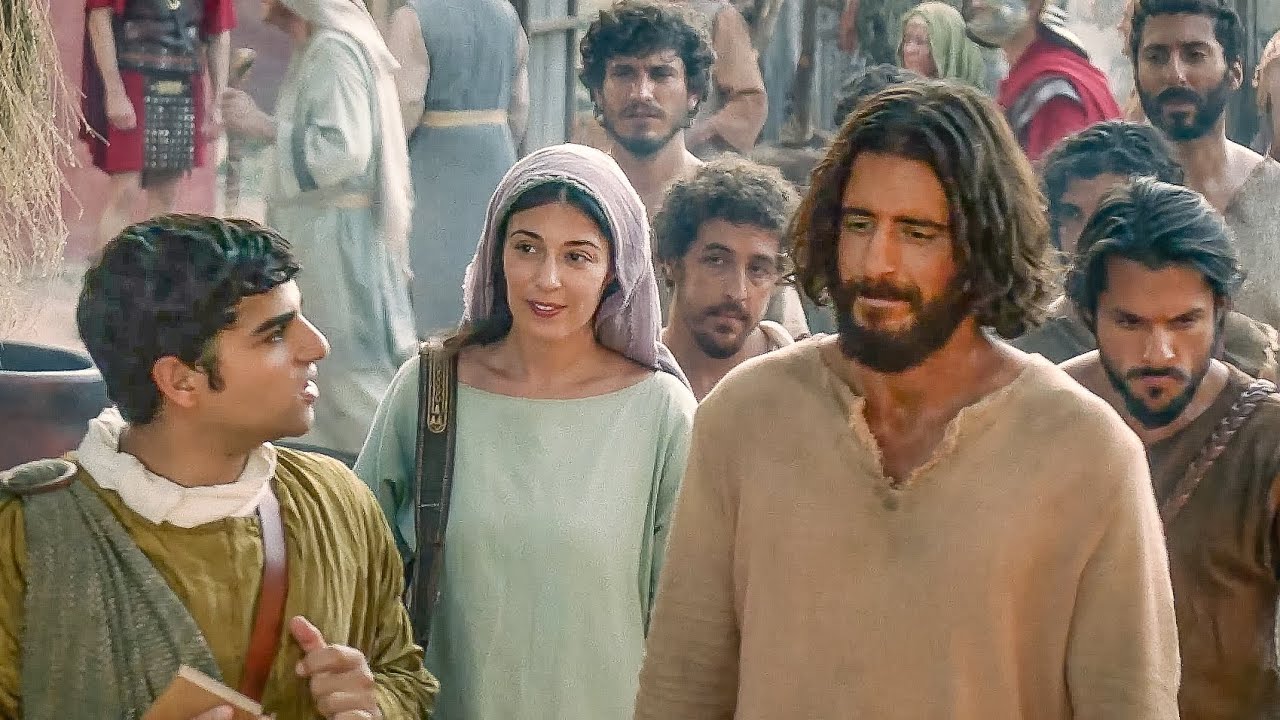
Yet Jesus remains resolute. When a follower questions the choice, expressing confusion with “I don’t get it,” Jesus replies calmly, “You didn’t get it when I chose you either.” This line subtly reminds viewers that the circle of disciples itself consists of improbable candidates — fishermen, zealots, and ordinary men with their own flaws and doubts. The distinction drawn by the objector — “But this is different. I’m not a tax collector” — highlights human tendencies to rank sins or social statuses, assuming some barriers are too great even for divine mercy. Jesus’s response cuts through these objections with quiet authority: “Get used to different.”
This phrase encapsulates a central theological and narrative principle of the series. Jesus’s kingdom operates according to values that invert worldly expectations. He prioritizes the heart’s openness over social standing, past failures, or outward respectability. The call to Matthew is not an endorsement of his former life but an invitation to radical transformation. It echoes broader biblical motifs, such as the calling of Levi in the Gospels, where Jesus shares meals with tax collectors and sinners, declaring that he came not for the righteous but for those who need repentance.

The emotional weight of the scene lies in its portrayal of internal conflict and external pressure. Matthew must abandon security, reputation, and community approval. His choice represents a profound leap of faith, trusting in a teacher who sees potential where others see only corruption. For the audience, this moment serves as a powerful reflection on the nature of divine calling. It challenges viewers to consider their own preconceptions about who is “eligible” for grace. In a world that categorizes people by achievements, mistakes, or social roles, the scene asserts that no one lies beyond the reach of compassionate invitation.
The broader context within *The Chosen* enriches this encounter. The series humanizes biblical figures, depicting their doubts, interpersonal conflicts, and gradual spiritual growth. Matthew’s arc, in particular, evolves from isolation and resentment to devoted discipleship. His analytical mind and attention to detail later contribute uniquely to the group, demonstrating how God redeems and repurposes individual traits for higher purposes. The scene also underscores Jesus’s empathy and strategic wisdom. By including someone like Matthew, he bridges divides and models reconciliation, preparing his followers for a mission that transcends ethnic, economic, and moral boundaries.
Theologically, the moment resonates with core Christian teachings on justification by faith and the universality of salvation. It recalls the Apostle Paul’s assertion that in Christ there is neither Jew nor Gentile, slave nor free. Grace levels the playing field, extending to the marginalized and the despised. For contemporary audiences, the narrative invites introspection: What “respectable” structures or identities might we cling to that prevent us from fully responding to a call toward change? Are there people we have written off as irredeemable whose stories could mirror Matthew’s?
Moreover, the scene highlights the cost of discipleship. Following Jesus often requires relinquishing comfort and facing opposition. Matthew’s willingness to “throw it all away” foreshadows the sacrifices demanded of all who embark on this path. Yet the series balances this demand with the promise of profound belonging and purpose. The diverse group of disciples, initially skeptical of one another, gradually forms a new community defined by shared loyalty to their teacher rather than former affiliations.
In cinematic terms, the direction employs restrained performances and meaningful pauses to convey the gravity of the decision. The reactions of bystanders amplify the drama, making Jesus’s calm authority stand out in sharp relief. This artistic choice reinforces the theme that true power manifests not in coercion or status but in transformative love that sees beyond surface appearances.
Ultimately, this encounter in *The Chosen* serves as an enduring parable of hope. It reassures that personal history, no matter how compromised, does not disqualify one from divine purpose. Jesus’s invitation remains open, extending to anyone willing to step away from the familiar and embrace the unfamiliar ways of the kingdom. “Get used to different” becomes not merely a retort but a guiding philosophy for life under grace — one that prioritizes mercy, inclusion, and inner renewal over conformity to societal norms.
The scene’s resonance extends far beyond its historical setting. In an era marked by polarization and judgment, it offers a countercultural vision: a call to examine our own hearts, extend grace more freely, and remain open to the surprising movements of the divine. Through Matthew’s story, audiences are reminded that the path of faith is rarely predictable, but it is always marked by the possibility of profound personal and communal transformation.