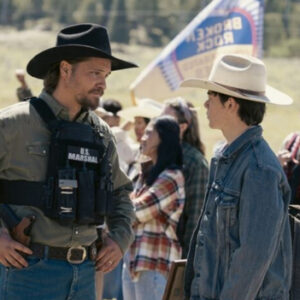
Costner’s departure was officially confirmed in 2024, when the actor announced that he would not return for the second half of Yellowstone Season 5. At that point, however, the relationship between the star and the production had already become a major source of speculation. Scheduling problems, negotiations over the show’s fifth season, Costner’s commitment to his Horizon: An American Saga film project and reports of disagreements over production plans all became part of the conversation.
Costner himself later described the situation as the result of a “long, hard-fought negotiation” surrounding the decision to divide Season 5 into two parts. He also pushed back against the idea that Horizon alone was responsible for his departure, arguing that repeated changes and delays involving Yellowstone contributed to the scheduling conflict.
That distinction matters because the popular narrative often reduced the entire dispute to one simple explanation: Kevin Costner chose Horizon over Yellowstone.
The reality appears considerably more complicated.
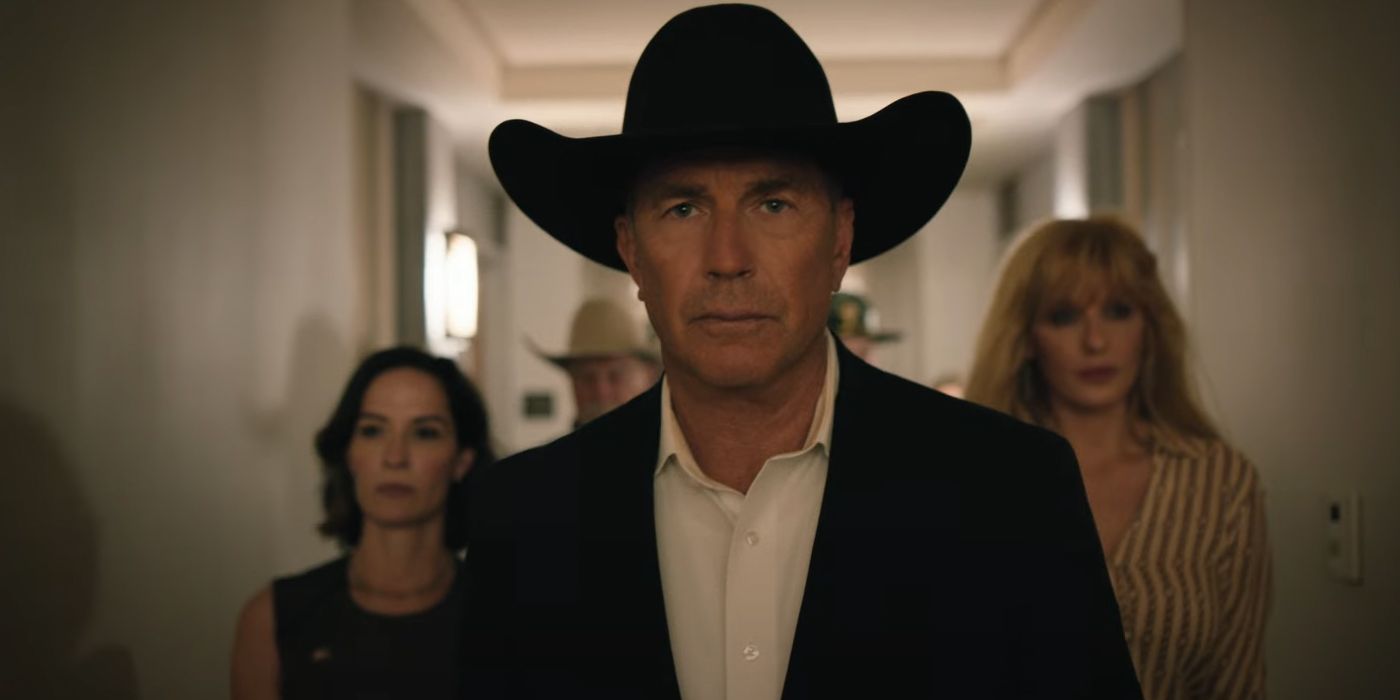
Sheridan has now offered his own version of events, and his account fundamentally changes how Costner’s exit can be interpreted. According to Sheridan, Costner was originally contracted to appear in only the first three seasons of Yellowstone. In Sheridan’s original vision, John Dutton’s story was supposed to transition much earlier, with the younger generation taking over the center of the story.
That means John Dutton was never necessarily intended to remain the permanent centerpiece of the franchise.
The extraordinary popularity of Costner’s performance changed those plans.
As Yellowstone became a phenomenon, the network wanted to keep John Dutton at the heart of the series. Sheridan has explained that the original arrangement evolved because the success of the character made it difficult to move away from him. What began as a story that could transition after three seasons instead became a five-season saga built around Costner’s patriarch.
In that sense, Costner’s departure can be viewed not simply as a production crisis, but as the eventual return to an idea Sheridan had contemplated from the beginning.
John Dutton was always going to have an ending.
The question was when.
And why the ending happened became the controversial part.
Sheridan recently said that Costner was essentially “ready to go,” recalling a conversation in which the actor indicated that he wanted to pursue his own work. Sheridan’s comments suggest that he did not view Costner’s decision primarily as a personal betrayal or an attempt to sabotage Yellowstone. Instead, he described it as a moment when the actor was ready to move on.
That interpretation directly challenges some of the more dramatic speculation surrounding their relationship.
For years, reports suggested that Costner and Sheridan had clashed over the production schedule and the amount of time Costner was willing to devote to the series. Costner’s commitment to Horizon became particularly important because he was simultaneously directing, starring in and financing his ambitious Western film project.
From Costner’s perspective, Horizon was not simply another acting job.
It was a personal creative project.

He had invested years into it and wanted to complete the story he had envisioned.
The conflict therefore became partly a question of priorities.
For Sheridan, Yellowstone was an ongoing television production with a large cast and crew depending on a predictable schedule.
For Costner, Horizon represented a long-term filmmaking ambition that required his direct involvement.
Neither objective was inherently unreasonable.
But the two schedules became increasingly difficult to reconcile.
That tension eventually became impossible to ignore.
And once Costner’s departure became inevitable, Sheridan had to solve a major storytelling problem: how do you end the story of John Dutton without Kevin Costner appearing onscreen?
The answer was brutal.
John Dutton was killed off.
His death occurred offscreen, with the character’s body later discovered after he was assassinated. The decision allowed the series to move forward without Costner while maintaining the emotional consequences of his absence.
But it also created one of the strangest endings in modern television.
The man who had been the face of Yellowstone for years was suddenly gone.
The story continued without its central patriarch.
Beth, Jamie, Kayce and Rip were left to deal with the consequences.
And the Dutton family became more important than John Dutton himself.
Ironically, this was close to Sheridan’s original structural idea.
If John had only been intended to dominate the first three seasons, the younger Dutton generation would eventually have inherited the story anyway.
The difference was that the transition happened much later and under circumstances that were far more contentious.
That may explain why the second half of Season 5 felt fundamentally different.
The show was no longer about protecting John Dutton’s ranch at any cost.
It became a story about what remained after John.
Beth had to determine what she wanted to do with her father’s legacy.
Kayce had to decide whether the ranch was actually the future he wanted.
Jamie was pushed toward the final confrontation that ultimately destroyed him.
And Rip was left to protect the people he loved while the world he had served for years collapsed around him.
The result was a finale that essentially transformed Yellowstone from the story of one powerful rancher into the story of what happens when his family finally stops fighting to preserve his exact vision.
That transition would have happened eventually.
Costner’s exit simply accelerated it.
Yet the controversy surrounding his departure continued long after the show ended.
Sheridan has now spoken publicly about the situation, but the two sides have not always described the circumstances in exactly the same way.
That is important.
There is no reason to treat either person’s account as the single unquestionable version of events.
Costner has publicly explained his concerns about scheduling, the production’s changing plans and his commitment to Horizon. Sheridan has emphasized that Costner was ready to leave and that the actor had originally been contracted for fewer seasons than he ultimately completed.
The available evidence therefore points toward a collision of circumstances rather than one simple villain.
The show’s enormous success changed the expectations surrounding Costner’s role.
Costner’s expanding commitment to Horizon changed his availability.
Production delays complicated scheduling.
Negotiations became increasingly difficult.
And eventually, the two sides reached a point where continuing together no longer appeared practical.
But there is another fascinating question: Would Yellowstone have ended differently if Costner had stayed?
Almost certainly.
John Dutton’s survival would have fundamentally changed the final power structure.
Beth and Rip’s future would have remained tied more closely to John.
Kayce’s relationship with the ranch would have developed differently.
And Jamie’s final confrontation with Beth would have carried a different emotional weight if their father were still alive.
More importantly, the franchise might not have needed to end when it did.
Costner’s John Dutton was the gravitational center of the original series. Removing him did not simply eliminate a character; it changed the show’s entire narrative architecture.
That may be why Sheridan’s recent comments are so interesting.
If John was always destined to leave the story after a certain point, then perhaps Costner’s departure did not destroy Sheridan’s original vision.
It disrupted the timing.
The difference is enormous.
Sheridan was forced to execute a transition earlier and under far more difficult circumstances than he initially intended.
But the eventual destination may not have been completely different.
The younger Duttons were always going to inherit the consequences of their father’s decisions.
John’s death simply made that inheritance unavoidable.
There is also an important irony in the fact that Yellowstone itself became much larger than anyone originally expected.
The series eventually generated prequels and spinoffs, including 1883, 1923 and the newer Dutton Ranch, while Sheridan continued expanding his television universe. The franchise became an enormous cultural phenomenon rather than the relatively contained ranch drama it may have been at the beginning.
That success changed everyone’s expectations.
Paramount wanted more Yellowstone.
Audiences wanted more John Dutton.
Sheridan wanted to continue developing his larger universe.
Costner wanted to pursue Horizon.
Eventually, those ambitions could not all coexist comfortably.
And that may be the real story behind the breakup.
It was not necessarily that one man destroyed the relationship.
It was that Yellowstone became too successful, too complicated and too valuable for everyone involved to continue operating under the assumptions that existed when the series began.
Costner had become inseparable from John Dutton.
But Sheridan had also built a universe that could survive beyond him.
That became the ultimate test.
Could Yellowstone survive without Kevin Costner?
The answer, at least commercially, appears to be yes.
The franchise continued.
The finale aired.
New Dutton stories emerged.
Rip and Beth received their own continuation.
And Sheridan’s television empire continued expanding far beyond the original series.
But survival is not the same as replacement.
No new character can completely recreate what John Dutton represented.
Costner brought a particular combination of authority, vulnerability and old-school Western gravitas that defined the show’s identity.
That is why his departure remains one of the most debated moments in the franchise.
It was not merely the loss of an actor.
It was the loss of the character around whom the entire modern Dutton mythology had been constructed.
And perhaps that is why Sheridan’s recent explanation feels so significant.
He is effectively arguing that John Dutton’s story had an expiration date all along.
Costner’s decision to leave simply forced everyone to confront that reality sooner.
The final irony is that both men may have gotten something they wanted.
Costner was able to turn his attention toward Horizon and his own filmmaking ambitions.
Sheridan was ultimately able to complete the Dutton story without keeping John at its center.
Neither outcome came without conflict.
But Yellowstone survived.
And the franchise’s future suggests that Sheridan’s greatest achievement may not have been creating a story that depended on Kevin Costner.
It may have been creating one that could eventually survive without him.
Kevin Costner did not simply walk away from Yellowstone because of one scheduling disagreement or one movie. The evidence points to a much more complicated collision between an evolving television production, a massive personal filmmaking ambition and a story that Taylor Sheridan had originally designed to move beyond John Dutton. Costner’s exit changed the ending, accelerated the generational transition and permanently altered the franchise—but it did not destroy Sheridan’s vision. If anything, it proved that Yellowstone had become bigger than the man who originally held its center.