Zendaya has built a reputation for turning every premiere, press event, and red carpet into a spectacle. She does not just show up. She arrives with a statement, often dressed as if she has stepped directly out of the world she is there to promote. But at CinemaCon in Las Vegas on Tuesday, that approach triggered one of the fiercest reactions fans have had to one of her looks in recent memory.
The 29-year-old actress, who plays Chani in Denis Villeneuve’s sweeping sci-fi saga, walked the carpet in an unusual Schiaparelli ensemble that immediately set social media on fire. The outfit, pulled from the fashion house’s fall/winter 2026 collection, featured a flesh-toned blazer with oversized lapels, sharply sculpted hips, and a matching pencil skirt. Schiaparelli labeled the design “Look 9” and described it as a “single-breasted tailored jacket in nude corset toile covered with a play of multiple layers of jersey and wadding to create a depth-effect and featuring molded hips. Matching pencil skirt.”

It was not subtle. It was not safe. And it was never going to pass through the internet quietly.
The moment photos began circulating, fans flooded social media with reactions ranging from admiration to disbelief. For some, the textured, body-contouring suit felt perfectly in sync with the desert aesthetic of Dune. For others, it looked like one of the rare occasions when Zendaya’s fashion instincts had gone too far.
The jokes came quickly and mercilessly.
“I see she chose paper over plastic,” one fan wrote on X, while another noted, “Zendaya in a dress made of sand.”
Another fan commented, “It’s giving silent hill nurse glam.”
Not everyone was impressed by the experiment. One X user wrote, “Zendaya always looks sickening but I fear this might be her worst look,” while another was even harsher, calling it “A rare fail. Looks like something Ed Gein would wear.”
The internet, as usual, kept escalating the absurdity. “Can I get the Zendaya burrito extra spice,” one fan wrote, while another joked, “LMAO she looks like she’s wearing a saltine cracker.”

That is the strange territory Zendaya occupies now. She is not judged like an ordinary celebrity wearing an unusual outfit. Every appearance becomes a kind of cultural test. The bar is impossibly high because she has spent years making the impossible seem effortless. When she wins, the internet crowns her instantly. When a look confuses people, the backlash is louder because it comes wrapped in surprise.
Yet even amid the mockery, there was a strong current of praise. Many fans argued that the outfit did exactly what a major press-tour look is supposed to do: connect fashion to the story being sold. Zendaya has repeatedly leaned into that strategy, using clothing as an extension of the films she promotes rather than treating premieres like generic style opportunities. For supporters, this Schiaparelli moment was not a miss at all. It was commitment.
“Love her commitment to having an outfit inspired by the film she’s promoting,” one fan wrote.
Another took the simpler route: “She never misses.”
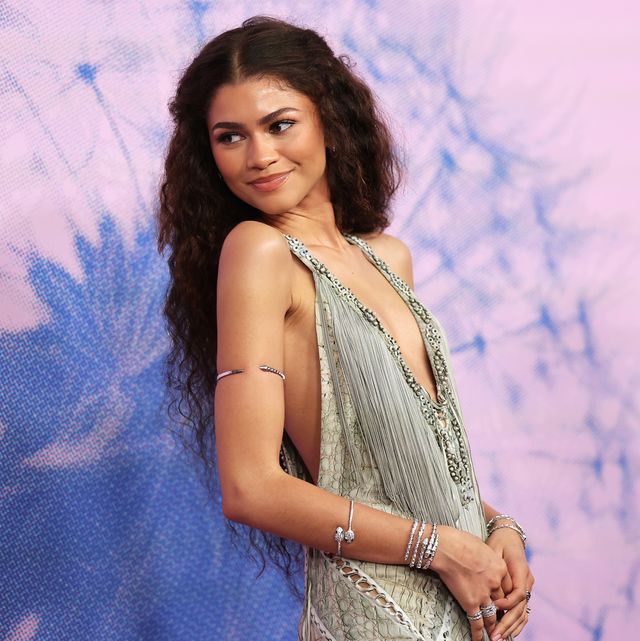
That divide says almost as much about Zendaya’s public image as it does about the outfit itself. She has become one of the very few modern stars whose fashion choices are treated like events in their own right. People do not merely observe what she wears. They decode it, compare it, meme it, defend it, and tear it apart within minutes. Her appearance at CinemaCon was not just another stop on a promotional schedule. It became its own headline.
The timing only intensified the attention. Zendaya was not attending a minor industry event or quietly posing for photographers. She was there alongside major Dune names, including Timothée Chalamet, Jason Momoa, and director Denis Villeneuve, at the Dolby Colosseum at Caesars Palace for the Warner Bros. presentation. The event carried real weight, especially with the team unveiling the first seven minutes of “Part 3.”

That meant Zendaya’s outfit was always going to be viewed through the lens of spectacle. With a franchise as visually monumental as Dune, a conventional red carpet look might have felt forgettable. Instead, she delivered something that seemed almost molded from the same barren, alien world that defines the films. Flesh-toned, sculptural, and oddly severe, the Schiaparelli design blurred the line between couture and costume. That was precisely why some viewers loved it and others recoiled.
There is also something revealing in the way fans reacted. Even the sharpest jokes carried an undertone of fascination. Nobody ignored the look. Nobody scrolled past it without an opinion. In an era when celebrity fashion can disappear into an endless content stream within hours, Zendaya managed to force people to stop and stare, whether in admiration or horror.
That may be the real victory.
Fashion this bold is never designed to please everyone. It is designed to provoke, unsettle, and leave a mark. Zendaya’s Schiaparelli suit did all three. It may not go down as one of her most universally beloved appearances, but it did exactly what memorable red carpet fashion is meant to do: it created a moment people could not stop talking about.
And in the unforgiving arena of celebrity image-making, that kind of chaos is not failure. It is power.