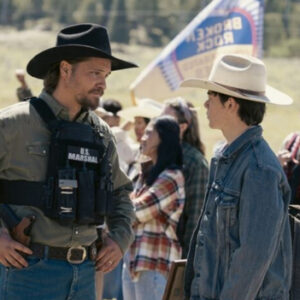
Some crossover ideas feel like fan service for its own sake. Putting Jennifer Landon’s Teeter in the world of Taylor Sheridan’s Landman feels different. It is not about dragging the Yellowstone bunkhouse to Texas wholesale. It is about dropping one of Sheridan’s most fearless, funny, and unfiltered creations into a setting where those traits would not soften—they would sharpen.
Imagine Teeter trading the Montana ranch for the brutal economy of West Texas oil: the noise, the money, the accidents waiting to happen, the family loyalty that doubles as a liability. Around Billy Bob Thornton’s Tommy Norris and the fractured Norris orbit, her refusal to back down would not be a quirky side note. It would be survival equipment.
Teeter was never only comic relief
From her arrival in Yellowstone Season 3, Teeter announced herself as more than a punch line. The accent, the hair, the barrage of one-liners—those made her memorable on contact. What kept her in the conversation was everything underneath: loyalty to the bunkhouse, a willingness to work as hard as anyone on the crew, honesty that did not pause for politics, and toughness that did not need a speech to prove itself.
Sheridan’s best supporting players often live in that space. They are entertaining first, then slowly reveal they are load-bearing. Teeter became one of the bunkhouse’s defining presences precisely because she was not written as a mascot. She was written as a hand who happened to be impossible to ignore.

That is the version of the character a Landman crossover needs—not a cameo that quotes old bits, but a person whose instincts still work when the job site changes.
Landman’s world is built for her kind of energy
Landman runs on pressure: leases, blowouts, lawyers, roughnecks, overnight fortunes, and overnight funerals. Tommy Norris moves through that chaos as a man who has seen too much and still has to make the next call. The Norris family drama—love, resentment, dependency, ambition—gives the oil spectacle a human cost.
Teeter’s fearlessness and sharp humor would cut through that atmosphere without needing to become another executive in a conference room. Put her on a crew, in a yard, in a bar after a sixteen-hour day, or in Tommy’s path when someone is lying and she is the only one willing to say it out loud. The collision would be entertaining because the tones match in an unexpected way: Yellowstone’s bunkhouse grit meeting Landman’s industrial fatalism.
Danger, money, family, survival—Sheridan returns to those themes across his shows. Teeter already lived three of them on the ranch. Oilfield Texas would simply raise the temperature.
A Yellowstone connection that does not repeat the ranch
Crossovers fail when they import plot instead of character. Fans do not need Teeter to recreate bunkhouse dynamics with different hats. They need her in a new ecosystem where her loyalty, temper, and humor have different consequences.
On the Yellowstone, the hierarchy was Dutton-centered. In Landman, power is messier: corporate, criminal-adjacent, familial, and financial all at once. Teeter would not be protecting a brand of cattle. She would be navigating people who sell risk for a living. That shift gives Jennifer Landon new notes to play—same spine, different stakes—while giving Sheridan a living thread between universes without turning Landman into Yellowstone South.
It also rewards longtime viewers without locking out new ones. You can enjoy Teeter in West Texas without a full recap of Montana land wars. The performance carries the reference.

Why Tommy Norris and Teeter would be fun in the same frame
Billy Bob Thornton’s Tommy is dry, battered, and fluent in bad news. Teeter is blunt, loud when she needs to be, and allergic to pretension. Their scenes would not require romance or a forced mentor arc to work. Professional friction would be enough: she says what everyone is thinking; he has to decide whether that honesty helps him or sets another fire.
Sheridan has always liked pairings where one character absorbs chaos and the other generates it. Teeter in Tommy’s periphery—hired on, stuck under his protection, or entangled with the wider Norris family mess—writes itself in outline form. The fun is in the execution: her language against his silences, her loyalty tested by oil money the way it was once tested by ranch politics.
What a smart Season 3 role could look like
Without spoiling or inventing official plans that have not been announced, a satisfying arc would likely:
- Put Teeter inside the labor reality of the fields, not only in cameo-adjacent dinner scenes
- Let her earn trust the hard way, consistent with how she earned it in the bunkhouse
- Use her humor as pressure relief and truth serum, not only as comic breaks
- Tie her to the Norris world through work and consequence, not nostalgia alone
Done that way, “Teeter in the Texas oilfields” stops being a slogan and becomes a story engine.
Why fans respond to the idea
Yellowstone made Teeter a favorite because she felt specific. Landman has built an audience on stress, swagger, and moral gray zones. The overlap is attitude under pressure. Fans are not only asking for a familiar face. They are asking for that face to be challenged by a world as unforgiving as the one she left—and to watch her refuse to flinch.
Jennifer Landon has already proven she can hold the screen in Sheridan’s register. Season 3 of Landman would be a chance to prove the character travels: same fearless energy, new dirt under the boots, and a chaotic West Texas stage big enough for Teeter to stand out all over again.
Teeter in the oilfields is the rare crossover pitch that serves character, tone, and franchise at once. If Sheridan ever opens that door, a large part of the audience will not need to be convinced. They have been imagining the first shift since the idea hit the timeline.