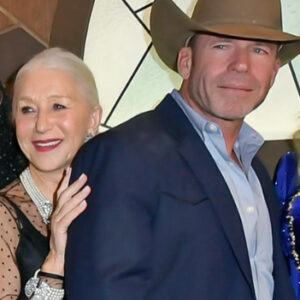
Taylor Sheridan has spent years building one of television’s most powerful modern Western empires, but according to the Yellowstone creator himself, none of it was supposed to continue indefinitely. Sheridan recently revealed that he had actually planned to retire after completing Yellowstone—until an extraordinary opportunity involving the historic Four Sixes Ranch in Texas forced him to rethink his entire future.
The revelation adds a surprising twist to Sheridan’s already remarkable career story. The man behind Yellowstone, 1883, 1923, Landman, Tulsa King, Lioness and Mayor of Kingstown was apparently not dreaming about creating an even bigger television universe. He was preparing to step away.
Instead, a ranch reportedly worth $330 million changed the equation.
During an appearance on Dale Brisby’s Rodeo Time podcast, Sheridan explained that he had been “set up to retire” after Yellowstone. He had already purchased a ranch in Weatherford, Texas, and envisioned settling into a quieter life. But the opportunity to acquire the historic Four Sixes Ranch was too significant to ignore.
The timing was crucial.
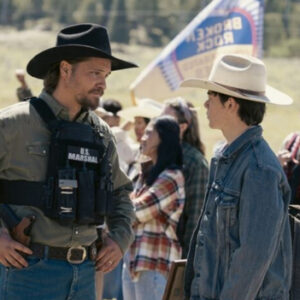
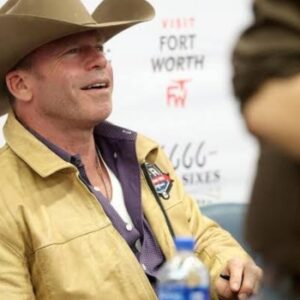
The Four Sixes, also known as the 6666 Ranch, is one of the most famous working ranches in Texas. Sheridan had already developed a connection with the property through Yellowstone, where the ranch became part of the show’s mythology after Jimmy Hurdstrom traveled there to learn the cowboy trade.
But Sheridan’s relationship with the property eventually became much more than a television connection.
After the death of longtime owner Anne Marion, the future of the ranch became uncertain. Sheridan and a group of investors ultimately acquired the property in 2022, with reports placing the transaction at approximately $330 million. The ranch covers more than 142,000 acres and has a long history dating back to the 19th century.
There was just one problem.
Sheridan did not have anything close to $330 million sitting around that he could simply use to purchase the ranch.
His own description of the situation was blunt: he was reportedly about $300 million short.
That financial reality forced him to reconsider the retirement plan he had already made.
Rather than walking away from Hollywood, Sheridan approached Paramount and negotiated a major exclusive arrangement that helped provide the financial foundation necessary to pursue the ranch acquisition.
And that decision may have completely transformed the television industry.
Because instead of retiring, Sheridan went on to expand his already enormous slate of projects.
The result was an extraordinary burst of production.

He continued developing shows across multiple genres, from the Western drama of Yellowstone and its prequels to the crime drama of Mayor of Kingstown, the military thriller Lioness and the oil-industry drama Landman. His output became so extensive that Sheridan’s name effectively turned into a television brand of its own.
The irony is that the entire expansion may have been triggered by a desire to stop working.
Sheridan wasn’t necessarily chasing more fame.
He wanted the ranch.
And the ranch required money.
The story becomes even more interesting when placed alongside Sheridan’s earlier struggles.
Before becoming one of Hollywood’s most successful creators, Sheridan experienced periods of extreme financial hardship. He recently revealed that he was homeless twice and lived in his car for roughly six months while trying to establish himself as an actor.
He eventually landed a recurring role on Sons of Anarchy, but even that success did not immediately provide financial security. Sheridan later said that he was paid so little that he had to leave the set and go to another job because his acting income was not enough to cover his rent and living expenses.
That experience ultimately pushed him away from acting and toward writing.
His screenplay Hell or High Water became a breakthrough, and the money and credibility he gained from screenwriting helped him begin investing in property and developing a deeper relationship with ranching.
Years later, that journey culminated in his involvement with the Four Sixes.
The transformation is almost difficult to comprehend.

A man who once slept in his car eventually became wealthy enough to participate in the purchase of one of America’s most iconic ranches.
But Sheridan’s relationship with ranching also explains why his retirement story is more complicated than a simple “Hollywood creator wants to quit” narrative.
He appears to have discovered that ranch ownership was not merely a retirement hobby.
It became another enormous responsibility.
Sheridan has described himself increasingly as a rancher rather than simply a Hollywood producer. He has invested heavily in ranch operations, horses and cattle, and much of his creative work is now connected to the physical world of ranching and rural America.
In that sense, Sheridan did not really choose between Hollywood and ranching.
He built a system in which one could finance the other.
His entertainment career generates the resources.
The ranch provides the lifestyle and real-world environment that increasingly inspires his creative work.
And the success of the television shows gives him even greater control over the ranching projects he cares about.
That may explain why his decision to continue working was not simply motivated by greed or an endless desire for television dominance.
The Four Sixes appears to have represented something personal.
Sheridan has become increasingly protective of the real ranch and its employees. That attitude was made particularly clear when he recently confirmed that the long-discussed 6666 Yellowstone spinoff will not be produced.
The decision is striking because a television series centered on the famous ranch would seemingly be an obvious commercial opportunity.
The property already has a built-in audience.
Yellowstone viewers are familiar with the ranch.
Jimmy’s storyline created an established connection.
And Paramount had announced the spinoff years ago.
Yet Sheridan now says he would never fictionalize the real Four Sixes.
His reasoning is that he does not want to invent dramatic stories about real people who actually live and work on the ranch. He considers himself responsible for protecting the authenticity of the property and its community.
That decision reveals something important about his priorities.
Sheridan may have returned to work because he needed the financial resources to acquire the ranch, but once he obtained it, the ranch itself became more important than simply turning it into another television product.
That distinction could become increasingly significant in the future.
Sheridan has already demonstrated that he is willing to reject certain commercial opportunities if he believes they compromise authenticity.
At the same time, his enormous workload has created another intriguing question: If the ranch was the reason he abandoned retirement, could the ranch eventually become the reason he returns to it?
That possibility cannot be ruled out.
Sheridan has repeatedly expressed frustration with Hollywood’s conventional power structures. In a recent interview, he attacked studio executives and critics and emphasized his determination to tell stories on his own terms.
His career increasingly reflects that philosophy.
He does not appear particularly interested in creating television simply because the industry expects another season.
He wants control.
He wants authenticity.
And perhaps most importantly, he wants his entertainment career to support the life he has chosen away from Los Angeles.
That makes the Four Sixes purchase a fascinating turning point.
Without it, Sheridan might have finished Yellowstone, walked away from Hollywood and spent his days running his ranch.
Instead, the ranch became the reason he needed Hollywood more than ever.
The result was a strange reversal.
Hollywood once represented the dream Sheridan was desperate to achieve.
After achieving it, Hollywood became the financial engine that allowed him to pursue something else.
His priorities had changed.
He was no longer trying to become famous.
He was trying to build a life.
And ironically, building that life required him to become even more productive.
There is also a broader lesson in Sheridan’s story.
His career demonstrates how dramatically success can change the meaning of money.
When he was sleeping in his car, money meant survival.
When he was an actor struggling to pay rent, money meant freedom from financial instability.
After becoming a successful screenwriter, money allowed him to purchase land.
And now, at the highest level of his career, money has become a tool for acquiring and protecting an entire way of life.
The $330 million ranch is therefore not simply another expensive asset.
It represents the culmination of Sheridan’s evolution.
Actor.
Writer.
Creator.
Producer.
Rancher.
And potentially, one day, retiree.
But retirement has already proven surprisingly difficult for him.
He thought he had reached the end of his Hollywood journey.
Then the Four Sixes appeared.
And suddenly, the man who wanted to stop working had a reason to keep going.
That creates one of the strangest contradictions surrounding Sheridan today.
The more successful he becomes in Hollywood, the closer he seems to move toward the ranching world he ultimately wants.
His television empire may therefore be less about Hollywood itself and more about financing his escape from Hollywood.
That could also explain why his relationship with the Yellowstone franchise has become increasingly complicated.
He continues to expand the universe, but he is also willing to close projects that no longer fit his philosophy. The cancellation of 6666 demonstrates that Sheridan’s definition of success is not simply “more shows.”
For Sheridan, the real victory may be having enough power to say no.
That is a remarkable position for someone who once could not even afford his rent.
He spent years trying to convince Hollywood to give him an opportunity.
Now he is wealthy and influential enough to reject opportunities himself.
And that may ultimately be the clearest measure of his transformation.
Taylor Sheridan wanted to retire after Yellowstone, but a $330 million ranch changed his plans. The Four Sixes forced him back into the business world he had hoped to leave, turning retirement into another chapter of relentless work. Yet the irony is that Sheridan may not be working harder because he loves Hollywood—he may be working harder because he loves the life he has built beyond it. From sleeping in a car to controlling one of television’s biggest creative empires and helping preserve a legendary Texas ranch, Sheridan’s journey has come full circle: Hollywood was once the destination, but now it appears to be the engine funding his escape.