The house smelled of burnt coffee and something medicinal. I dropped my duffel bag in the hallway, the familiar creak of the old floorboards under my boots the only sound breaking the silence. Six months in the desert, six months of dust and danger and letters I wrote to her every night, dreaming of this moment. I had pictured her laughing, throwing her arms around my neck, kissing me like the world had stopped turning.
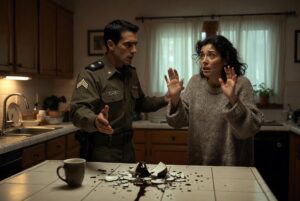
Instead, Elena stood at the counter in an oversized gray sweater that swallowed her frame, her dark hair pulled back in a messy bun. She looked smaller. Fragile. The woman I had married—the strong, vibrant Army nurse who could handle twelve-hour shifts and still tease me about my terrible cooking—seemed like a ghost of herself.
I stepped closer, reaching for her hand. My fingers barely brushed her wrist before she jerked back, eyes widening in something close to panic. The mug she was holding slipped, shattering on the tile floor.
“Elena?” My voice cracked. “Baby, what’s wrong?”
She bent quickly to clean up the pieces, avoiding my eyes. “Careful. There’s glass everywhere.”
I knelt beside her, ignoring the shards, and gently touched her shoulder. She flinched again, a small involuntary movement that hit me harder than any IED. “Talk to me. Please.”
She stood, wiping her hands on the sweater. “You’re home. That’s what matters.” Her voice was flat, exhausted. “Welcome home, Alejandro.”
No hug. No kiss. No tears of relief. Just those four words and the distance in her eyes.
I followed her into the living room, my combat boots leaving faint prints on the floor. The house felt wrong—too quiet, too clean in a sterile way. Photos of us were still on the mantel, but something was missing. The warmth.
“Elena, six months,” I said, voice low. “I wrote to you every day. I thought about you every night. What happened?”
She sat on the edge of the couch, arms wrapped around herself. The sweater slipped slightly, revealing a bruise on her collarbone—fading yellow-green, but unmistakable. My stomach dropped.

“Who did that to you?”
She pulled the fabric higher. “It’s nothing. I fell.”
“Bullshit.” I knelt in front of her, careful not to touch her without permission. “I know every mark on your body. I know when you’re lying. Tell me the truth.”
Her eyes filled with tears she refused to let fall. “Your father came by. A lot. He said he was checking on me while you were gone. Helping with the house. Then… it changed.”
My blood ran cold. My father—retired Colonel Raymond Vargas—had always been strict, controlling. He had never approved of Elena fully, calling her “too independent” for a military wife. I had ignored the warnings, believing family was family.
“He said I needed to be a better wife,” she whispered. “That I was too focused on my nursing job. That when you came home, things would change. He… grabbed me one night when I told him to leave. Said I was disrespecting the family name.”
I stood slowly, fists clenched. Six months of missing her, dreaming of holding her, and this was what I returned to. My own father had broken the woman I loved.
“Where is he?” I asked, voice dangerously calm.
“Alejandro, no.” Elena stood, reaching for me this time. Her hand trembled but made contact. “He’s not worth it. I’ve already filed a report. The military police know. I just… I didn’t want to tell you in a letter. I wanted you home safe first.”
I pulled her into my arms carefully, feeling her finally relax against me. She smelled like hospital soap and the faint lavender shampoo I loved. “I’m sorry,” I whispered into her hair. “I’m so sorry I wasn’t here.”

We stood like that for a long time, the weight of six months and betrayal settling between us. Later that night, as she slept fitfully in my arms, I stared at the ceiling. My father would face consequences. The Army didn’t tolerate that kind of abuse, especially from one of their own.
But the real healing would take time. Trust rebuilt slowly. Elena’s flinch when I touched her that first night haunted me for weeks. We went to counseling together. She returned to work gradually. I took leave to be present in a way I hadn’t been before.
Months later, my father was charged and faced administrative punishment. The family fractured, but Elena and I grew stronger. She started smiling again—real smiles that reached her eyes. We talked about the future, about maybe trying for a child when she was ready.
The night she finally initiated contact—her hand sliding into mine without hesitation—I knew we had turned a corner.
“Welcome home,” she whispered again, this time with warmth.
I kissed her forehead. “I’m never leaving you alone like that again.”
Some deployments end when the plane lands. Others take months to truly come home. But we made it. Together.