The paper was thin enough to tear with trembling fingers, yet strong enough to carry the weight of a man’s life.
No one in the ruined orchard spoke as the wind dragged itself through the broken branches. The air smelled of damp soil, rotting fruit, and distant artillery. Somewhere beyond the low ridge, the guns never stopped—an endless growl like a beast that had forgotten how to sleep.
Gefreiter Lukas Weber held the paper in both hands, careful not to crease it again. The edges were already worn, softened by sweat and fear. He had read the words so many times he no longer needed to look down. He could recite them even now, with his eyes fixed on the gray horizon.
“Safe conduct,” it promised in stiff, formal German. “You will be treated fairly as a prisoner of war. Food. Medical care. Protection.”
Lies, said the voice in his head—the voice that sounded like every officer he had ever obeyed.
Hope, whispered something quieter.
Beside him, Otto Krüger shifted his weight, boots crunching softly on frost-stiff grass. Otto was older, his beard unshaven, his eyes hollowed out by weeks of retreat. He glanced at the paper as if it might suddenly vanish.
“You’ve read it again,” Otto muttered.
Lukas didn’t answer.
On Lukas’s other side, young Emil Hartmann hugged his rifle like a lifeline. Or perhaps like a coffin. It was hard to tell anymore.
“They shoot deserters,” Emil said suddenly. His voice cracked. “You know they do.”
“They shoot everyone now,” Otto replied flatly. “That’s the difference.”
A shell burst somewhere far off, the dull thud rolling over the land like thunder. Emil flinched. Lukas didn’t. He had stopped flinching days ago, somewhere between the burning village and the frozen river where they had lost half their unit.
The paper trembled in his hands—not from fear, he told himself. From cold.
“We’re not deserters,” Lukas said at last. “We’re soldiers making a decision.”
Otto let out a dry laugh. “That’s a generous way to say surrender.”
Lukas folded the paper carefully, as if it were something sacred, and tucked it inside his coat. Close to his chest. Close to his heartbeat.
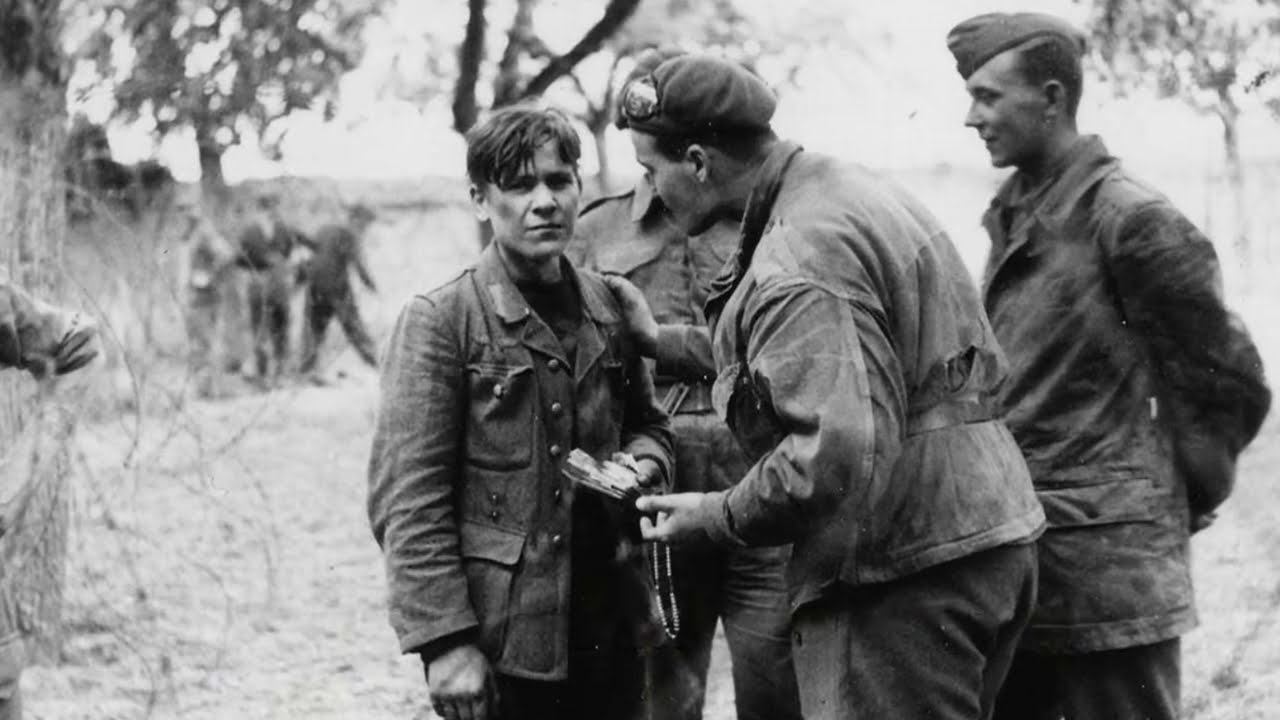
“It’s not surrender if it saves us,” he said.
They had found the leaflet two nights earlier.
It had drifted down out of the black sky like a ghost—one among thousands, pale shapes fluttering silently over the treeline. At first, they had thought it was ash. Then snow. Then Otto had caught one midair and cursed under his breath.
“Propaganda.”
They had burned most of them.
That was the order, anyway. Burn them immediately. Do not read. Do not keep.
Lukas had burned his too—or at least pretended to. He had held it close to the flame just long enough to darken one edge, then slipped it inside his coat while the others weren’t looking.
He had told himself it was curiosity.
That was the first lie.
The second lie came when he read it.
“You will be treated in accordance with international law,” it said. “You will not be harmed. Show this paper when surrendering.”
It even included instructions. Simple. Clear. Raise both hands. Approach slowly. Do not make sudden movements.
It was absurd. Ridiculous.
And yet…
“Why would they lie?” Lukas whispered into the darkness that night.
No one answered.
By the third day, they had stopped receiving orders.
Their company had dissolved into scattered fragments, each group clinging to survival by instinct rather than command. The officers were gone—dead, captured, or simply vanished into the chaos.
Rumors spread faster than bullets.
“The Americans shoot prisoners.”
“No, they give you cigarettes.”
“They hang anyone who wears the uniform.”
“They treat you better than our own officers do.”
Truth had become a luxury no one could afford.
That was when Otto spoke.
“I saw them once,” he said quietly, as they huddled in the orchard that evening. “Last year. In Italy.”
Lukas looked up. “And?”
Otto hesitated.
“They fed the prisoners before they fed themselves.”
Emil shook his head violently. “That’s impossible.”
“Is it?” Otto asked.
Emil had no answer.
Lukas reached into his coat and pulled out the paper again.
This time, he didn’t hide it.
The three of them stared at it as if it might speak
The decision did not come all at once.
It came in fragments.
In the empty stomach that twisted with hunger.
In the boots that no longer kept out the cold.
In the silence of radios that would never crackle to life again.
In the realization that no one was coming.
Not for them.
Not ever.
“You believe this?” Emil asked finally.
Lukas met his eyes. “I want to.”
“That’s not the same thing.”
“No,” Lukas said. “It’s not.”
Otto leaned forward, his elbows on his knees. “Belief isn’t the point,” he said. “Survival is.”
Emil looked between them, his breathing shallow.
“And if it’s a trap?”
Lukas didn’t hesitate.
“Then we die,” he said.
The words hung in the air, heavy and absolute.
Otto nodded slowly. “And if we stay?”
Lukas met his gaze.
“Then we die anyway.”
Dawn came pale and merciless.
A thin mist clung to the ground, turning the world into a blurred, uncertain shape. It felt like standing inside a dream—or a grave.
Lukas took out the paper one last time.
He unfolded it carefully, smoothing out the creases.
“We do this together,” he said.
Otto nodded.
Emil hesitated.
Then, slowly, he set his rifle down.
The sound it made hitting the ground was louder than any gunshot.
Lukas followed. Then Otto.
Three rifles, abandoned in the frost.
Three lives, balanced on a piece of paper.
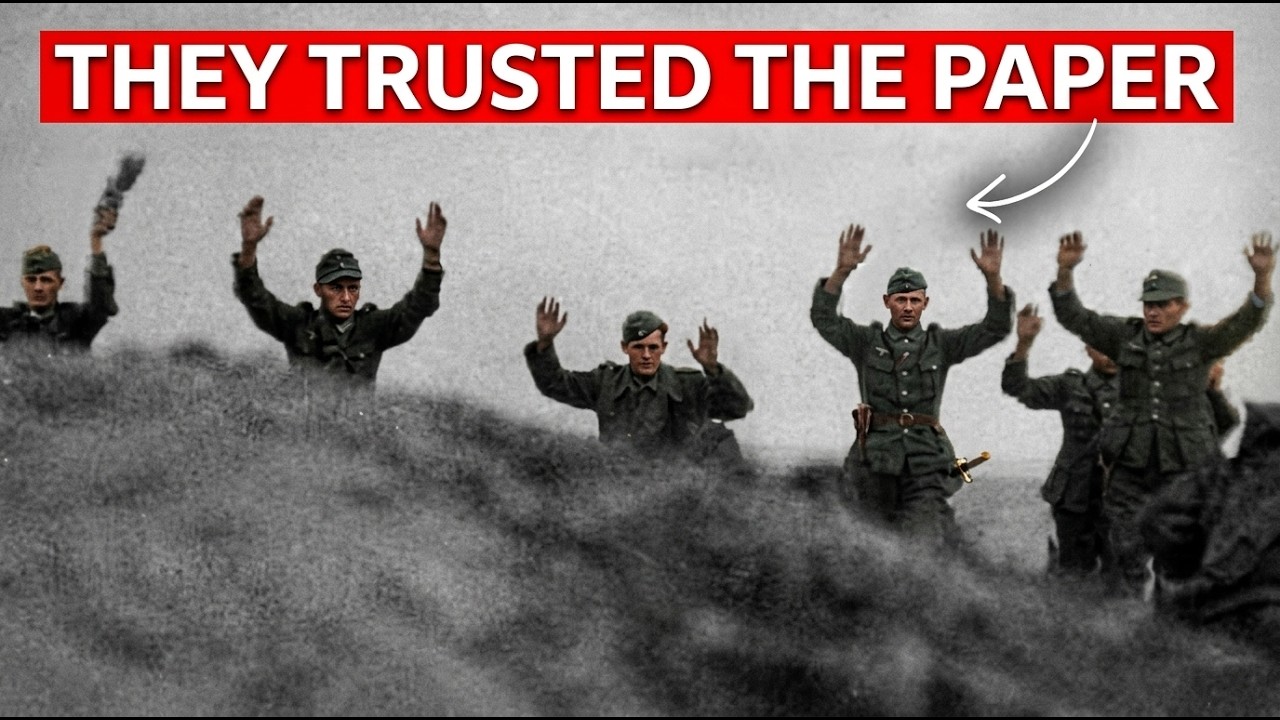
“Hands up,” Lukas said softly.
They raised them.
But then Otto did something unexpected.
He reached for the paper.
“Wait,” he said.
Lukas frowned. “What are you doing?”
Otto took one corner of the leaflet between his fingers. Emil, after a moment’s hesitation, took another.
“Not just you,” Otto said. “All of us.”
Lukas understood.
He grasped the third corner.
Three men.
Three hands raised high.
Three fingers clinging to a promise they did not fully trust—but could not afford to ignore.
They walked slowly over the ridge.
Every step felt like a betrayal.
Every heartbeat felt like a countdown.
The mist began to thin, revealing shapes ahead—dark outlines, angular and unnatural.
Vehicles.
Sandbags.
Men.
American soldiers.
“Don’t run,” Lukas whispered.
“I’m not,” Emil said, though his voice shook.
A shout rang out.
“Stop! Hands up!”
They froze.
As if they had any other choice.
Lukas lifted the paper higher, his arm trembling.
“Safe conduct!” he called out in broken English. “We surrender!”
The words tasted strange in his mouth.
Final.
Irreversible.
For a moment, nothing happened.
The Americans stared at them, rifles raised, eyes sharp and wary.
Time stretched.
Lukas felt sweat run down his spine despite the cold.
Then one of the Americans stepped forward.
He was young—no older than Lukas. His helmet sat slightly crooked on his head. His expression was cautious, but not cruel.
He gestured with his rifle.
“Come forward. Slow.”
Lukas obeyed.
One step.
Then another.
The paper fluttered slightly in the breeze, its edges catching the light.
The American’s eyes flicked to it.
Something changed.
Not much.
But enough.
“Keep coming,” he said.
When they were close enough, the American lowered his rifle.
Not completely.
But enough.
He reached out.
For a split second, Lukas hesitated.
This was the moment.
The point of no return.
He looked at Otto.
At Emil.
At the paper between them.
Then he let go.
The American took it.
He glanced down at the leaflet, scanning the familiar text.
Then he looked back up at them.
And nodded.
“You’re okay,” he said.
Just two words.
Simple.
Unremarkable.
But they hit Lukas harder than any explosion.
You’re okay.
His knees nearly gave out.
Otto let out a breath that sounded like it had been trapped inside him for weeks.
Emil began to cry.
No one shot them.
No one beat them.
Instead, another soldier approached and gestured for them to lower their hands.
“It’s over,” he said.
Over.
Lukas wasn’t sure he believed that word either.
But he wanted to.
Later, as they sat behind the American lines, wrapped in blankets and clutching tin cups of hot coffee, Lukas watched the paper being passed between soldiers.
They examined it with casual interest, as if it were nothing more than a scrap.
To them, it was ordinary.
To him, it was everything.
Otto leaned back against a crate, eyes closed.
“They kept their promise,” he murmured.
Lukas nodded slowly.
“Yes,” he said.
Emil stared into his cup, still trembling.
“Why?” he asked. “Why would they do that?”
Lukas thought of the words printed on the leaflet.
Of the risk.
Of the doubt.
Of the choice.
“Because if they didn’t,” he said quietly, “no one would ever believe it again.”
He looked at the paper one last time as the wind carried it gently across the camp.
Thin.
Fragile.
Unremarkable.
And yet strong enough to make three men walk out of war with their hands in the air—and their lives still their own.