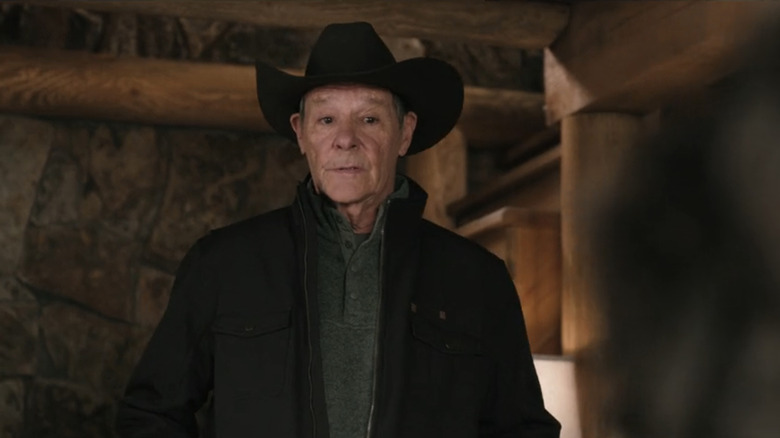
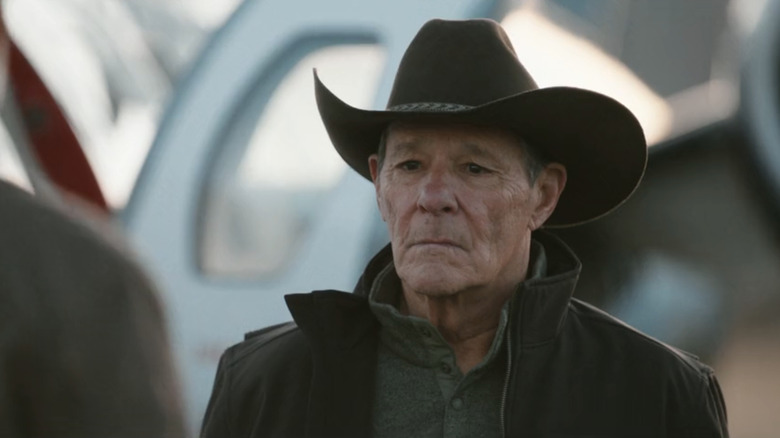
“Marshals” Season 1 concluded with a revelation that Tom Weaver, the owner of Weaver Ranch and a former stockbroker, was the central antagonist all along. Portrayed by Chris Mulkey, Weaver emerges as the orchestrator of the violent incidents targeting Kayce Dutton, played by Luke Grimes, and his family. While this twist should have been impactful, the series’ inconsistent storytelling has diluted its significance, leaving the reveal feeling underwhelming.
Introduced in Episode 4, Weaver is initially presented as a retired stockbroker who relocated to Montana to establish his ranch. At first glance, he seemed like a more tempered counterpart to John Dutton, potentially guiding Kayce through his personal and professional challenges. However, his sporadic appearances—returning briefly in Episode 7 and not resurfacing until Episode 12—mean that viewers had little opportunity to form a connection with him before the climactic reveal. By the season finale, the audience learns that Weaver is pressuring Kayce to sell his East Camp property to facilitate the expansion of Weaver Ranch. The tension escalates when Weaver abducts Kayce’s son, Tate, and sends his enforcer, Jeb, to eliminate other characters, including Pete Calvin. The motives are now clear, yet the execution of this arc feels anticlimactic because the narrative spent insufficient time developing Weaver as a compelling villain.
Earlier in the season, the series introduced another antagonist, Randall Clegg, played by Michael Cudlitz, who initially appeared to be the main threat. The Cleggs, who had historical ties to the Dutton family, were expected to serve as long-term adversaries. However, by the end of Episode 9, the Cleggs’ storyline had concluded, leaving the remainder of the season to focus on the Weaver family. This shift contributes to a sense of narrative inconsistency, as the show briefly positions one antagonist as central before revealing the true villain without adequate buildup.
Weaver’s appearances are limited to four episodes out of thirteen, and in the interim, “Marshals” has adhered to a procedural format with weekly cases. Unfortunately, these crime-of-the-week plots often feel underdeveloped and fail to enhance the overarching narrative. The show attempts to balance multiple storylines, including exploring the socio-political challenges faced by Native American reservations, the complexities of Kayce’s dual role as a law enforcement officer and family man, and personal conflicts among secondary characters. This juggling act dilutes the impact of each storyline, leaving the central narrative about Weaver’s machinations underexplored.
Secondary arcs further complicate the season’s cohesion. Riley Green’s character Garret, a former Navy SEAL and Kayce’s ex-comrade, arrives in Episode 8, triggering a brief subplot centered on military trauma that resolves in just four episodes with Garret’s death in an explosion. Similarly, the show oscillates between crime thriller, socio-political commentary, and naturalistic family drama. This indecision prevents “Marshals” from establishing a clear tonal or thematic identity, weakening the emotional stakes when major plot developments, such as the Weaver reveal, occur.
The limited time spent with Weaver means that his characterization lacks depth. Unlike other series, such as the “Dutton Ranch” spin-off, which gradually develops its characters, “Marshals” introduces its antagonist without allowing the audience to form meaningful impressions or attachments. Consequently, when Weaver’s dark side is finally revealed, the moment lacks the punch it should carry, as viewers have little investment in him beyond the immediate conflict.
Despite these shortcomings, the final episode delivers moments of action and suspense. The climax features an attempted attack on Thomas Rainwater (Gil Birmingham), the intervention of Kayce and his Marshals, and the strategic manipulations of Weaver and his daughter, Dolly (Ellyn Jameson). These sequences provide temporary excitement but are ultimately overshadowed by the season’s broader narrative incoherence.
In conclusion, the revelation of Tom Weaver as the true villain of “Marshals” Season 1 is hampered by inconsistent storytelling and fragmented character development. The show introduces numerous storylines and secondary conflicts that distract from the central plot, preventing the final twist from achieving its full dramatic potential. While the series presents an interesting premise and sporadic moments of tension, the lack of focus and insufficient buildup to Weaver’s villainy underscore one of the main weaknesses of “Marshals”: it still does not fully understand what it wants to be. The season’s conclusion highlights the challenges of balancing procedural elements with serialized storytelling and suggests that future seasons will need more cohesive plotting to deliver satisfying narrative payoffs.