June 18, 1944 — Philippine Sea
The Pacific was strangely calm that morning.
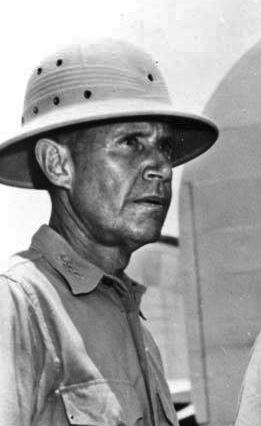
From the flag bridge of the heavy cruiser USS Indianapolis, Admiral Raymond A. Spruance stood motionless beside the chart table, hands clasped behind his back, staring through thick binoculars toward the empty eastern horizon. The sea stretched endlessly beneath a pale gray sky, broken only by the wakes of American warships cutting through the water in disciplined formation.
Behind him, officers moved quietly between radar stations and communications desks. Nobody spoke louder than necessary. On Spruance’s flagship, silence was almost part of the command structure itself.
At fifty-seven years old, Spruance did not look like the kind of admiral newspapers liked to print on front pages. He was thin, reserved, soft-spoken — an engineer by training, not a theatrical warrior like Admiral William Halsey. Sailors joked that Spruance looked more like a university professor than the commander of the most powerful fleet ever assembled in the Pacific.
But beneath that calm exterior was the man who had helped destroy Japan’s carrier force at Midway.
And this morning, somewhere beyond the horizon, another Japanese admiral was waiting for him.
Nearly six hundred miles away aboard the carrier Taihō, Vice Admiral Jisaburō Ozawa studied his operations map with quiet confidence.
For months, the Imperial Japanese Navy had prepared for this battle.
The Americans had landed on Saipan three days earlier, threatening the Mariana Islands — the inner defensive ring of the Japanese Empire itself. Tokyo could not allow those islands to fall. From Saipan, American B-29 bombers would eventually be able to reach the Japanese home islands.
So Ozawa had built a trap.
And on paper, it was nearly perfect.
His carriers would stay beyond immediate American range while launching wave after wave of aircraft from extreme distances. Land-based planes from Guam would assist. American commanders, eager for a decisive victory, would almost certainly chase the retreating Japanese carriers westward.
And once they did…
Japanese submarines and carrier aircraft would strike the American fleet far from the protection of Saipan.
Ozawa believed he understood the American mentality perfectly.
Aggressive.
Impatient.
Hungry for glory.
Especially after years of commanders like Halsey.
He even told one of his staff officers quietly that morning:
“The Americans will pursue. They always pursue.”
The officer nodded confidently.
“They will overextend themselves.”
Ozawa looked toward the west, where dawn sunlight reflected off the flight decks of his carriers.
“They have already won too many victories,” he said softly. “Victorious men become careless.”
Back aboard the Indianapolis, Spruance lowered his binoculars slowly.
A communications officer stepped forward.
“Admiral, new reconnaissance reports from Task Force Fifty-Eight.”
Spruance accepted the papers without speaking.
Rear Admiral Marc Mitscher, commander of the fast carrier task force, stood nearby watching him carefully. Mitscher was an aviator — aggressive, sharp, impatient for action.
“So?” Mitscher finally asked.
Spruance read the report once.
Then again.
Japanese carrier forces had been located west of the Marianas.
Farther west than expected.
Almost inviting pursuit.
Mitscher crossed his arms.
“If we move now,” he said, “we might catch them before sunset tomorrow.”
Several officers around the room quietly agreed.
This was what the U.S. Navy had been waiting for since Pearl Harbor:
A chance to destroy the remaining Japanese carrier fleet once and for all.
But Spruance said nothing.
He walked slowly to the large operations map mounted against the bulkhead. Tiny colored markers showed the positions of American forces around Saipan — troop transports, supply ships, landing craft.
More than 128,000 American Marines and soldiers were still fighting ashore.
And if the Japanese fleet slipped past them…
The invasion fleet would be exposed.
One captain finally broke the silence.
“Sir… if we stay here, we may lose the opportunity to annihilate their carriers.”
Spruance remained still for a long moment.
Then he asked quietly:
“And if we chase them… who protects Saipan?”
Nobody answered immediately.
The only sound came from the soft hum of radar equipment and the distant crash of waves against steel hulls.
Mitscher stepped closer.
“With respect, Admiral,” he said carefully, “this may be the decisive carrier battle of the war.”
Spruance nodded once.
“Yes,” he said calmly. “Which is exactly why Ozawa wants us to think that.”
The room fell silent again.
Several officers exchanged uncertain glances.
Because in that moment, some of them began realizing something uncomfortable:
Spruance was not thinking about destroying the Japanese fleet.
He was thinking about something else entirely.
Then another radar operator suddenly looked up sharply from his console.
“Large airborne contacts detected west-southwest,” he announced. “Multiple groups… increasing rapidly.”
The room froze.
The first Japanese strike wave was already coming.

Spruance remained motionless for a heartbeat longer than anyone thought possible. The faint glow of radar screens illuminated the faces of his officers, their eyes wide with anticipation. The Philippine Sea stretched endlessly beyond the bridge, a deceptive mirror of calm, but Spruance knew better. The Japanese strike wave was already in the air, hundreds of miles away, approaching like a storm whose precise timing had been meticulously calculated.
“Alert the combat air patrol,” he finally said, his voice calm but carrying the weight of command. “And ready all anti-aircraft batteries.”
Mitscher, who thrived on action, leaned closer. “Sir, if we launch our planes now, we could intercept them before they reach our carriers. We could cripple their attack before it starts.”
Spruance looked at him steadily. “Admiral, the Americans are not going to make the mistake Ozawa expects. Our Marines on Saipan are counting on the fleet to protect them. Our carriers are a shield, not a bait. We hold our position. We control the timing.”
Mitscher hesitated. He had been raised on aggression, on striking first and striking hard. But there was something in Spruance’s calm, deliberate gaze that made him pause. This was strategy on a scale beyond a single dogfight—this was the orchestration of hundreds of ships, thousands of planes, and tens of thousands of men in a delicate balance between victory and catastrophe.
The radar operator broke the tense silence again. “Contacts confirmed. Torpedo bombers, dive bombers, fighters—approaching from bearing 240 degrees at high altitude. Estimated time to reach fleet: thirty minutes.”
Spruance turned back to the operations map. Each colored marker represented a different American formation: carriers, battleships, cruisers, destroyers. Saipan was marked with tiny rectangles, representing the vulnerability of the Marines ashore. He traced the line of approach with his finger, visualizing the enemy’s plan.
“They believe we will pursue them,” he murmured, almost to himself. “They are right… and wrong.”
Below the bridge, sailors moved like a well-oiled machine. Anti-aircraft guns were manned, lookouts scanned the skies through binoculars, and flight crews prepared to scramble. Yet Spruance did not issue the immediate order to launch. His officers felt the tension, the deliberate wait, the silent reasoning that would make or break the fleet in the next hour.
At that moment, the first Japanese planes appeared on the horizon as tiny black specks against the gray sky. And then, as if on cue, more appeared. Thousands of feet above the ocean, the Japanese air arm demonstrated the culmination of months of preparation—tight formations, disciplined timing, and calculated aggression.
“Launch CAP,” Spruance finally commanded. “Intercept at maximum distance. Protect the carriers first. Preserve the fleet.”
Mitscher’s voice rose with restrained excitement. “Yes, sir. Fighters are airborne!”
The sky erupted in motion. American F6F Hellcats roared from the decks of carriers like a sudden gale, ascending to meet the Japanese formation. The CAP intercepted the lead squadrons, engaging them in violent dogfights. Smoke and tracer rounds streaked across the sky, turning the calm morning into a whirlwind of chaos.
Spruance watched without flinching. The enemy was formidable, and their torpedo bombers pressed relentlessly. But the CAP, under Mitscher’s careful coordination, drew them away from the carriers and disrupted their timing. Several enemy planes were sent spiraling into the sea before they could release their ordnance.
“Admiral, two Japanese bombers breaking through!” an officer shouted.
Spruance nodded once. “Engage with flak. Direct fire from the heavy cruisers. Cover the carriers. Cover Saipan.”
The heavy cruisers unleashed their anti-aircraft batteries. Salvos of flak exploded in the air, sending showers of orange and black smoke. Torpedoes released from enemy aircraft were met with defensive maneuvers and gunfire. One by one, the incoming planes were destroyed or forced to abort.
Meanwhile, below the horizon, Japanese submarines that had been positioned to ambush American vessels moved silently through the water. Yet Spruance had anticipated this. Destroyer screens zigzagged and deployed sonar sweeps. Depth charges exploded with precision, neutralizing the submarine threat before it could reach the main fleet.
The battle raged for hours, a delicate balance of air and sea tactics. American pilots faced the deadly skill of Japanese aviators, yet the coordination and discipline of Spruance’s command began to tip the scales. Bombers were isolated, their formations broken, and the defensive coordination of American ships prevented catastrophic losses.
At 1030 hours, Spruance allowed a measured offensive move. “Launch strike on enemy carriers,” he ordered. “Hit them before they regroup. Ensure they cannot attack again today.”
American carrier-based aircraft surged into the sky in waves. The Japanese carriers, previously confident in their extended-range strike, now faced a coordinated counterattack. Bombs fell with devastating precision, fire erupted on decks, and the Japanese naval aviators found themselves under intense defensive fire while their own carriers were under attack.
Vice Admiral Ozawa, aboard the Taihō, realized too late that his trap had been anticipated. His planes were being destroyed faster than replacements could arrive, and the defensive perimeter around Saipan remained unbroken. The Americans had not overextended—they had controlled the engagement entirely.
The next few hours saw the destruction of three Japanese carriers. Spruance’s strategy was impeccable: preserve the fleet, protect Saipan, and use the enemy’s aggression against them. Japanese pilots, skilled and brave, found themselves victims of a strategy that anticipated every move they might make.
By late afternoon, the horizon was littered with the wreckage of Japanese planes, smoke rising from burning carriers, and the sea dotted with debris. American losses were comparatively minimal—a testament to the careful orchestration of CAP, anti-aircraft defenses, and strategic patience.
Spruance stood quietly on the flag bridge, observing the aftermath. Mitscher approached, a rare note of deference in his tone. “Sir… I don’t think anyone will question your judgment today.”
Spruance looked toward the horizon, eyes softening. “Victory is not just about aggression. It’s about foresight. And about protecting those who cannot protect themselves.”
Below, Saipan remained under American control. Marines advanced inland, secure in the knowledge that their fleet had shielded them from a devastating Japanese counterattack. The battle for the Mariana Islands would continue, but the carrier force that threatened their invasion had been broken.
As evening fell, Spruance issued orders for cleanup and rescue operations, tending to the wounded, and salvaging what could be salvaged. He walked the decks, acknowledging crews quietly. No speeches, no fanfare—just the steady professionalism of men who understood the stakes.
Later, in a private report to Washington, Spruance detailed the engagement. He emphasized the importance of patience, strategy, and the calculated use of force. The report would be studied for decades in naval academies worldwide. It was not the flamboyant victory of a reckless charge—it was a masterclass in command.
In Tokyo, Ozawa received word of the losses. The carriers he had counted on to defend the Marianas and maintain the illusion of Japanese dominance in the Pacific were gone. The attack, once so confidently planned, had failed catastrophically.
And so, as night fell over the Philippine Sea, Spruance allowed himself a rare moment of quiet reflection. The sea had returned to its deceptive calm, and the fleet, though weary, remained ready. The enemy had been defeated not by rashness, but by calculated foresight.
The war was far from over, but the lessons of the Philippine Sea would resonate for years: patience, strategy, and the understanding of one’s own strengths and the enemy’s tendencies could triumph where brute force alone might fail.
Spruance retired to his quarters, exhausted but serene. The weight of command was always heavy, but moments like this—when lives were saved, objectives secured, and victory achieved through intellect and foresight—made it bearable.
The sea, calm once again, reflected the setting sun. The carriers, cruisers, and battleships glided across it, silent guardians of freedom and democracy in a vast ocean. And for those who would study history, the lesson was clear: true leadership often spoke not in loud declarations, but in measured, deliberate action.
In the days that followed, the American fleet repaired, regrouped, and prepared for the next phase of operations. The Japanese navy, shattered and demoralized, would struggle to regroup. And the war in the Pacific had shifted irrevocably in favor of those who understood that patience, preparation, and strategy were just as deadly as firepower.
Admiral Spruance’s calm, deliberate actions that day earned him the nickname “the Professor” among his men—a leader who had taught the art of war through action, foresight, and unshakable composure.
And in the quiet of the Philippine Sea, as the stars emerged above the endless water, the lesson endured: victory was not for the bold alone—it was for the patient, the strategic, and those who understood the cost of every decision.