For many television series, expanding a supporting character’s role is usually a sign that bigger things are coming. More screen time often means richer storylines, deeper emotional development, or new relationships that allow the audience to see another side of the character.
In Ransom Canyon Season 2, that expectation never fully materialized for Angie O’Grady.
Instead, the character found herself appearing more frequently while remaining surprisingly disconnected from the romantic and personal storylines that surrounded nearly everyone else. According to an opinion piece published by Pajiba, Angie became one of the season’s most overlooked characters—not because she lacked potential, but because every opportunity for growth seemed to disappear just as quickly as it arrived.
On paper, Season 2 looked like progress.
After appearing in only two episodes during the first season, Angie returned in five episodes during the second. That increase suggested the writers intended to make her a more meaningful part of the series.
What actually happened, however, was something quite different.
Rather than receiving a storyline centered on her own journey, Angie spent much of the season serving as emotional support for her sister, Quinn.
While Quinn navigated two romantic interests and prepared for a country music festival, Angie consistently occupied the role of the dependable sister. She listened, encouraged, comforted, and offered advice whenever Quinn needed someone beside her. Even when their mother, Claire O’Grady, returned and complicated family dynamics, Angie largely remained the steady presence helping everyone else cope.
The irony is that the series had already established a compelling direction for her character.
The show openly acknowledged that Angie’s husband had cheated on her, leaving her newly divorced and, as her official character description states, “back on the market for romance.”
That description naturally created expectations.
Viewers anticipated seeing Angie rebuild her confidence, open herself to new relationships, and perhaps discover happiness after experiencing betrayal. Instead, the season repeatedly hinted at possibilities without ever allowing them to develop.
Perhaps the clearest example involved Sheriff Dan Brigman.
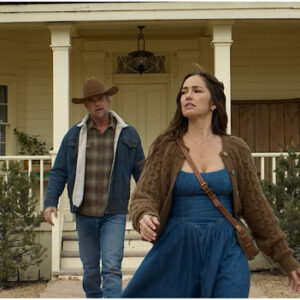
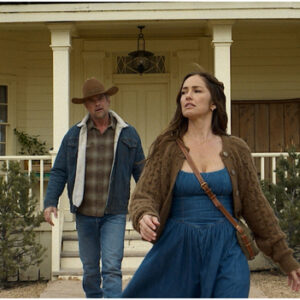
Dan appears to be an almost perfect match within the world of Ransom Canyon. He is a single father, the town sheriff, and embodies the classic cowboy image that fits seamlessly into the show’s setting.
Several moments suggest that the writers might be leading Angie and Dan toward a romance. Shared glances, subtle interactions, and carefully framed scenes briefly encourage audiences to imagine the possibility.
Yet nothing comes of it.
Each time the relationship seems ready to move forward, the narrative simply shifts its attention elsewhere.
The repeated hesitation makes those scenes feel less like deliberate slow-burn storytelling and more like abandoned ideas.
If that disappointment were not enough, the season introduces an even stranger twist involving Angie’s own mother.
At one point, Claire O’Grady appears to do exactly what viewers have been hoping the writers would do: introduce Angie to an attractive police officer.
For a brief moment, it seems as though Angie has finally been given a legitimate romantic opportunity.
Then the finale completely reverses the situation.
Instead of Angie pursuing the relationship, Claire herself kisses the same man and invites him to visit her new home.
The unexpected turn transforms what initially looked like a promising setup into one of the season’s most surprising reversals.
The Pajiba article humorously argues that this was not even a traditional love triangle. Instead, it calls the situation “a heist.”
The description feels fitting.
The one believable romantic prospect who enters Angie’s orbit never truly becomes hers. Before anything meaningful can begin, the opportunity is effectively taken away by her own mother.
That storyline leaves Angie exactly where she started—alone once again.
The frustrations surrounding the character extend beyond romance.
According to information referenced in the article, Angie has a son named Tim, who appeared during Season 1 as a wide receiver. Yet after watching all eight episodes of Season 2, the writer jokes that there is barely any evidence the teenager still exists within the series.
His absence turns another important part of Angie’s identity into an unresolved thread.
As a result, multiple aspects of her life remain suspended.
She has an ex-husband who betrayed her.
She has a son who is barely acknowledged.
She has an almost-romance with Sheriff Dan Brigman that never develops.
She briefly receives a promising new suitor, only to lose him to her own mother.
Meanwhile, Quinn continues receiving nearly every major romantic storyline available within the series.
Viewed together, these developments create an unusual imbalance.
Angie is never portrayed as an unimportant character. In fact, Season 2 clearly values her presence enough to feature her in more episodes. The problem is that she functions primarily as someone who supports other people’s emotional journeys rather than experiencing meaningful growth herself.
Increasing screen time without increasing narrative importance can leave viewers feeling that a character has been expanded in quantity but not in substance.
That is ultimately why Angie has become such a frequent topic of discussion among fans.
She possesses all the ingredients for a compelling story: personal heartbreak, family complications, emotional maturity, and the possibility of starting over after betrayal. Yet Season 2 repeatedly stops just short of allowing those possibilities to become reality.
Looking ahead, the path forward seems obvious.
If Ransom Canyon receives a third season, Angie does not necessarily need the show’s biggest romance. She simply needs one that belongs to her.
After spending two seasons watching other people’s relationships unfold while her own opportunities disappear, she has arguably earned something the series has consistently denied her—a genuine chance at happiness.
Or, as the Pajiba writer humorously pleads in closing, in a town overflowing with handsome ranchers and cowboy types, “There are shirtless men everywhere. Spare one. Spare Angie one.” That playful conclusion may be exaggerated for comic effect, but it reflects a sentiment many viewers can easily understand: Angie deserves to be more than the person standing on the sidelines while everyone else gets the love story.