Success is usually treated as the reward for making a great first season. For The Pitt, however, success immediately became the problem Season 2 had to solve.
After its freshman season earned 13 Emmy nominations and won five awards, including Outstanding Drama Series, the medical drama was no longer an unknown show capable of surprising viewers without expectations hanging over it. Suddenly, every creative decision would be examined against what had come before. Season 2 was not simply being asked to continue the story. It had to demonstrate that Season 1 had established something sustainable.

That pressure makes the show’s latest achievement particularly significant. Season 2 received an extraordinary 25 Emmy nominations — the most of any show in any category this year.
Even creator and showrunner R. Scott Gemmill was stunned by the number, describing it as “almost embarrassing,” while also calling it “wonderful.”
But behind those nominations is a revealing story about what happens when a television series becomes successful before its creators have had much time to process that success.

According to an interview published by The Hollywood Reporter, Gemmill explained that the circumstances surrounding the two seasons could hardly have been more different.
When the team made Season 1, they essentially worked in a vacuum. The entire season had been written and produced without an airdate, and the creators had received virtually no audience feedback. They did not even know whether people would watch.
That uncertainty may have been uncomfortable, but creatively, it also offered something valuable: freedom.
There was no successful previous season to imitate. There were no enormous expectations to satisfy. And there was no established audience scrutinizing every choice.

The 13 Emmy nominations therefore arrived as both a surprise and validation.
Season 2 reversed that situation.
This time, Gemmill was worried about an entirely different possibility: that the industry might decide The Pitt had been a one-off success, a series that simply had “one good season.”
That fear explains why the 25 nominations arguably matter beyond the numbers themselves. They represent evidence that the show’s initial success could be repeated — exactly what its creators were under pressure to prove.
As Gemmill put it, the recognition surrounding the first season placed the team “under the microscope,” forcing them to show that “it wasn’t just a fluke.”
Success Created a New Kind of Creative Trap
The expectations were not the only difficulty.
Season 1 had another advantage that can never fully be recreated: novelty.
Viewers did not yet understand the show’s rhythms or know where its characters were going. That made genuine surprise easier.
By Season 2, the writers faced the consequences of everything they had already introduced.
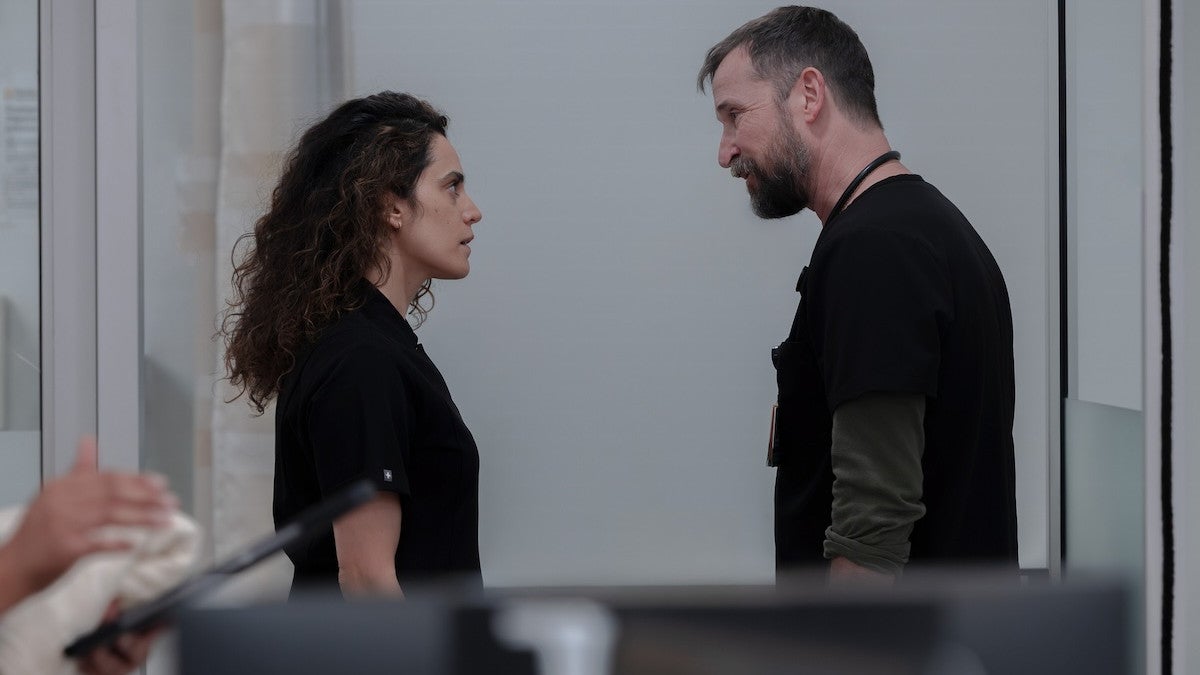
Gemmill acknowledged the familiar television-writing temptation of putting something into a story while thinking, “We’ll figure it out next season.” Eventually, however, next season arrives.
Every storyline, character decision and unresolved possibility becomes part of the world the writers inherit from themselves.
Yet rather than responding to that pressure by attempting to make The Pitt artificially bigger, Gemmill appears to have trusted the same principle that guided the series when nobody knew whether it would succeed: tell truthful stories about healthcare workers and what they face.
Emergency departments naturally bring together medical crises, human conflicts and wider social issues. In Gemmill’s view, that means there will continue to be stories worth telling without the series needing to abandon its identity simply to manufacture spectacle.
And nowhere is that philosophy clearer than in Dr. “Robby” Robinavitch.
Robby Became the Emotional Test of Season 2
Played by Noah Wyle, Robby remained the show’s central focus.
Season 1 had pushed him to a breaking point. Consequently, the creative “North Star” for Season 2 became deceptively simple: How does Robby come back from that?
Does he acknowledge what happened? Does he embrace the reality of his condition? Or does he fight against it?
Those questions transformed mental health into a major component of Robby’s Season 2 journey. But Gemmill emphasized that the subject extends beyond one character. Mental health has become an important part of healthcare and emergency department treatment more broadly, making Robby’s personal struggle compatible with the show’s larger commitment to depicting issues confronting medical workers.
That also helps explain why one apparently ominous storyline surrounding Robby did not develop in the way viewers might have expected.
Throughout Season 2, the show seemed to foreshadow the possibility that something terrible could happen to him, particularly involving his motorcycle.
That interpretation was not entirely imagined by viewers.
Gemmill revealed that the writers genuinely discussed whether Robby might suffer a serious accident or even experience a near-death event.
The possibility was real — but it was never inevitable.
Gemmill’s creative philosophy is to hold plans loosely enough that the writers can recognize better possibilities as a season develops. The motorcycle accident therefore became a path they considered without ultimately making it Robby’s Season 2 fate.
But perhaps the most intriguing revelation is that the underlying idea has not disappeared.
Season 3 May Recycle the Danger — But Not the Victim
Gemmill indicated that an element of the accident or near-death concept will make its way into Season 3.
The crucial distinction is that it will not necessarily happen to Robby.
Instead, he may be privy to or witness such an event involving somebody else.
“It’s not necessarily about him,” Gemmill explained. “But it does impact his trajectory.”
That distinction could prove important.
If Season 2 asked how Robby recovers after reaching his own breaking point, Season 3 may test that recovery indirectly. A person does not necessarily need to become the victim of another catastrophe to be changed by it. Witnessing someone else’s crisis can force unresolved fears, vulnerabilities or beliefs back to the surface.
Based solely on Gemmill’s comments, exactly what happens — and to whom — remains unknown. But we do know the consequences will matter to Robby’s direction.
And perhaps that is also the clearest explanation for why The Pitt survived the enormous expectations surrounding its second season.
The series did not have to destroy Robby in a motorcycle accident or simply escalate the drama to prove Season 1 was not a fluke. Instead, its creators returned to the principle that existed before the Emmys, before the expectations and before anyone even knew whether audiences would watch: truthful stories about healthcare workers facing situations capable of changing them.
Season 1 had nothing to prove.
Season 2 had almost everything to prove.
Twenty-five Emmy nominations suggest it succeeded — but Gemmill’s tease about Season 3 indicates that Robby’s most consequential test may still be waiting for him.