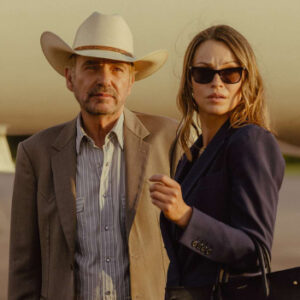
When Yellowstone ended, Ryan did not stay on the ranch. In the series finale, Ian Bohen’s cowboy chose the other life on offer: he left the bunkhouse world behind to follow Abby, the country singer played by Lainey Wilson. It was one of the gentler exits in a franchise built on funerals and land wars—a clean romantic decision in a universe that rarely grants them.
Bohen did not leave Taylor Sheridan’s orbit. He reappears as Grady, a Delta Force operator and K9 handler, in Sheridan’s spy thriller Lioness, led by Zoe Saldana. Season 3 premiered August 2, 2026, on Paramount+, with new episodes on Sundays, and Bohen has been talking about both the new war story and the unfinished business of the old Western one.
Lioness Season 3: drones, dogs, and a battlefield without CGI comfort
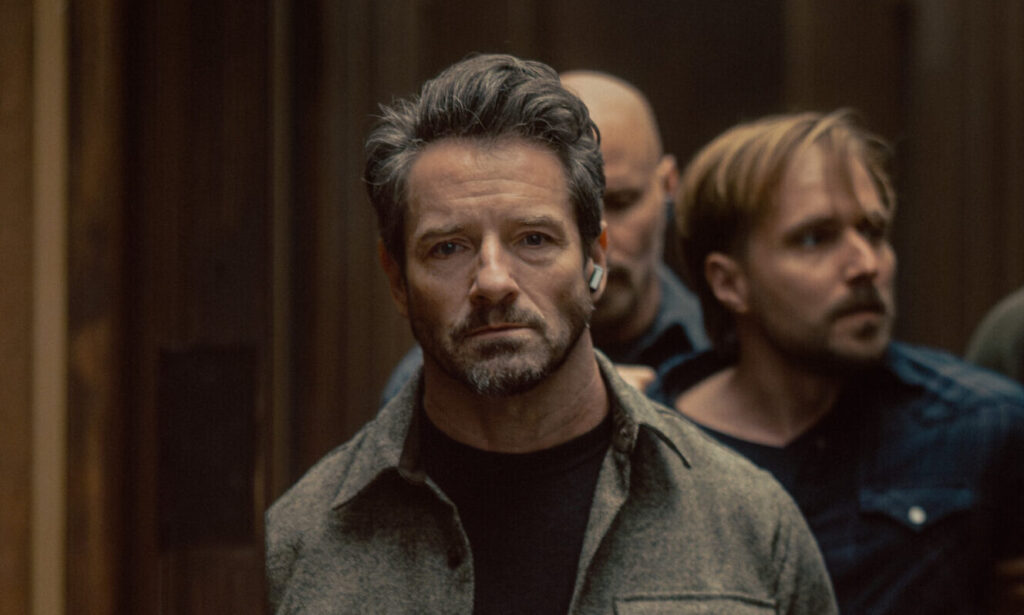
The new season, Bohen says, draws on the look and logic of current conflict rather than stock action-television warfare. The premiere puts Saldana’s Joe and her team in front of trench and drone combat that lands as a shock inside the show’s world as much as outside it.
“What you see on the field with the drones is really never been put on film before,” Bohen told Nerd Reactor. “When you add the complexity of the dogs within everything, it’s remarkable that we were able to capture it just from a practical perspective, with no CGI. We produced one of the coolest modern-day battle sequences I think we’ve seen in this decade.”
That emphasis on practical work matters for how Lioness sells itself: not as fantasy special-ops gloss, but as a series trying to stage contemporary tools of war—unmanned systems, working animals, tight unit movement—with bodies and cameras in real space. For Grady, whose role is bound up with K9 partnership, the method is also character. The dog is not a mascot. The dog is part of the operator’s nervous system.
The death that hit before the cameras did
Season 3’s premiere carries one of the show’s hardest emotional turns for Grady: he comes back from a mission destroyed by the loss of his dog, Titan. Bohen’s reaction started on the page.
“I was devastated when I read that page that said, ‘Titan’s lifeless body,’” he said. “I’m like, ‘God damn it, you’re joking. No, why do you have to do this?’ I was like, ‘They’re gonna be so pissed at you, Taylor.’”
The joke at Sheridan’s expense is affectionate and revealing. Sheridan’s television has always treated animal death and human death as related currencies—ranch horses, wolves, cattle, and now a working military dog. Losing Titan is not a cheap shock for Grady; it is the kind of loss that rewires a handler’s anger and grief before the plot explains anything else. Bohen’s immediate thought about the audience’s fury is also a quiet admission that the attachment was real in performance. Viewers were meant to feel the partnership before the script tore it out.
Ryan and Abby: a finale that still wants a second chapter
While Lioness occupies Bohen’s present, Yellowstone still occupies fan demand—especially wherever Beth and Rip’s Texas chapter is concerned. Dutton Ranch has finished its first season, with Kelly Reilly and Cole Hauser rebuilding a life far from Montana. The bunkhouse ecosystem that once surrounded them did not all relocate on screen. That gap is where Bohen places his hope.
“I would love to see those two people in that world again because you just don’t want to think it’s over,” he said of Ryan and Abby. “So fingers crossed that Lainey and I will be on Dutton Ranch together, having some fun with Kelly and Cole. I would be mystified if you didn’t start to see some of the bunkhouse populate a little bit.”
The comment does several jobs at once. It respects the finale’s choice—Ryan left for Abby—while refusing to treat that choice as a permanent exile from Sheridan’s Western map. It also reads the logic of Dutton Ranch: a new ranch in a new state still needs hands, tension, and familiar faces if it is going to feel like a continuation rather than a sealed couple’s bubble. Bohen is not announcing a booking. He is describing the gravitational pull of a shared world. If the Texas series opens the gate even slightly, Ryan and Abby are among the characters who already have a story shaped for walking through it—tour on the road, history with Rip and the crew, and unfinished social texture from the original show’s final movement.
Two Sheridan lanes, one actor

Bohen’s career inside this ecosystem now splits cleanly across Sheridan’s favorite modes. Yellowstone gave him the cowboy who could choose love over the brand of the brand. Lioness gives him the operator who pays for mission success in the currency of a dog’s life and a team’s next impossible entry. One world is horses, hierarchy, and land. The other is drones, handlers, and deniable war. The connective tissue is Sheridan’s interest in men defined by codes—and by what happens when the code costs more than they budgeted.
Lioness Season 3 is the job in front of him: weekly Paramount+ episodes, modern combat staged with unusual practical ambition, Grady carrying Titan’s absence into whatever the season demands next. Dutton Ranch is the wish in parallel: Lainey Wilson back in frame, Kelly and Cole as hosts of a bunkhouse that might remember Montana, Ryan and Abby not archived as a closed credit roll.
Whether Sheridan and Paramount ever grant that crossover is still unconfirmed. Bohen’s position is simpler and, for fans, more durable. He does not want the Ryan-and-Abby story to feel finished only because the mother show ended. In a franchise that resurrects ranches in Texas and marshals in new badges, a cowboy who left for a singer is exactly the kind of loose end that could, on the right Texas night, show up again—dust on the boots optional, history required.