Before Yellowstone turned Taylor Sheridan into a franchise brand, before the Duttons and the spinoff machine, he was a working actor who never quite became a star and a screenwriter who suddenly could not be ignored. Sicario and Hell or High Water announced him as a major voice in American crime and frontier storytelling. Wind River, which he wrote and directed, was the first time that voice controlled the camera as well as the page—and it remains one of the clearest proofs that his television empire grew out of something colder, quieter, and more politically specific than ranch-family melodrama alone.
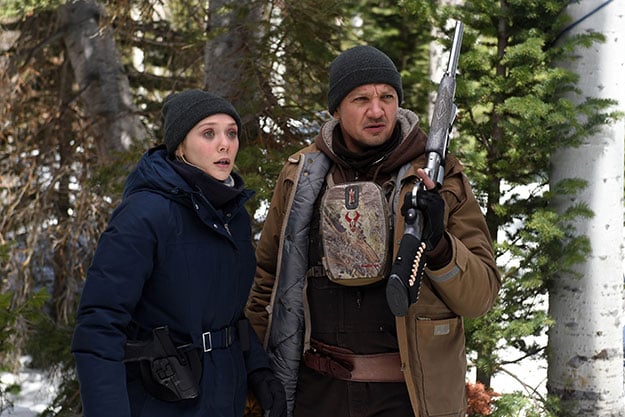
The film follows Cory Lambert, played by Jeremy Renner, a wildlife officer and tracker who discovers the body of an eighteen-year-old woman in the snow on a Native American reservation in Wyoming. The autopsy establishes rape; the jurisdiction establishes a nightmare. FBI agent Jane Banner, played by Elizabeth Olsen, arrives to investigate and quickly learns how thin federal reach can be on reservation land in winter. Lambert becomes her guide through country he knows by habit and grief. As they push the case forward, the investigation turns dangerous for them as well as revelatory about the conditions that allowed the crime to happen and, in too many real cases, to remain unsolved.

Sheridan has been explicit about the engine of the script. It was not a genre exercise first. It was an attempt to put on screen a crisis that official America often treats as background noise: sexual violence against women on Native American reservations. “This issue with sexual assault against women on the reservation—I mean, it’s existed since the inception of a reservation system. But, really, in the past 15, 20 years, it’s exploded. And it gets no attention, which is the motivation for writing the film,” he said.
That motivation shapes the movie’s temperature. Wind River is a thriller with gunmen and chases, but its dread is institutional as much as criminal. Who has authority? Who has resources? Who is left to track a body through snow when paperwork and distance conspire toward silence? Sheridan’s Wyoming is beautiful in the way a trap can be beautiful: white space, hard wind, isolation that reads as freedom until it reads as abandonment. Renner’s Lambert is competent without being invincible, a man whose professional skill cannot fully armor private loss. Olsen’s Banner is capable and out of her depth in the same hour—not incompetent, but honest about how alien the terrain and the jurisdictional maze are to someone flown in from outside.
Critics and audiences met the film with unusual alignment. On Rotten Tomatoes it earned roughly 87% from critics and 90% from audiences, a spread that suggests the movie’s severity did not strand viewers who came for plot. Rotten Tomatoes later slotted it at No. 32 on a list of the greatest modern Westerns. Letterboxd users placed it around No. 59 on a broader all-time Westerns ranking. ScreenRant, grouping it among the strongest Westerns of the twenty-first century, urged Yellowstone fans to treat it as essential homework: “Wind River is a movie that anyone who loves Taylor Sheridan’s television work, particularly on shows like Yellowstone, should seek out and watch immediately. This movie was Yellowstone before he ever created that hit series.”
The comparison is useful if held carefully. Wind River is not a secret pilot for the Dutton saga. It shares DNA with Sheridan’s later television: land as character, masculinity under ethical pressure, violence that is never only spectacle, and an interest in people the coastal prestige economy often ignores. What it does not share is the soap opera expansiveness of Yellowstone. There is little comfort branding here, little world-building for merchandising. The film stays close to one death, one investigation, and a community asked to absorb another girl’s name into a long list.
That focus is why the “modern Western” label fits without needing horses as primary props. The Western, in Sheridan’s hands, is less about period costume than about contested ground and the laws that fail at its edges. Reservation borders, federal agents, local officers, and corporate or transient outsiders collide in a landscape that predates all of them. Tracking becomes both literal plot device and metaphor: following prints in snow is the only way anyone will be made to answer. When the movie is praised for its portrayal of Native American life and for shining light on ignored violence, the praise points at that insistence on attention. Sheridan has said the stories that drove him were real; the film’s reputation rests partly on viewers believing that the horror is not invented for atmosphere.
Wind River also occupies a thin shelf in Sheridan’s filmography as director. He is ubiquitous as a writer and showrunner of television. Feature directing credits are rarer. That scarcity makes the debut easier to underrate in a career narrative dominated by Paramount ratings and spinoff maps. Rankings from Rotten Tomatoes and Letterboxd push back against that underrating. They place the film inside the Western conversation alongside works with longer legends, on the strength of craft and subject rather than franchise footprint.
:max_bytes(150000):strip_icc():focal(736x326:738x328)/wind-river-elizabeth-olsen-graham-greene-090825-44db0df824f441c5b0eaff1637e55786.jpg)
For audiences who know Sheridan only through Beth Dutton’s one-liners or Kayce’s silences, Wind River is a recalibration. Renner and Olsen lead a story with no ranch empire to save—only a body, a tracker, an agent, and a system that has failed women for as long as the reservation system has existed. The movie’s cold is not only weather. It is what happens when assault “gets no attention,” in Sheridan’s phrase, until someone decides a script might force a look.
That is the debut’s lasting claim. Hell or High Water and Sicario proved Sheridan could write menace and moral gray at a high level. Wind River proved he could direct those qualities into a complete, severe Western that critics and audiences both backed—and that later ranking lists still treat as one of the century’s notable entries in the genre. Yellowstone made him unavoidable. Wind River shows why the unavoidable voice was always aimed at ground where the law is thin and the snow keeps its own records.