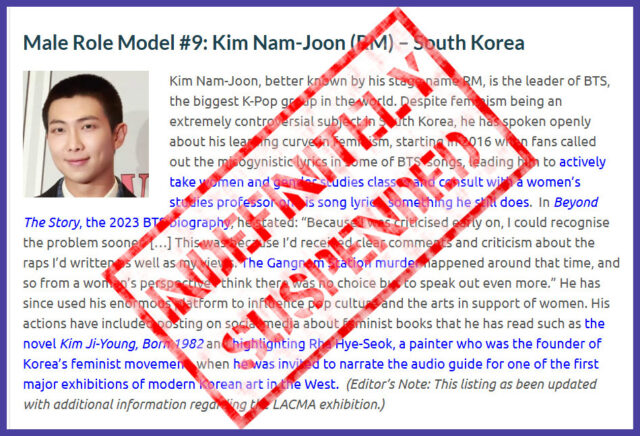
The backlash surrounding BTS leader RM has taken a far more serious turn after The Pixel Project, a nonprofit focused on ending violence against women, indefinitely suspended him from its list of “16 Male Role Models Helping to Stop Violence Against Women.” The decision follows RM and fellow BTS member J-Hope attending Chris Brown and Usher’s concert in Toronto on August 12, followed by a backstage photograph showing the two BTS members with Brown. What initially appeared to be a controversial celebrity encounter has now become a larger debate about accountability, public influence and whether a public figure’s actions can contradict the values for which he was previously recognized.
The controversy became especially significant because RM was not simply an ordinary celebrity on The Pixel Project’s list. The organization had previously presented him as an example of a male public figure who had demonstrated growth in confronting misogyny, supporting women in the arts and speaking about violence against women in South Korea. In 2024, RM was included among 16 male role models, while a 2025 Father’s Day article used him as an example of an “imperfect” male role model capable of learning and changing. The Pixel Project has now announced that it will review and revise that earlier article as well.
That history is what makes the latest decision more damaging than ordinary online criticism. The organization is not accusing RM of personally committing violence against women, and that distinction is important. Instead, The Pixel Project says his public association with Brown conflicts with the standards it expected from someone it had previously elevated as an example of positive male behavior. The controversy therefore centers on association, influence and accountability, rather than an allegation that RM himself engaged in abuse.

The triggering incident occurred on August 12, when RM and J-Hope attended the Toronto concert featuring Chris Brown and Usher. J-Hope shared footage from the performance, and Brown later posted a backstage photograph with both BTS members. For many fans, the photograph transformed the situation from simply attending a concert into something more publicly symbolic because Brown himself shared the image with his enormous audience. The photo subsequently circulated across social media, prompting criticism from fans who believed the BTS members should have considered the implications of appearing alongside Brown.
The criticism is rooted in Brown’s documented legal history, most notably his 2009 felony assault conviction involving Rihanna. His history has continued to generate controversy over the years, and his legal problems have remained part of the public conversation surrounding his career. That history is precisely why some fans argue that celebrities with enormous platforms should be particularly careful about publicly associating with him.

However, the debate is not as simple as saying that attending a concert automatically means RM endorsed everything Brown has ever done. That interpretation is being challenged by supporters who argue that attending a performance does not necessarily constitute approval of an artist’s personal history. Some fans have also questioned whether a celebrity should be expected to publicly distance themselves from every controversial person whose music they encounter. The controversy has therefore divided ARMY rather than producing a universally accepted interpretation of RM’s actions.
The Pixel Project, however, adopted a different standard. Its argument focuses on impact rather than intent. According to the organization, even if RM and J-Hope did not intend their photograph with Brown to serve as an endorsement of an alleged abuser or violence against women, their extraordinary level of fame meant that the image could still have the effect of normalizing Brown in front of millions of people. The organization specifically argued that public figures can contribute to normalization even when they do not explicitly make a statement supporting harmful behavior.
This is arguably the most important part of the controversy. RM does not have the same level of public influence as an ordinary concertgoer. BTS has one of the world’s largest global fan communities, and virtually anything involving its members can spread internationally within minutes. A private individual attending a concert may have little measurable influence on an artist’s reputation. A BTS member appearing publicly with that artist is a completely different situation because the image itself becomes news.
The Pixel Project also emphasized that it had not expected RM to be perfect. In fact, its original decision to include him was based partly on the idea that role models can be imperfect people who demonstrate a willingness to learn and improve. That makes the organization’s decision particularly revealing: it appears to believe the current controversy is not simply about whether RM made one questionable decision, but about what happened afterward.
According to the organization, it waited approximately one week for RM to publicly acknowledge the controversy before making its decision. When no public response came, The Pixel Project described the silence as “deafening.” That phrase has become central to the criticism because it suggests that, from the organization’s perspective, the problem was no longer merely the concert appearance. It was the combination of the controversial association and the absence of a public acknowledgment addressing why the appearance happened.

This creates an interesting question about celebrity accountability. Does remaining silent mean that RM agrees with Brown? Not necessarily. Silence can have many explanations, particularly when a global celebrity is surrounded by management, legal considerations and a carefully controlled public-relations strategy. But silence can also frustrate people who believe that a public figure should acknowledge concerns when an action has caused genuine harm or disappointment among members of his own audience.
That tension is particularly sharp because RM had previously been recognized for publicly engaging with issues involving misogyny and gender equality. The Pixel Project’s original profile praised him for his efforts to address internalized misogyny, support women in the arts and speak about violence against women in a patriarchal social environment. Consequently, critics now see a contradiction between the values associated with his previous recognition and the decision to publicly associate with Brown.
There is also a broader lesson here about the danger of turning celebrities into moral symbols. The Pixel Project itself described RM as an “imperfect” role model, acknowledging that public figures are human and capable of mistakes. Yet the controversy demonstrates how quickly an individual who has been celebrated as a positive example can become the subject of intense scrutiny when one public decision appears inconsistent with that image.
Some online commenters have consequently questioned whether organizations should create celebrity-based “role model” lists in the first place. Discussions surrounding the decision have pointed out that public figures can easily become symbols of values they may never have formally agreed to represent. Once that happens, every future action is measured against the standards attached to the title. The controversy therefore raises a difficult question: is it fair to expect celebrities to maintain an almost flawless moral record simply because an organization once selected them as role models?
At the same time, supporters of The Pixel Project argue that accountability is precisely what makes a role model meaningful. From that perspective, removing RM does not require claiming that he is an inherently bad person. It simply acknowledges that his recent public conduct no longer aligns with the criteria under which the organization previously recognized him. The Pixel Project has therefore left open the possibility of reassessing his status in the future rather than permanently declaring him unworthy of recognition.
The reaction among ARMY has reflected this complicated divide. Some fans have defended RM and J-Hope, arguing that attending a concert does not automatically mean endorsing the performer’s entire history. Others have openly criticized the BTS members, saying that being a fan does not require defending every decision they make. Some fans have gone further, arguing that public figures with enormous audiences have a greater responsibility to consider who they publicly support and associate with.
That last argument may ultimately become the most influential one. BTS members have spent years building an image connected to messages of self-love, youth empowerment and social responsibility. The group’s previous partnership with UNICEF and its broader public advocacy have made its members more than conventional entertainers in the eyes of many supporters. Because of that history, some fans believe their choices should be evaluated according to a higher standard than those of ordinary celebrities.
Still, it would be premature to assume that the controversy will permanently damage RM’s reputation. The Pixel Project is a nonprofit organization, not a regulatory body, and its decision does not impose a legal or professional penalty on RM. The suspension is symbolic, but symbolism can be extremely powerful in celebrity culture. Being removed from a list that once celebrated him as a male role model creates a narrative that can spread far beyond the organization itself.
More importantly, the controversy may ultimately be determined by what happens next. If RM eventually acknowledges the criticism and explains his position, the situation could begin moving toward reconciliation. If he continues to remain silent, critics may interpret that silence as further evidence that he does not understand why the association caused concern. Meanwhile, supporters may continue arguing that the public is assigning intentions to him that have never been explicitly stated.
The most balanced conclusion is that The Pixel Project’s suspension is not proof that RM personally supports violence against women, but it is a clear statement that the organization believes his recent public choices conflict with the standards expected of someone previously presented as a role model against such violence. The controversy is ultimately less about a single photograph than about what that photograph represents when attached to one of the world’s most influential music stars.
For RM, the most difficult part may not be losing a place on a nonprofit’s honor roll. It may be confronting the contradiction between the public image of growth and accountability that once earned him recognition and the silence that has followed this latest controversy. The Pixel Project has now drawn a line, but whether that line becomes a temporary setback or a lasting change in how RM is perceived will likely depend on what he chooses to do next. The photograph may have lasted only a moment, but the conversation about responsibility, influence and accountability surrounding it is only getting bigger.