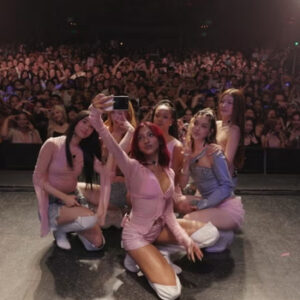
BIBI has finally addressed the controversy surrounding her headline-making performance at Waterbomb Seoul 2026, and her explanation reveals that the provocative staging was not something she approached casually. During the August 28 broadcast of My Grumpy Secretary, she explained that she believes performers should give audiences the full value of the money they spent on tickets. She described preparing intensely for three months and approaching the festival as though it could be her final opportunity to perform. That mindset helps explain why she pushed herself to deliver an unusually dramatic and physically demanding stage. Yet her explanation also exposes the complicated boundary between artistic freedom, audience expectations, and the pressure entertainers feel to make every performance unforgettable.
BIBI’s Waterbomb appearance quickly became one of the most discussed performances of the 2026 festival. While many viewers praised her confidence, stage presence, and willingness to create a spectacle, others argued that some parts of the choreography crossed into excessive sensuality. The most controversial moment came when BIBI, wearing a wet jumpsuit, dramatically unzipped it while kneeling and revealed a bikini top underneath. Rather than simply being another choreography choice, the moment became the visual centerpiece of the performance and consequently dominated much of the online discussion. The debate was intensified by the fact that BIBI already had a history with Waterbomb, including her widely discussed handling of a near wardrobe malfunction at the festival in 2022. As a result, audiences were not evaluating the 2026 performance in isolation but comparing it with an earlier moment that had already become part of her public image.
What makes BIBI’s response particularly interesting is that she does not appear to frame the performance as an accident or something she regrets. Instead, she explains it through a philosophy of professional responsibility: if people spend money to watch her perform, she believes she owes them a memorable experience. That argument shifts the discussion away from whether a particular movement was “too sexy” and toward a broader question about what audiences actually purchase when they buy concert tickets. They are not simply paying to hear songs reproduced live; they are paying for an experience that cannot be obtained by streaming an album at home. BIBI appears to understand that distinction very clearly, and her three months of preparation suggest that the performance was intended to be a carefully constructed event rather than spontaneous shock value.
However, there is a potential weakness in the “money’s worth” argument that deserves attention. Giving fans their money’s worth does not necessarily mean giving them the most provocative or physically extreme performance possible. Different audiences define value in radically different ways, with some prioritizing vocals, musicianship, choreography, emotional connection, production quality, or simply the opportunity to see an artist they admire. BIBI’s philosophy is therefore personal rather than universal, and it should not automatically become the standard by which every performer is judged. At the same time, critics of her performance cannot automatically claim that a sensual performance has less artistic value simply because they personally find it uncomfortable. The controversy ultimately demonstrates that “fan service” and “artistic expression” can overlap without being exactly the same thing.
Another revealing part of the story is the contrast between BIBI’s confidence on stage and her nervousness backstage. During the television program, viewers reportedly saw her trembling and stretching repeatedly before the performance, even though she eventually became one of the most talked-about artists at the festival. That contrast humanizes the controversy because the confident figure audiences saw on stage was apparently dealing with intense nerves immediately beforehand. Her preparation was not simply about creating a provocative moment but about mentally and physically preparing herself to deliver under enormous pressure. The backstage footage therefore complicates the idea that BIBI was simply trying to generate attention. It suggests that behind the spectacle was an artist who cared deeply about whether she could execute the performance successfully.
This distinction matters because provocative entertainment is often judged entirely through the final few seconds that become viral online. A short clip can remove the surrounding choreography, the musical context, the preparation, and the artist’s intention, leaving viewers to interpret the most sensational moment on its own. That is particularly relevant to BIBI because her Waterbomb performance was designed as a complete stage rather than a single viral gesture. Her explanation indicates that she had spent months preparing for the overall showcase, meaning the controversial moment represented only one part of a much larger performance concept. Nevertheless, once a dramatic image becomes the dominant social-media clip, the rest of the artistic work can disappear from the conversation. The result is a familiar problem in modern pop culture: the most controversial five seconds can overshadow months of preparation.

BIBI’s approach also reflects how Waterbomb itself has changed the expectations surrounding festival performances. Unlike a conventional indoor concert, Waterbomb is built around water, heat, summer energy, revealing stage outfits, and a highly physical atmosphere. Performers are expected to interact with the environment rather than simply stand behind microphones and reproduce studio arrangements. That environment naturally creates space for artists to emphasize physicality and spectacle more aggressively than they might at a traditional music festival. BIBI’s performance therefore existed within a setting where sensuality and visual impact were already part of the event’s broader identity. The disagreement is less about whether Waterbomb allows spectacle and more about where individual viewers believe the boundary should be drawn.
Her statement about treating the performance as though it were her final stage is arguably even more revealing than the “money’s worth” comment. It suggests an all-or-nothing mentality in which every major opportunity must be approached with maximum commitment. That mindset can produce extraordinary performances because artists stop holding back and focus completely on creating something memorable. But it can also create pressure to constantly escalate, because once audiences have seen one spectacular performance, the next one is expected to be even more unforgettable. For artists such as BIBI, whose image already embraces unconventional and provocative elements, that escalation can become especially difficult. The challenge is maintaining artistic authenticity without allowing the demand for virality to determine every creative decision.
There is also a gendered dimension to the controversy that should not be ignored. Female performers are often simultaneously encouraged to be confident, sexy, charismatic, and visually bold while being criticized when they appear to cross an undefined line. The same performance can therefore be interpreted as empowerment by one viewer and inappropriate by another. BIBI’s response implicitly asserts her right to determine how she presents herself on stage rather than allowing external expectations to define her boundaries. That does not mean every audience member must like the result, but it does mean the discussion should distinguish between personal discomfort and legitimate criticism of performance quality or context. Otherwise, female artists can end up trapped in a contradictory expectation where they are praised for being fearless until they become too fearless for someone’s taste.

At the same time, BIBI’s explanation does not completely eliminate the criticism. An artist can have genuine intentions and still create a performance that some viewers reasonably find excessive. Artistic freedom does not require universal approval, and audience members who felt uncomfortable are allowed to express that reaction. The important distinction is between criticizing the artistic choice and attacking BIBI personally. The available reporting shows that the response was mixed, with many praising her stage presence while others criticized the choreography as overly explicit. That split is actually evidence that the performance succeeded in generating a strong reaction, although controversy itself should not automatically be treated as proof of artistic quality.
The reference to BIBI’s 2022 Waterbomb appearance adds another fascinating layer. During that earlier festival performance, she experienced a near wardrobe malfunction but handled the situation professionally, an incident that became part of her reputation for staying composed under pressure. Four years later, her 2026 performance deliberately leaned much further into theatrical control of her image. The difference suggests that BIBI is increasingly comfortable deciding exactly how much vulnerability, sensuality, and unpredictability she wants to incorporate into a live performance. Instead of merely reacting to an unexpected wardrobe problem, she was now controlling the visual reveal herself. That transformation is important because it reframes her as an artist actively managing her stage identity rather than simply becoming the subject of viral moments.

Ultimately, BIBI’s response makes the Waterbomb controversy more complicated rather than ending it. She did not apologize for giving audiences a bold performance, nor did she dismiss the criticism by pretending that nobody was uncomfortable. Instead, she explained the work ethic and philosophy behind the stage, emphasizing three months of preparation and her belief that ticket buyers deserve an experience worth remembering. That explanation may convince some critics while leaving others unconvinced, but it at least provides context that short viral clips cannot capture. The larger lesson is that modern performers are increasingly judged not only on whether they can sing or dance but on whether they can create moments powerful enough to dominate the internet.
In the end, BIBI’s Waterbomb controversy may say as much about the modern concert economy as it does about BIBI herself. Fans pay for live entertainment because they want something bigger, more immediate, and more emotionally intense than what a recording can provide. BIBI clearly believes that obligation requires her to leave everything on the stage, even if the result divides the audience. Her performance may have been too provocative for some viewers, but the available evidence suggests that it was neither careless nor accidental; it was the product of months of preparation and a deliberate philosophy about live entertainment. The real question is not whether everyone should approve of BIBI’s choices, but whether artists should still be allowed to define their own performance boundaries when those choices are made deliberately and professionally. In that sense, the Waterbomb debate is unlikely to disappear soon, because BIBI has exposed a much bigger tension at the heart of modern pop performance: audiences want unforgettable experiences, but they do not always agree on what unforgettable should look like.