It began with a confession that would unsettle even the most devoted believers: “Jesus doesn’t actually make for a good main character.” From that provocative realization, director Dallas Jenkins ignited a creative gamble that would ultimately redefine how one of history’s most sacred stories could be told on screen.
Long before The Chosen became a worldwide sensation, Jenkins found himself at a personal and professional crossroads. Struggling after setbacks in his filmmaking career, he turned inward—and upward. “I truly surrendered,” Jenkins says. “Instead of trying to make another big movie, I figured I’m going to do what I feel is best, what is most honoring to God and to my wife and people I care about. I’ll make anything.”

That mindset led him to create a modest project for his church, Harvest Bible Chapel—a Christmas Eve short film centered on the birth of Christ. Despite its spiritual focus, the production was far from minimal, carrying a $100,000 budget. Written alongside Tyler Thompson, the film approached a familiar biblical moment through an unexpected lens: the perspective of a shepherd.
This narrative choice was not new territory for Jenkins. He had previously experimented with telling biblical events through secondary figures, including a short film about the crucifixion that focused on the two thieves beside Jesus. What he discovered was striking—these overlooked characters grounded the story, making it feel more human, more accessible, and more emotionally immediate.
Then came the breakthrough.

While running on a treadmill and watching HBO’s The Wire, Jenkins experienced what he would later describe as a defining moment of inspiration. What if the story of Christ could be told not as a traditional, singular narrative, but as a sprawling ensemble drama? A series that moved between different perspectives—social, political, and personal—while placing supporting characters at the forefront?
“I thought, ‘Man, this could be so cool. Whoever does this is going to look really smart,’” Jenkins recalls.
The idea was bold—but also risky. Biblical storytelling has long been treated with reverence and caution, and any attempt to reinterpret it carries the potential for backlash. Jenkins was well aware of the precedent set by Martin Scorsese’s controversial 1988 film The Last Temptation of Christ, which faced widespread criticism and boycotts. He had no desire to alienate his own faith community, yet he understood that reaching modern audiences would require breaking away from conventional portrayals.
“I know this sounds bad, but Jesus doesn’t actually make for a good main character,” he says. “He doesn’t learn anything. He doesn’t grow. He doesn’t struggle.”
Instead of centering the narrative entirely on Jesus, Jenkins shifted the focus to those around Him—the disciples, followers, and even adversaries whose lives intersected with His. This approach allowed for character development, internal conflict, and transformation—elements that traditional depictions often struggle to emphasize.
To bring the project to life, Jenkins partnered with Angel Studios, then known as VidAngel. At the time, the company was primarily recognized for offering edited versions of mainstream films for Christian audiences. Their proposal for funding, however, surprised him: a crowdfunding model similar to the one that revived Veronica Mars.
Jenkins initially dismissed the idea. “Ridiculous,” he thought. But his skepticism quickly turned to astonishment when the campaign raised $11 million in its first round—a record-breaking achievement for a television or film project.
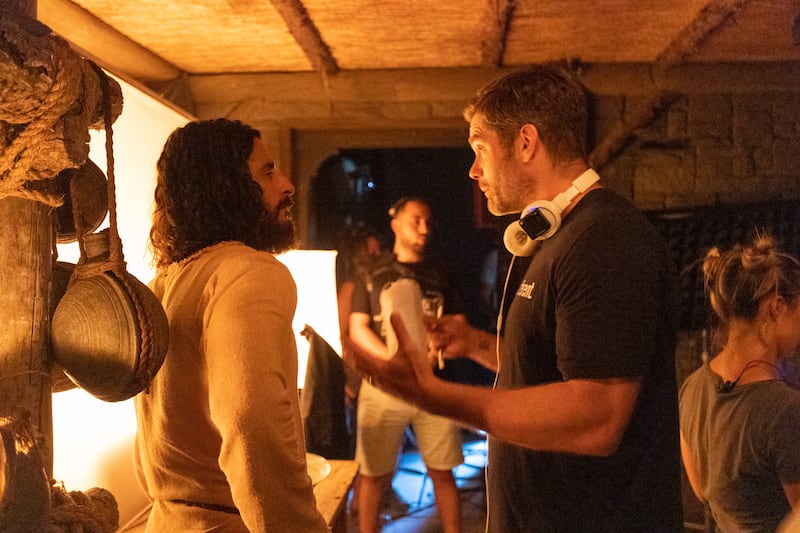
The first season of The Chosen was produced on a tight budget, with rural Texas standing in for ancient Judaea and Galilee. Jenkins operated out of Midlothian, a small town that became the unlikely backdrop for a story of global significance. The cast featured actors of diverse ethnic backgrounds, all adopting Middle Eastern accents to enhance authenticity.
From the very beginning, the series embraced creative risks.
Mary Magdalene, portrayed by Elizabeth Tabish, is depicted as both an alcoholic and a survivor of sexual trauma. Matthew, played by Paras Patel, is reimagined as a tax collector on the autism spectrum. Even the Roman authorities—traditionally portrayed as purely oppressive—are given moments of relatability.
The narrative initially centers on Simon, played by Shahar Isaac, whose introduction includes a street fight—an unconventional entry point for a biblical drama. “Simon has the biggest and most temperamental arc, and we thought, ‘He’s the James Kirk of the story,’” Jenkins explains.
Stylistically, the pilot episode drew inspiration from The West Wing. Much like President Bartlet’s delayed appearance in that series, Jesus does not appear until the final moments of the first episode—a deliberate choice that builds anticipation and intrigue.
Casting Jesus himself was another critical decision. Jenkins selected Jonathan Roumie, a relatively unknown actor whose natural resemblance to traditional depictions of Christ had long been noted by those around him. Roumie’s portrayal combines warmth, quiet authority, and subtle humor, presenting a version of Jesus that feels both approachable and profound.
“Dallas tried to temper my expectations, like, ‘Look, this probably won’t go anywhere, but at least it’ll be a couple of episodes of work,’” Roumie recalls.
Limited resources, rather than hindering the production, often enhanced its creativity. When it came to depicting miracles, Jenkins avoided elaborate visual effects. Instead, he opted for understated techniques that emphasized realism. In one scene, as Jesus fills Simon’s fishing nets, the boat suddenly jerks under the weight—a simple yet effective moment that conveys awe without spectacle.

When The Chosen debuted on the Angel Studios app in 2019, it carried a disclaimer acknowledging that certain elements—dialogue, backstories, and character details—had been adapted or expanded beyond the Gospel accounts. Jenkins understood the sensitivity of these choices.
“People just needed to know that I know that this is different and difficult,” he says. “I’m not apologizing — this is such a dangerous show that if I cared at all about what people think, it’d cripple me.”
What emerged from that risk was not just a television series, but a cultural shift—one that challenged expectations while inviting audiences into a more intimate, character-driven exploration of faith.
And at its core lies a daring creative truth—one that doesn’t diminish its subject, but instead redefines the lens through which the story is told—ultimately exposing a bold vision that continues to reshape how the life of Jesus is portrayed on screen.