Wallace is arguably the perfect person to explain where Landman separates reality from television. Before working with Sheridan, he spent time reporting on the West Texas oil boom and created the Boomtown podcast, which explored the people, money and dangers surrounding the Permian Basin. His firsthand experience means the show’s writers are not simply imagining what oil workers do based on stereotypes. Wallace has said that the production uses real drilling rigs and real roughnecks whenever possible, creating an environment where the actors and audience can see genuine oil-field equipment and working conditions rather than Hollywood substitutes. That commitment to authenticity gives Landman an unusually credible foundation even when the story itself becomes dramatically exaggerated.
One of the show’s strongest areas of realism is its depiction of the oil-field environment itself. The roughnecks, drilling operations, terminology and dangerous working conditions are rooted in experiences that Wallace encountered during his reporting and time around the industry. Some of the show’s most disturbing accidents are not simply inventions designed to shock viewers, but dramatizations of real types of incidents that have occurred in oil fields. Wallace has previously explained that the series went deeply into oil-field accidents and safety, including a pipe-crushing death based on a real story he had heard from his uncle. These moments are important because they reveal the physical danger underlying an industry that can otherwise look glamorous when viewed only through the enormous amounts of money it generates.
However, authenticity does not mean that Landman is a documentary. Wallace openly acknowledges that the writers sometimes use shortcuts when communicating technical information to the audience. In real life, an oil professional might spend considerable time discussing exactly which gauge, piece of equipment or drilling procedure is being referenced, but television cannot always afford that level of technical precision. The production therefore sometimes simplifies terminology so viewers can understand what is happening without turning every scene into an engineering lesson. Wallace’s point is essentially that the show tries to preserve the truth behind the work while simplifying certain details for storytelling purposes. That distinction explains why industry insiders may occasionally notice something that feels technically imprecise even though the broader situation remains recognizable.
Tommy Norris himself represents perhaps the biggest compromise between realism and entertainment. A real landman’s job is generally far less glamorous than Tommy’s daily life suggests. Wallace has joked that if the series showed what landmen actually spend much of their time doing—pulling files, researching records and working on computers—audiences would quickly lose interest. Tommy is therefore written as a dramatically enhanced version of the profession, functioning almost like an oil-industry fixer who can move between executives, landowners, lawyers, workers and emergencies. Real landmen certainly negotiate leases, manage relationships and deal with complicated property issues, but Tommy’s constant involvement in life-or-death situations is clearly designed for television rather than representative of an average workday.
That creative exaggeration becomes especially obvious when Tommy’s relationship with organized crime enters the story. The show presents cartel threats as an intense and sometimes deeply personal danger, creating a storyline in which the oil business becomes entangled with violence, kidnapping and high-level criminal operations. Wallace has acknowledged that drug trafficking, oil theft and equipment theft are genuine issues in the region, meaning the basic environment is not invented from nothing. What is fictionalized is the extent to which a landman like Tommy would personally become involved with a cartel in the manner shown on screen. In other words, Landman takes a real regional problem and dramatically amplifies it into a central thriller storyline.
One particularly interesting example demonstrates how Sheridan transforms reality into television spectacle. In the first season, a cartel-related sequence involves a small plane landing on a remote road in West Texas. That might initially seem like one of Sheridan’s more outrageous inventions, but Wallace revealed that the sequence had a real historical inspiration. He had encountered accounts involving cartel aircraft landing on extremely rural roads to unload cargo, with Texas Rangers eventually ambushing them. The series took that real-world kernel and built a much larger dramatic scenario around it. This is arguably the best way to understand Landman: the show often starts with something that genuinely happened and then asks how far it can push the situation while keeping the story entertaining.
The same principle applies to the show’s depiction of the oil business as a high-stakes ecosystem. The financial scale is real, the competition is real and the consequences of mistakes can be enormous. But television compresses timelines and concentrates responsibility into a handful of characters because a realistic corporate structure would involve dozens of departments, lawyers, engineers, managers and contractors. Tommy consequently becomes a narrative shortcut for a much larger system. He can solve problems, negotiate deals and confront threats that would realistically be distributed among multiple professionals. That does not necessarily make the show worthless as a representation of the industry; instead, it means viewers should treat Tommy as a dramatic composite rather than a typical landman.
The show’s attention to oil-field language and culture is another reason many viewers familiar with the industry have praised it. Former industry professionals have noted that Landman understands the role of the landman as a middleman connecting different parts of the business. Matt Toohey, a land manager in San Antonio, has said that the show succeeds in capturing the business’s language and portraying the landman as the company’s intermediary. At the same time, he has pointed out that some of Tommy’s activities are unrealistic, particularly situations in which the character personally operates wells. That combination of praise and criticism is revealing because it suggests that the show’s authenticity is strongest when it focuses on the structure and culture of the industry rather than on Tommy’s extraordinary individual abilities.

Another area where viewers should be particularly cautious is the show’s broader commentary about energy and environmental issues. Landman frequently gives Tommy strong opinions about oil, renewable energy and the importance of fossil fuels, and those speeches can sound authoritative because they are delivered by a character deeply embedded in the industry. But a fictional character’s argument should not automatically be treated as an objective explanation of scientific reality. Earlier criticism of the series has pointed out that some of its claims about wind power and carbon emissions are contested by established research. The distinction matters because Landman is simultaneously telling a dramatic story and presenting a particular worldview about energy, and those two functions should not be confused.
The show’s approach to environmental and political questions therefore makes its realism more complicated. The oil industry depicted by Sheridan is not merely a workplace; it is presented as a fundamental part of modern American life, with enormous economic and geopolitical consequences. That perspective reflects how many people working in the sector understand their own importance, but it is still a perspective rather than a neutral documentary account. Wallace’s role is particularly interesting because his contribution provides firsthand industry knowledge while Sheridan transforms that material into a dramatic narrative with strong ideological and emotional positions. The result is a series that can be authentic about how people in the oil industry talk and work while still presenting a highly stylized interpretation of what the industry means.
Even the show’s seemingly unusual details can have roots in reality. Wallace has previously defended elements that viewers might assume were invented, including bikini-clad baristas in the Texas oil region. His explanation is not that every bizarre event shown in Landman happens regularly, but that many of these details exist somewhere within the real culture surrounding the oil boom. That is an important distinction. Authenticity does not require every event to be statistically normal; it can simply mean that the world contains recognizable details drawn from real observation. Sheridan then arranges those details into a concentrated narrative where unusual events happen far more frequently than they would in ordinary life.
This is ultimately why Landman can feel both extremely authentic and wildly unrealistic at the same time. The production has made a serious effort to reproduce the physical environment, terminology and culture of the oil fields, while the story deliberately amplifies danger and conflict. Wallace himself has described this as a process of finding compromises between reality and what makes compelling television. If the writers followed reality literally, viewers would spend far more time watching paperwork, computer research, meetings and routine negotiations. Sheridan instead takes the underlying truth and concentrates the most dramatic elements into Tommy’s life, creating a character who experiences an impossibly intense version of an already complicated profession.
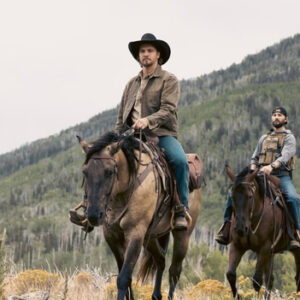
The distinction is particularly important when considering the show’s reputation as a modern Western. Landman may not feature the horses, ranches and cattle that dominate Yellowstone, but Sheridan treats the Permian Basin as another frontier where money, land and power collide. The oil field becomes the new range, drilling rigs replace some of the traditional symbols of Western labor and corporate negotiations take the place of old-fashioned territorial disputes. Violence remains close to the surface, while men are frequently judged by their ability to survive dangerous environments and protect their interests. In that sense, the show’s heightened drama is not an accident; it is part of Sheridan’s deliberate transformation of contemporary Texas into a modern Western landscape.
Christian Wallace’s involvement is what prevents that transformation from becoming completely detached from reality. His background gives the series access to stories, terminology and experiences that a conventional Hollywood production might struggle to reproduce convincingly. He has described spending substantial time on set helping with equipment, costumes, dialogue and other details, effectively serving as an authenticity filter between the fictional script and the real oil industry. Sheridan provides the heightened drama, while Wallace helps ensure that the world underneath that drama remains recognizable. Their partnership is arguably the central reason Landman can exaggerate so aggressively without completely losing its connection to the industry that inspired it.
The most revealing part of Wallace’s explanation may therefore be his admission that accuracy depends on who you ask. An oil worker with decades of experience may immediately identify small inaccuracies that an ordinary viewer will never notice. Another industry professional may recognize the broader situation and consider the portrayal remarkably convincing. Both reactions can be valid because Landman is operating at two levels simultaneously. It is technically detailed enough to reward viewers familiar with oil and gas, but it is also deliberately simplified and intensified for an audience that wants drama rather than an instructional course in petroleum engineering.
Ultimately, Landman should neither be dismissed as completely fictional nor treated as a reliable documentary about the oil business. Its strongest elements are grounded in real people, real places, real terminology, genuine workplace dangers and documented experiences from the Permian Basin. Its weakest claims emerge when dramatic storytelling is mistaken for objective fact, particularly when characters make sweeping statements about energy, politics or the industry’s future. Christian Wallace’s explanation makes the formula clear: the production wants to get as close to reality as possible, but it also knows that reality alone would not make good television.
That may actually be the secret behind Landman‘s appeal. The series does not need every scene to be literally accurate to make audiences feel that they are witnessing a real world. It needs the details that surround the drama—the rigs, the terminology, the roughnecks, the dangerous accidents, the land negotiations and the culture of West Texas—to feel authentic enough that viewers believe the larger story could happen somewhere beyond the screen. Sheridan then takes those authentic ingredients and turns the intensity up to an almost impossible level. So the answer to whether Landman is accurate is neither a simple yes nor a no: the oil field is real, many of its details are real, and some of its most frightening incidents have real-world roots—but Tommy Norris is television’s version of that world, where ordinary oil-field problems are transformed into extraordinary battles for survival.