In February 1944, during the peak of what would later be known as “Big Week,” the United States Army Air Forces launched massive bombing operations aimed at crippling Nazi Germany’s aircraft industry. From airbases scattered across East Anglia, hundreds of heavy bombers took off day after day, flying deep into enemy territory with a single objective: strike at the industrial heart of the German war machine. On one of those cold, gray mornings, with fog still clinging low over the runway, James Stewart walked toward the B-24 Liberator he would command that day, carrying the quiet understanding shared by every crewman around him—that each takeoff might be their last.
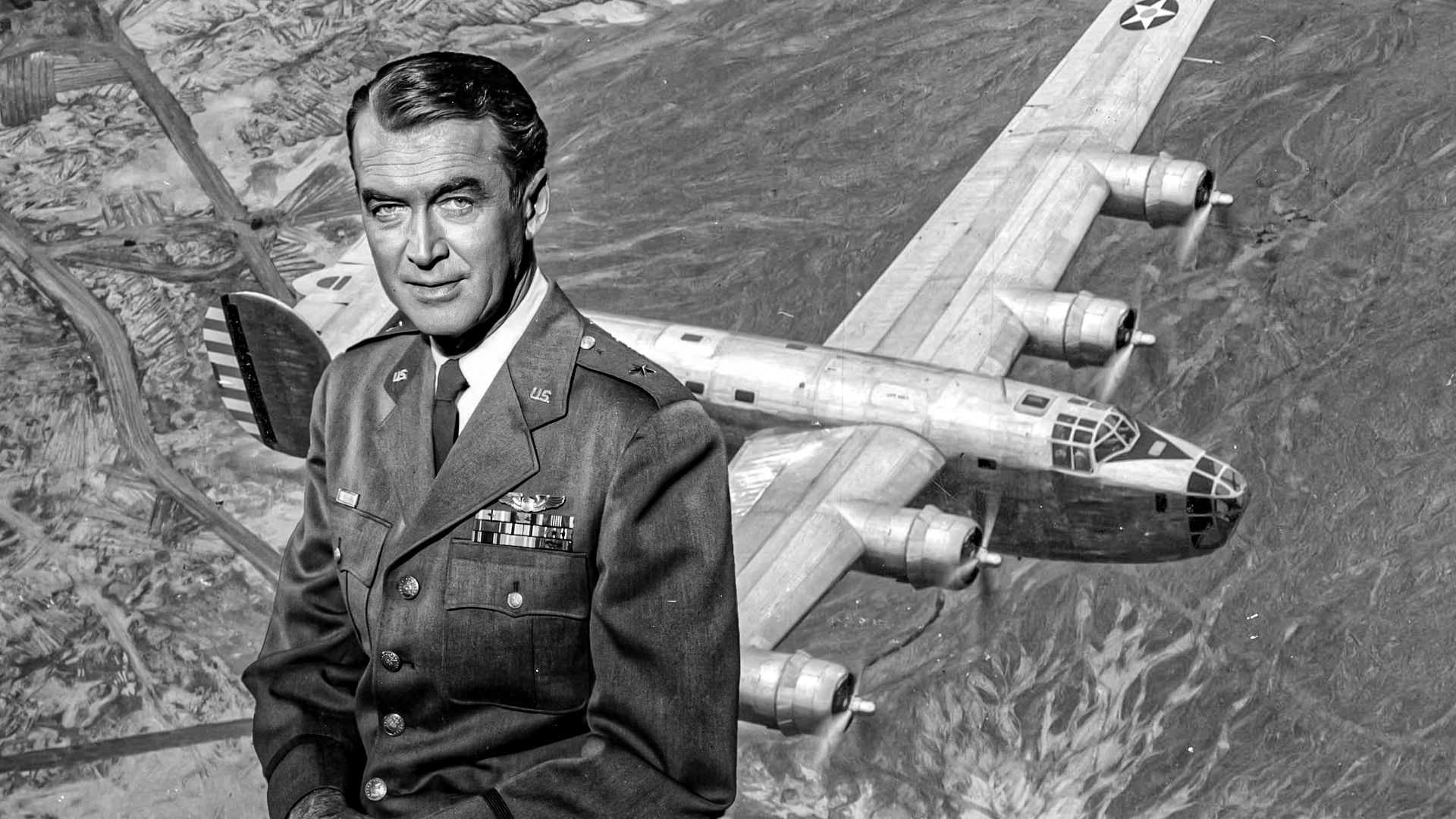
The target lay near Brunswick, a key industrial center tied to German aircraft production, and reaching it meant flying hundreds of kilometers through heavily defended airspace where anti-aircraft systems were not only dense, but terrifyingly precise. As the B-24s lifted off one by one, heavy but steady, and gradually formed into a tight formation over the gray English sky, no one aboard believed this would be a simple flight. They knew exactly what lay ahead—it wasn’t a mission, it was a passage through fire.

The moment they crossed the coastline into continental Europe, the atmosphere changed. The sense of safety vanished, replaced by a suffocating silence that lasted only seconds before everything erupted. German anti-aircraft fire—Flak—opened up without warning. The first explosions were scattered, but within moments, the sky filled with bursts of black smoke, each one marking a shell detonating at a precisely calculated altitude. This wasn’t random fire. It was mathematics, experience, and deadly efficiency combined.
Stewart’s aircraft shuddered as fragments tore through the air around them. The sharp clang of metal being struck echoed through the fuselage, but he kept his hands steady on the controls, eyes fixed forward. In that moment, survival didn’t come from dodging every shell—it came from holding formation. If the formation broke, each bomber would become an isolated target, and isolated targets did not survive long.
Despite every effort to maintain cohesion, war had its own logic. Within minutes of entering the flak zone, a B-24 flying ahead took a direct hit. The explosion wasn’t catastrophic, but it was enough. One engine burst into flames, and the aircraft lurched violently. For a few seconds, it fought to stay in position, as if the crew inside were refusing to give in, but then it began to fall behind, trailing a thick column of smoke across the sky. No one could help. No one was allowed to break formation. That was the cruelty of aerial warfare—everyone saw it, but no one could act.
The tension inside Stewart’s cockpit tightened, but there was no time to dwell on it. A new threat was already approaching. Distant specks appeared on the horizon, growing larger, moving faster than the bombers, closing the gap with alarming speed. Within seconds, they were unmistakable—Messerschmitt Bf 109 interceptors.

Unlike flak, the fighters didn’t attack immediately. They circled, observed, selected. They hunted the weak—the damaged, the stragglers, the vulnerable. One of them broke formation and angled directly toward Stewart’s aircraft, approaching from behind as the warning crackled through the headset. The air inside the cockpit seemed to thicken as the distance closed.
The tail gunner opened fire, streams of tracer rounds cutting across the sky, forcing the German fighter to veer away. But it didn’t leave. It circled back, lower and faster this time, lining up with deadly precision. When it fired, the impact was immediate. The bomber jolted hard, and a voice cut through the intercom—one engine had been hit.
The aircraft lost speed. It grew heavier, harder to control. And most dangerously, it began to drift backward, slipping out of formation.
This was the moment every pilot feared. Stewart had a choice—reduce speed, break away, and try to survive alone, or hold position and risk everything to keep the formation intact. He didn’t hesitate long, and the choice he made was not the safe one. He held course, adjusting the controls carefully to compensate for the damaged engine, maintaining just enough speed to avoid falling behind while not overstraining the remaining engines.
The German fighter returned for another pass, but this time the gunners were ready. A concentrated burst of fire forced it to break off. There was no time to celebrate. The formation had reached the target.
For a few critical seconds, everything had to be perfect. Bombers aligned. Altitude steady. Speed controlled.
“Bombs away.”
The payload dropped toward Brunswick below, striking the industrial complex as planned.
The mission objective was achieved.
But the most dangerous part was still ahead—the return.
As the bombers turned back, Stewart’s aircraft could no longer keep pace. The gap between him and the formation widened until, eventually, he was alone. No covering fire. No mutual defense. Just a single damaged bomber over enemy territory.
Time stretched painfully. Every vibration felt like a warning. Every sound suggested another attack. But none came. No fighters returned. No flak followed. Whether it was luck, timing, or something else entirely, he was given a narrow path out.
When the coastline finally appeared, followed by the familiar outline of England, the tension that had held tight for hours began to ease. The runway came into view, and Stewart guided the damaged B-24 down with extreme caution, knowing that landing with a failed engine could be just as deadly as the mission itself. The aircraft touched down hard, shuddered, but held together, rolling to a stop.
There was no cheering. No celebration.
Only silence.
James Stewart stepped off the aircraft like any other pilot, offering little about what had just happened. To him, it was simply another mission.
But to those who understood aerial combat, it was something else entirely—a flight where one different decision, one small mistake, would have meant he never came back.