In 1940, as war spread across Europe while the United States still remained on the sidelines, Hollywood continued to glow as if it belonged to a completely different world. Among its brightest stars was James Stewart—tall, slender, soft-spoken, and already one of the most respected actors of his time. He had just won an Academy Award, his career was soaring, and his future seemed secure under the spotlight.
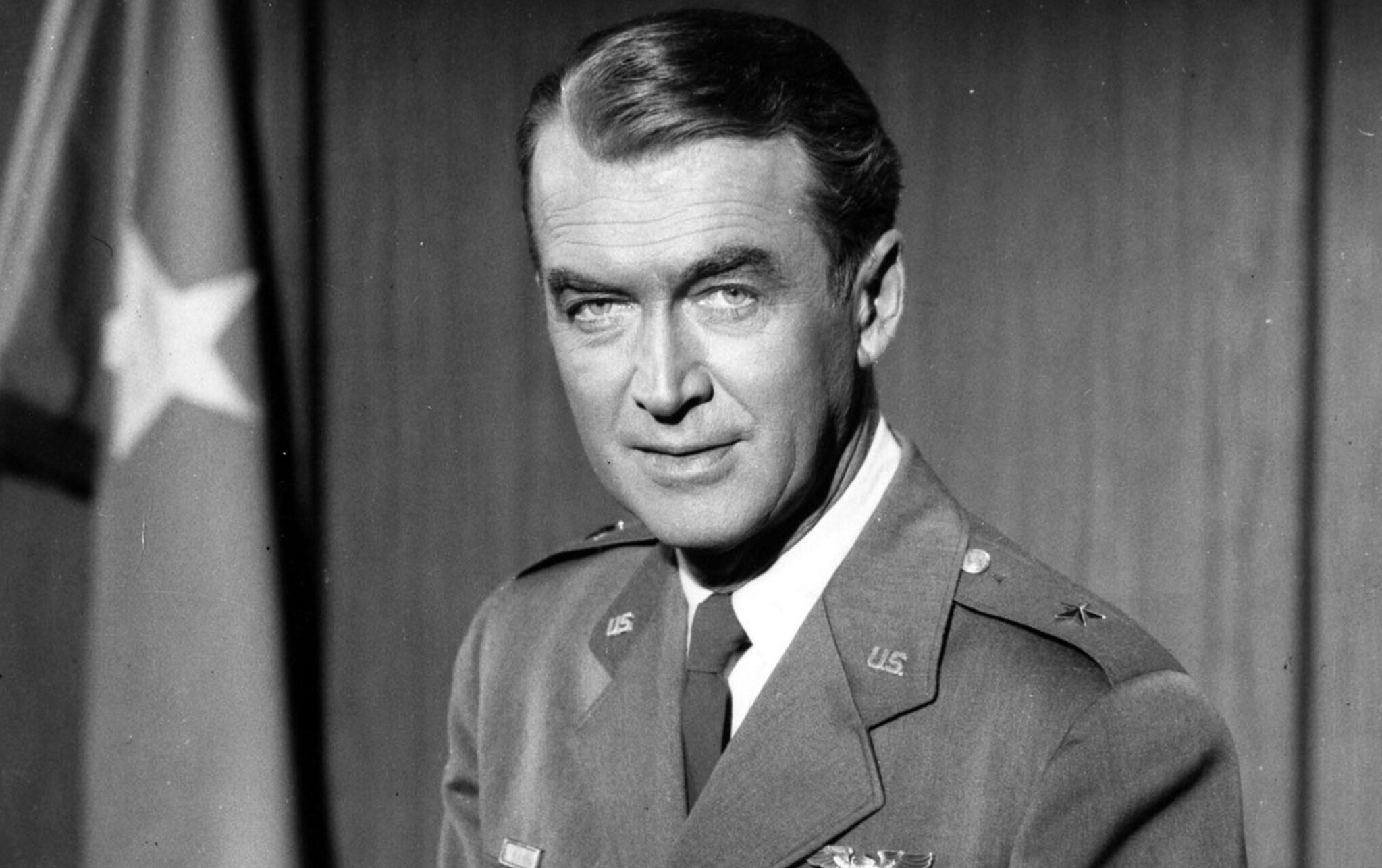
He could have stayed. No one would have blamed him.
But Stewart didn’t see the world that way.
While others in the film industry tried to keep their distance from the growing conflict, he felt drawn toward it. Not because of pressure, not for publicity, but because of a simple belief: if ordinary men were expected to go to war, then he had no right to remain behind simply because he was famous.
So he enlisted.
The day he walked into the recruitment center, there were no cameras, no applause, no recognition. Just a plain room, rows of wooden chairs, and men waiting for their turn. In that place, James Stewart was not a movie star. He was just another applicant.
The examination began normally. Height—acceptable. Vision—good. Reflexes—steady. Nothing seemed to stand in his way.
Until he stepped onto the scale.
The metal dial moved… then stopped.
Underweight.
Not by much. Just a few pounds. But in the military, “almost enough” still meant “not enough.”
The officer wrote down the number, looked up, and said flatly:
“You don’t meet the standard.”
No argument. No exception.
That was it.
The moment was quiet, almost insignificant on the surface. But for Stewart, it carried a weight far greater than any failure he had experienced in Hollywood. Not because he had been rejected—but because he had been denied the chance to serve in something he believed was his duty.
He walked out in silence.
But he didn’t walk away.
The days that followed brought no dramatic announcements. No public statements. Just a private decision: he would come back—and next time, he would qualify.
His life changed in small, deliberate ways. He began eating more, even when he didn’t feel like it. He trained his body, not to become an athlete, but simply to gain what he lacked. Every meal became a task. Every day became progress.
No one saw that struggle.
There were no headlines, no applause.
But to Stewart, it was a real battle—one fought against his own limits.
People around him didn’t understand. Why would a man at the peak of fame push himself this way? Why chase something he didn’t need?
But Stewart wasn’t trying to prove anything to others.
He was proving something to himself.
Weeks later, he returned.
Same room. Same process. Same scale.
This time, everything felt slower.
The needle rose… a little further… and then stopped.
Above the required mark.
Not by much.
But enough.
The officer checked the number, looked up, and said:
“You’re in.”
Two simple words.
And everything changed.
From that moment, James Stewart was no longer an outsider. But what he entered was not glory—it was discipline, hardship, and a system that did not care who he used to be.
Training was unforgiving. There were no privileges for being a Hollywood star. In fact, it made things harder. Some doubted him. Some assumed he was only “playing a role.”
There was only one way to erase that doubt.
Work.
He learned everything from the beginning—military discipline, endurance, flight training. There were mistakes, pressure, and exhaustion. But he never tried to stand out.
He just tried to improve.
Day by day.
Gradually, the skepticism faded.
He was no longer “the actor.”
He was a pilot.

After the Attack on Pearl Harbor brought the United States fully into the war, Stewart was no longer preparing.
He was flying.
He became a bomber pilot, flying missions over Europe—missions that meant entering heavily defended airspace, facing anti-aircraft fire, enemy fighters, and the constant possibility of not returning.
There were no second takes.
No scripts.
Only decisions made in seconds.
At first, he was not the most exceptional pilot. But he was one of the most determined. He learned from every mission, every mistake. And unlike some, he never avoided danger.
He volunteered for more flights.
Not for recognition.
But because he believed it was his responsibility.
Over time, he didn’t just fly.
He led.
From pilot to squadron commander, his role grew heavier. The decisions he made no longer affected only himself—they affected the lives of others.
Men who depended on him.
Men who might not come back.
The pressure was immense.
And unlike Hollywood, there was no retake.
As the war continued, James Stewart rose through the ranks—not because of who he had been, but because of who he became. He eventually reached the rank of colonel, a rare achievement for someone from the film industry.
But when looking back, the most important moment wasn’t a mission.
It wasn’t a promotion.
It wasn’t even the war itself.
It was something much smaller.
A scale.
A number just a few pounds short.
A quiet rejection.
If he had accepted that moment as the end, his story would have stopped there.
But he didn’t.
And that made all the difference.
In war, people often remember acts of heroism—moments of courage under fire, decisions that change lives.
But sometimes, the most important moments are silent ones.
A room.
A single sentence.
A choice not to give up.
The story of James Stewart is not just about a movie star who became a soldier.
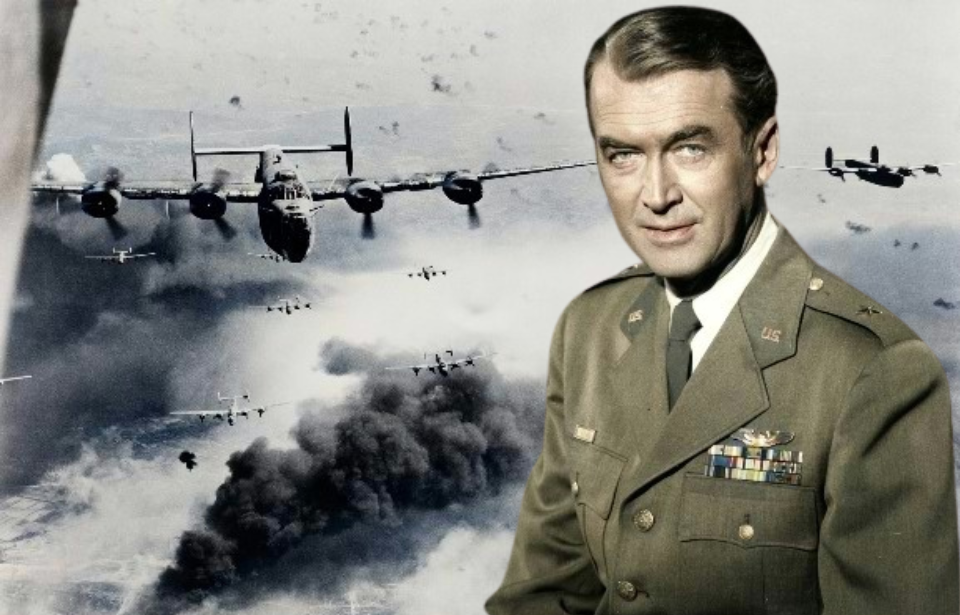
It is about a man who refused to stand on the sidelines…
All because of a number on a scale.